






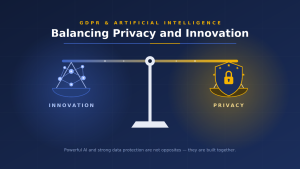
AI has progressed from being an emerging technology to a fundamental business skill. From financial services to healthcare, manufacturing to retail, and public sector organizations, AI is penetrating every sector to enhance customer experience, automate processes, optimize costs, and create new revenue streams.
But AI systems are data-driven and personal data is a growing component of that data.
For organisations dealing with European customers or based in Europe, this presents a serious problem for them: how can they innovate using AI without compromising privacy and regulatory standards?
The key is to develop AI systems that are not only powerful, but also transparent, secure, and accountable.
New industry studies underscore the importance of this balance. According to the IBM Cost of a Data Breach Report, organisations adopting AI technologies without corresponding investments in governance and security controls face increased risks associated with privacy, compliance, and data exposure.
In the absence of governance readiness, organisations are operating at higher risk of privacy and security issues as they embrace AI earlier than expected. Organisations that are moving into AI Governance before they are ready are being exposed to increasing privacy and security risks. In an era where AI is rapidly becoming a standard part of business operations, and European regulations are constantly evolving, companies that understand and adhere to this balance between innovation and trust will find themselves with a clear competitive edge.
Why GDPR Matters More Than Ever in the AI Era
The General Data Protection Regulation (GDPR) has been implemented to empower people with control over their personal data. While the regulation was written before the recent generative AI era and large language models, many of its principles are applicable to current AI systems.
AI models are often used to analyze:
* Customer profiles
* Employee records
* Behavioural analytics
* Biometric identifiers
* Location data
* Financial information
* Healthcare records
The problem is that AI systems can uncover new knowledge from this information that users might not know or be aware of.
GDPR requires organizations to answer critical questions:
- What is the purpose of this data?
- Does there exist a legal basis for processing?
- Is the data being used as intended?
- Are people able to comprehend the process of decision making that impacts their own lives?
- Does the user have the option to have his or her data deleted?
Questions surrounding these issues have become key components of today’s AI Governance Services and enterprise Responsible AI Consulting efforts.
The Biggest GDPR Challenges for AI Systems
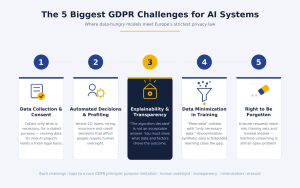
The top challenges of GDPR for AI systems are listed below.
-
Data Collection & Consent Management
One of the initial steps of an AI project is to assume:
*”More data creates better models.”*
GDPR brings a completely new concept of collecting what is necessary.
Organisations need to establish:
- What is personally required:
- The purpose for which it is being collected.
- The period that it will be kept.
- Who can access it
This is especially difficult in organizations that try to leverage their customer data for new AI projects.
For instance, if a retailer gathers purchase data for order fulfillment, they may be subject to a different set of restrictions if they want to use that data for recommendation engines and predictive purchasing models.
Good governance, compliance, and consent management are then crucial elements of modern AI deployments.
-
Automated Decision-Making and Profiling
GDPR provides the personal rights to not be subject only to automated decisions that may significantly affect them (Article 22).
Examples include:
- AI-powered loan approvals
- Insurance premium calculations
- Recruitment screening tools
- Employee performance assessments
- Fraud detection systems
- Credit scoring models
Organizations using these solutions need to make sure there is relevant human oversight.
The accountability of AI decisions will become one of the essential needs of Responsive AI Strategy initiatives as AI usage increases.
-
Explainability and Transparency
There are a lot of high-level AI systems that can be used as a black box.
An algorithm can be very accurate but give little insight into how the results were reached.
Unfortunately, “the algorithm decided” is not an acceptable explanation under GDPR.
Organizations increasingly need to explain:
- What information was utilized
- What methods were used to make decisions?
- Which factors affected the results
- Effects of decisions on people
Deep learning and generative AI systems face a greater challenge with this challenge.
Industry frameworks increasingly identify explainability as a fundamental requirement for trustworthy AI. Transparency and accountability are now becoming business expectations rather than purely regulatory obligations.
Hence the growing investments in AI Risk Assessment, explainability frameworks and governance tools in Europe.
-
Data Minimization in AI Training
Traditional machine learning approaches foster the accumulation of a lot of data. GDPR encourages the inverse rule, which is “data minimization”.
Organizations should only process information that is used for a particular purpose.
This presents some challenging questions:
- Can historical customer information be stored ad infinitum?
- Yes, but they typically should not be used for retraining.
- Is it appropriate for synthetic data to replace personal data?
With increasing recognition, the most prominent organizations are taking to privacy-enhancing technologies like:
- Data anonymization
- Pseudonymization
- Differential privacy
- Federated learning
This will facilitate innovation without exposing privacy in an unnecessary way.
These practices are integral parts of Privacy by Design Consulting strategies.
-
The Right to Be Forgotten
One of the greatest challenges of GDPR is what the provision of the “right to erasure” means in terms of AI.
If any person requests deletion of his/her information:
- Can the organisation exclude it from training data sets?
- Is there a way to take it out of the model?
- Is retraining required?
This challenge is becoming increasingly important for generative AI applications and enterprise copilots.
New ideas like machine unlearning might ultimately yield real-world solutions, but there are still several organizations that are still working on how to operate compliance processes.
AI Use Cases Creating New Privacy Risks
Some AI use cases are more privacy-sensitive than others. Some of these examples need further investigation, such as:
-
Facial Recognition Systems
Under GDPR, biometric data is highly sensitive personal data.
-
AI Recruitment Platforms
Algorithms for hiring can be designed to be biased and to discriminate.
-
Customer Profiling Engines
Recommendation systems often make profiles of users that they don’t necessarily know.
-
Healthcare AI Applications
Some of the most personal and sensitive data exists in healthcare systems.
-
Generative AI Assistants
Staff can inadvertently share sensitive data, such as business info or client details, when using public AI services.
New research from industry has revealed that the management of AI-related security incidents and data exposure risks is more challenging for organizations with weak governance controls. This is fueling a surge in investments in AI Security Services, cybersecurity services, and AI governance initiatives within enterprises.
Privacy by Design: Building Compliance into AI From Day One
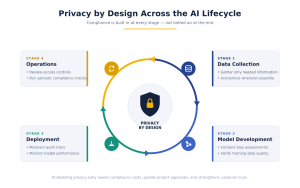
Privacy by design is one of the key principles of GDPR. Organizations should not only consider privacy as a compliance exercise at the end of development but also make privacy a part of the entire AI lifecycle.
-
During Data Collection
- Gather only needed information.
- Wherever possible, anonymize.
-
During Model Development
- Conduct bias assessments.
- Ensure the quality of the training data.
-
During Deployment
- Maintain audit trails.
- Monitor model performance on a continual basis.
-
During Operations
- Review access controls.
- Perform periodic compliance checks.
Compliance costs, project approvals, and customer trust are among the benefits of implementing privacy by design early on. This method is becoming more aligned with current compliance and risk management programs and enterprise AI governance framework development efforts.
The Rise of AI Governance and European Regulation
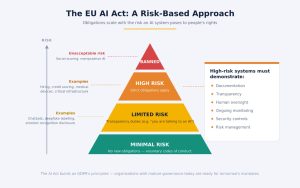
The European Union is complementing GDPR with a broader regulatory framework through the EU AI Act, introducing a risk-based approach to AI oversight. High-risk AI systems will require stronger documentation, transparency, human oversight, and ongoing monitoring requirements according to guidance published by the European Commission on the EU AI Act.
For high-risk systems, there will be more stringent requirements on:
- Documentation
- Transparency
- Human oversight
- Monitoring
- Security controls
- Risk management
These evolutions should be considered as opportunities for sustainable development, not obstacles to innovation.
Companies that develop a well-developed governance structure now will be well on their way to meeting future compliance mandates.
That is why there is an increasing demand for AI Governance Services, AI Compliance Assessments, and Responsible AI Consulting among the enterprises in Europe.
How Organizations Can Innovate Responsibly With AI
The most successful organizations are not deciding between innovation and privacy.
They’re working on building both.
Practical steps include:
- Set up enterprise AI governance frameworks.
- Establish inter-functional AI review boards.
- Carry out Data Protection Impact Assessments (DPIAs).
- Establish acceptable policies for the use of AI.
- Keep human control over risky decisions.
- Continually check models for bias and drift.
- Ensure AI efforts align with cybersecurity and compliance teams.
Compliance challenges are decreasing, and customer trust is improving among organizations that embed governance into development process cycles.
Key Takeaways
- Compliance with GDPR and innovation with AI can go hand in hand.
- Businesses are saying “explainability and transparency are requirements.
- Privacy should be built into the AI lifecycle.
- High-risk AI decisions still require human oversight.
- The EU AI Act will raise the bar for AI governance expectations.
- Well-developed governance structures increase trust and decrease risk.
- Responsible AI will be a differentiator.
Conclusion
AI is revolutionizing all industries, but innovation without trust is not sustainable. GDPR has set a global benchmark for privacy and accountability. The next generation of regulations for AI will be on top of these principles, not in lieu of them. Companies that view privacy as a strategic priority, instead of a regulatory requirement, will be more likely to innovate, scale, and build trust with customers.
The future is with intelligent, yet powerful, transparent, secure, and human-powered businesses.
How Sphinx Helps Organizations Build Responsible AI
At Sphinx, we enable enterprises to embrace AI with speed and confidence, while maintaining compliance, security, and trust.
Our expertise includes:
- AI Governance Services
- Responsible AI Consulting
- GDPR Compliance Services
- AI Risk Assessment
- Privacy by Design Consulting
- Cybersecurity Services
- AI Security Services
- Data Protection Services
- Compliance and Risk Management
- Enterprise AI Transformation
From organizations implementing generative AI, machine learning solutions, to intelligent automation platforms, Sphinx ensures that AI initiatives are secure, compliant, and future proof. But it’s not necessarily the fastest organization that will be the leader of the AI era, it will be the one that innovates responsibly.