




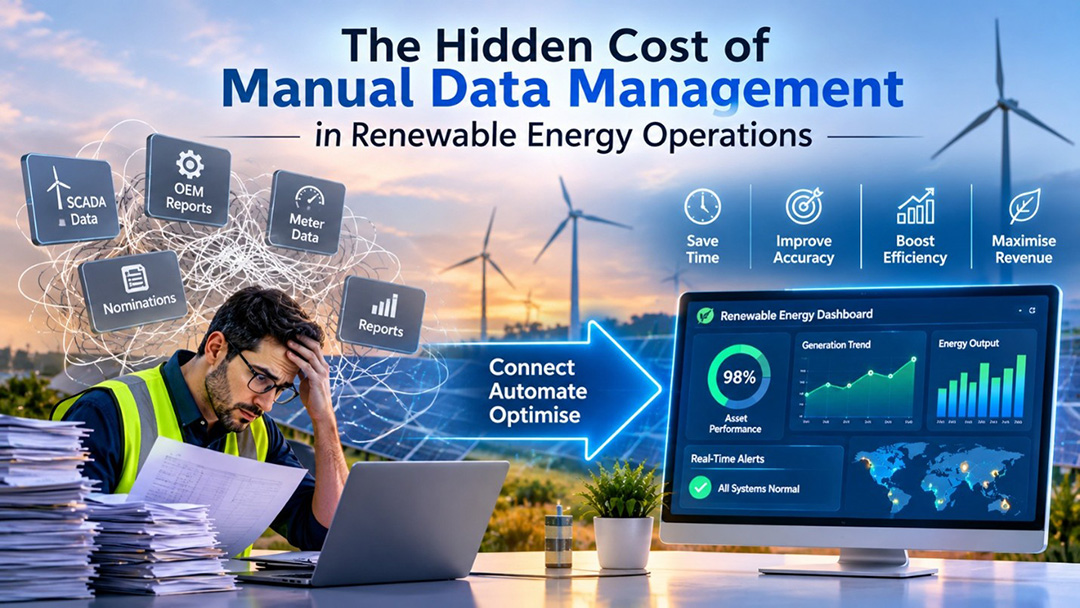

Renewable energy operations generate more data than ever. From wind turbines and solar inverters to SCADA platforms, OEM portals, smart meters, and weather monitoring systems, every asset contributes information that helps organizations monitor performance and manage daily operations.
Yet, despite this growing availability of data, many renewable energy companies still depend on manual processes to collect, organize, validate, and report operational information.
Teams spend hours downloading SCADA readings, retrieving OEM records, reconciling meter data, preparing generation nominations, and compiling reports using spreadsheets. These activities consume valuable working hours, increase the possibility of data errors, and delay decisions that depend on accurate information.
As renewable energy portfolios expand, these manual processes become increasingly difficult to manage.
The solution is not simply to collect more data. It is to connect existing systems, automate repetitive workflows, and make reliable information available when teams need it.
Through data engineering services, API integration, workflow automation, and centralized data platforms, renewable energy organizations can build more efficient data management environments.
Why Manual Data Management Is Holding Back Renewable Energy Operations
A typical renewable energy organization works with multiple technology platforms. SCADA systems monitor asset performance, OEM portals provide equipment information, meter systems record energy generation, and weather platforms supply environmental data. Trading, finance, and enterprise applications manage additional business information.
The challenge is that these platforms may operate independently, use different data formats, and follow different update schedules.
Consequently, employees often become responsible for moving information between systems.
For example, an operations analyst may need to download generation readings from SCADA, retrieve equipment availability records from an OEM portal, compare them with meter readings, and consolidate everything into a spreadsheet before preparing a daily report.
The same process may be repeated for nominations, availability declarations, financial reconciliations, and monthly reporting.
This creates a significant operational dependency on manual data handling. As the number of assets and reporting requirements increases, the workload grows alongside it.
Top Hidden Costs of Manual Data Management in Renewable Energy
- Repetitive Data Collection Reduces Operational Productivity
Collecting information from multiple systems is one of the most time-consuming activities for renewable energy operations teams.
Analysts frequently download SCADA readings, equipment performance records, meter data, and weather information separately. They then clean the files, standardize formats, check missing values, and transfer information into reporting templates.
Although these activities are necessary, performing them manually every day reduces the time available for operational analysis and performance improvement.
Technology solution: Automated Data Pipelines
Automated data pipelines can collect, transform, validate, and store information from connected sources at defined intervals.
Through data pipeline development, organizations can reduce repetitive data transfers and prepare structured datasets for operational applications, analytics, and reporting.
Sphinx Worldbiz offers data engineering services that help businesses build reliable data flows across different systems, supporting more consistent data collection and processing.
- Inconsistent Records Create Reconciliation Challenges
Different systems may report the same operational information using different formats, timestamps, measurement units, or asset identifiers.
For example, generation figures recorded by a meter system may not immediately match the corresponding SCADA records. Similarly, equipment availability information from an OEM portal may require additional checks before it can be included in a performance report.
Employees must investigate these differences, identify missing records, and correct inconsistencies before information can be used.
This makes reconciliation time-consuming and can affect the reliability of operational and financial reporting.
Technology solution: Data Validation and Centralized Data Platforms
Data validation rules can identify duplicate entries, missing values, inconsistent formats, and unexpected readings during data processing.
A centralized data platform can bring information from multiple sources into a structured environment, supported by standardized data definitions and appropriate quality checks.
Sphinx can help organizations develop data integration workflows and structured data environments that improve consistency and make information more useful for reporting and analytics.
- Manual Nominations and Reporting Increase the Risk of Errors
Renewable energy operations involve recurring activities such as generation nominations, availability declarations, market submissions, and operational reporting.
These processes often operate under strict timelines and rely on information collected from multiple systems.
When employees manually transfer figures between spreadsheets, emails, and business applications, the possibility of incorrect entries, missing information, and delayed submissions increases.
The problem becomes more challenging when several departments need to review and approve the same information.
Technology solution: Workflow Automation and API Integration
Workflow automation can streamline repetitive activities through defined business rules, validation steps, notifications, and approval processes.
For example, an automated workflow can retrieve relevant operational data, validate mandatory fields, flag exceptions, and route information to the responsible employee for review.
With API integration, compatible applications can exchange information through defined interfaces instead of depending entirely on manual transfers.
Sphinx’s custom software development and system integration capabilities can help renewable energy organizations connect applications and automate suitable operational workflows.
- Delayed Reports Limit Operational Visibility
Management teams need timely information about generation performance, asset availability, equipment issues, and operational costs.
However, when reports depend on manual data collection and reconciliation, the information may already be outdated by the time it reaches decision-makers.
Operations, finance, and management teams may also work with different spreadsheets or reporting versions, making it difficult to establish a consistent view of portfolio performance.
Technology solution: Centralized Dashboards and Data Analytics
Centralized dashboards can present information from connected data sources in an accessible format.
Depending on business requirements and available data, renewable energy dashboards can display:
- Actual versus expected generation.
- Asset availability and equipment performance.
- Missing or delayed operational data.
- Operational alerts and unresolved exceptions.
- Reporting and reconciliation status.
- Operating costs and asset-level performance indicators.
Through data analytics and custom dashboard development, Sphinx can help organizations make operational and financial information easier to access, monitor, and interpret.
- Growing Data Volumes Make Manual Processes Difficult to Scale
A renewable energy company managing a limited number of assets may initially handle data collection and reporting through spreadsheets.
However, as the business adds more wind farms, solar installations, battery storage systems, and operational applications, the volume and complexity of information increase.
Hiring additional employees to manage repetitive data processes may increase operating costs without addressing the underlying integration problem.
As technology environments expand, organizations also need to consider infrastructure capacity, data accessibility, system reliability, and security.
Technology solution: Cloud-Based Data Management
Suitable cloud platforms can support scalable data storage, processing, integration, and analytics.
A well-designed cloud environment can also help organizations modernize existing applications and support more connected reporting and operational workflows.
Sphinx provides cloud services across AWS, Microsoft Azure, and Google Cloud, supporting cloud modernization, application integration, and scalable infrastructure based on business and technical requirements.
For renewable energy companies, combining cloud platforms with data engineering and automation can provide a stronger foundation for managing growing operational data volumes.
How Sphinx Worldbiz Helps Streamline Renewable Energy Data Management
Addressing manual data management requires a connected technology environment where operational information can move reliably between systems, business applications, and reporting platforms.
Sphinx Worldbiz brings together capabilities in data engineering, software development, system integration, cloud, and cybersecurity to support renewable energy technology initiatives.
- Connect SCADA, OEM, Meter, and Enterprise Systems
Sphinx can help integrate relevant operational and enterprise applications through suitable APIs, interfaces, and data pipelines.
The objective is to reduce isolated data collection and improve information exchange without requiring organizations to replace every existing platform.
- Develop Automated Data Pipelines
Through data engineering services, Sphinx can help build pipelines that collect, transform, validate, and organize information from different sources.
These pipelines can support scheduled data ingestion, data quality checks, exception identification, and preparation of datasets for reporting and analytical applications.
- Establish Centralized and Trusted Data Environments
Sphinx can support the development of centralized data environments that bring together information from multiple applications.
Standardized data structures, validation rules, and appropriate data governance practices can help teams work with more consistent information across operational and business functions.
- Automate Repetitive Operational Workflows
Using custom software development, application integration, and workflow automation, Sphinx can help streamline activities such as reporting, data reconciliation, operational alerts, and approval routing.
This allows employees to spend less time on repetitive administrative work and more time on analysis and exception management.
- Build Operational and Financial Dashboards
Sphinx can develop tailored dashboards that present relevant information from connected data sources.
Depending on the available data and business requirements, these dashboards can support asset performance monitoring, generation reporting, operational analysis, and financial visibility.
- Support Secure and Scalable Data Operations
Connected systems require appropriate security, access management, and infrastructure planning.
Sphinx’s cybersecurity services and cloud services can support security-conscious application development, infrastructure modernization, and connected digital environments, with controls aligned to the organization’s technical and operational requirements.
A Practical Roadmap to Automate Renewable Energy Data Management
Organizations do not necessarily need to replace their existing technology landscape to improve data management. A phased approach can help address the most time-consuming processes first.
Step 1: Assess Existing Data Sources
Identify the systems used for SCADA, OEM information, meter readings, weather data, trading, finance, and reporting. Understand how information moves between them and where manual intervention is required.
Step 2: Identify Processes That Need Automation
Prioritise repetitive activities such as daily data collection, nomination preparation, reconciliation, and monthly reporting. Evaluate the time spent, frequency of errors, and operational impact.
Step 3: Define the Integration Architecture
Determine suitable APIs, data pipelines, storage environments, validation rules, and access controls. The design should account for existing applications, data ownership, security, and operational requirements.
Step 4: Implement and Validate Automated Workflows
Introduce selected integrations and automated processes. Test data accuracy, completeness, processing schedules, exception handling, and system reliability before expanding the implementation.
Step 5: Monitor Performance and Improve Continuously
Use dashboards and monitoring processes to track data quality, failed connections, workflow exceptions, and reporting performance. Refine the solution as operational requirements and data volumes evolve.
What Should Renewable Energy Companies Measure After Automation?
Technology investments should be evaluated through operational improvements rather than simply the number of systems or dashboards implemented.
Renewable energy organizations can monitor the following indicators:
| Business area | Performance indicator |
| Team productivity | Analyst hours spent on manual data collection |
| Data quality | Missing, duplicate, or inconsistent records |
| Reporting efficiency | Time required to complete monthly reports |
| Workflow performance | Time taken to prepare and validate nominations |
| Integration reliability | Failed data transfers and unresolved pipeline errors |
| Operational visibility | Time taken to identify and investigate data exceptions |
Tracking these indicators before and after implementation helps organizations assess whether automation is reducing manual effort, improving data reliability, and supporting faster reporting.
Conclusion: Build a More Connected Approach to Renewable Energy Data Management
Renewable energy companies already generate the operational information needed to monitor assets, manage workflows, and prepare business reports. The challenge is making that information accessible, consistent, and useful without depending on repeated manual intervention.
Disconnected systems, spreadsheet-based processes, and inconsistent records can consume employee time and delay important decisions.
By combining API integration, automated data pipelines, data validation, centralized data platforms, workflow automation, and operational dashboards, organizations can create a more connected approach to data management.
Sphinx Worldbiz supports these initiatives through data engineering services, custom software development, system integration, cloud services, cybersecurity services, and digital transformation services.
For renewable energy leaders, the opportunity is not simply to automate data collection. It is to give teams more time to analyze performance, improve operations, and make decisions using reliable information.
Looking to reduce manual data management across your renewable energy operations? Connect with Sphinx Worldbiz to explore data integration and automation solutions aligned with your existing technology environment.
Frequently Asked Questions
-
Why is data management important in renewable energy operations?
Renewable energy companies depend on information from SCADA platforms, OEM systems, smart meters, weather services, and business applications. Effective data management helps teams maintain consistent records, monitor asset performance, prepare reports, and support operational decisions.
-
How can automation reduce manual work in renewable energy companies?
Automation can streamline data collection, validation, reconciliation, reporting, notifications, and approval workflows. It reduces repetitive tasks and helps employees focus on analysis and exception management.
-
What is the role of API integration in renewable energy data management?
API integration enables compatible applications to exchange information through defined interfaces. It can connect operational systems, enterprise applications, and reporting platforms, reducing the need for repeated manual data transfers.
-
How can a centralised data platform help renewable energy companies?
A centralised data platform can bring information from multiple sources into a structured environment. With appropriate data governance and validation, it can support consistent reporting, analytics, and operational visibility.
-
Can cloud services support renewable energy data management?
Yes. Suitable cloud environments can support data storage, processing, analytics, and application integration. The right approach depends on data sensitivity, system architecture, connectivity, security, and operational requirements.
-
How can Sphinx Worldbiz support renewable energy data management?
Sphinx Worldbiz offers capabilities across data engineering and analytics, API integration, custom software development, system integration, cloud modernization, cybersecurity, and digital transformation. These capabilities can support connected data environments, automated workflows, centralized reporting, and operational dashboards.