



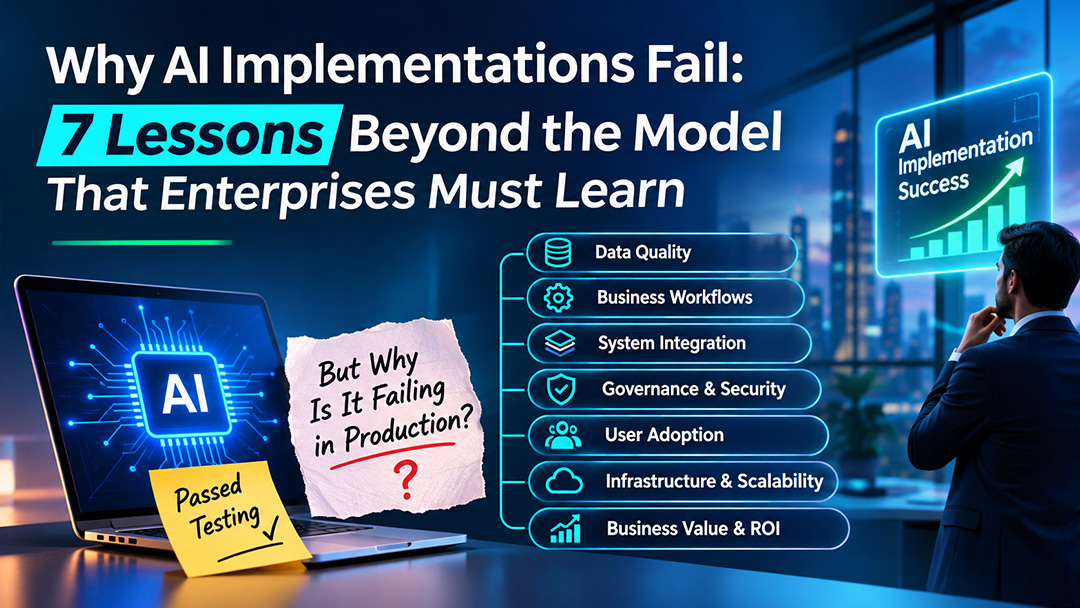

An AI model can perform exceptionally well in testing and still fail to deliver business value in production. The difference often lies in everything surrounding the model: data quality, system integration, infrastructure, workflows, governance, and user adoption.
Enterprise AI adoption is accelerating, but implementing AI successfully involves much more than selecting an algorithm or training a model. Organizations may invest in advanced machine learning, generative AI, and intelligent automation, yet struggle to translate these technologies into measurable business outcomes.
Proof of concept may demonstrate impressive accuracy. A chatbot may generate relevant responses. An AI agent may complete a task in a controlled environment. However, the real challenges emerge when these solutions work with enterprise data, interact with existing applications, handle exceptions, and support everyday business operations.
That is why AI implementation challenges rarely stop at model performance.
Successful AI adoption requires a connected approach that considers technology, people, processes, and business objectives from the beginning. Here are seven important lessons enterprises should understand before scaling their AI initiatives.
Lessons for Enterprises for Seamless AI Adoption
- Poor Data Quality Can Undermine Even the Most Advanced AI Model
AI models depend on the quality, relevance, and consistency of the information used to train, evaluate, and operate them.
Many enterprises maintain data across ERP platforms, CRM systems, databases, spreadsheets, cloud applications and legacy environments. These sources may contain duplicate records, inconsistent formats, missing information, or outdated entries.
When such data enters an AI pipeline without proper validation, the resulting output may be unreliable.
For example, an enterprise deploying an AI-powered customer service assistant may expect it to retrieve accurate information about orders, payments, and service requests. However, if customer records are inconsistent across systems, the assistant may provide incomplete or conflicting responses.
What enterprises should do:
- Assess data availability, quality, and relevance before model development.
- Establish data validation and standardization processes.
- Build reliable data pipelines across relevant enterprise systems.
- Define ownership and accountability for critical datasets.
- Monitor data quality continuously after deployment.
Treat a strong data foundation as an essential part of AI Development services, not a separate activity that begins after model selection.
- AI Solutions Must Fit Existing Business Workflows
An AI application may function perfectly as a standalone tool but still fail to create value if employees must leave their existing workflows to use it.
Consider an organization that deploys an AI-powered document processing solution. The application can extract information from invoices, but employees still need to manually transfer the extracted data into the ERP system and verify every transaction separately.
Technology works, but the overall process remains inefficient.
This happens when AI is implemented as an isolated capability rather than integrated into the business process it is expected to improve.
What enterprises should do:
- Identify the business workflow before selecting the AI solution.
- Map where AI can reduce manual effort or improve decision-making.
- Connect AI applications with relevant enterprise platforms.
- Automate suitable downstream actions.
- Define human approval and exception-handling processes.
This is where Digital transformation services become relevant. AI implementation should be part of a broader effort to improve how business processes operate, not simply another technology layer added to the existing environment.
- System Integration Is Often More Complex Than Model Development
Enterprise AI rarely operates independently. It needs to communicate with existing applications, access relevant information, and return outputs to the systems where employees make decisions.
This creates integration challenges involving APIs, databases, authentication, application compatibility, and data exchange.
For instance, an AI-powered sales forecasting application may need information from CRM, ERP, inventory and market intelligence platforms. If these systems do not exchange information reliably, the forecasting solution may operate on incomplete or outdated inputs.
The complexity increases when organizations use legacy applications, multiple cloud environments, or third-party platforms.
What enterprises should do:
- Assess the existing application and infrastructure landscape.
- Define integration requirements before development begins.
- Use suitable APIs, middleware and data pipelines.
- Establish secure access to enterprise systems.
- Test integration performance, reliability and exception handling.
A well-planned integration architecture helps ensure that AI Development services deliver capabilities that work within the enterprise environment instead of creating another disconnected application.
- Proof of Concept Is Not the Same as a Production-Ready Solution
Proofs of concept are useful for validating technical feasibility and demonstrating potential business value. However, a successful demonstration does not automatically mean a solution is ready for enterprise-wide deployment.
Production environments introduce requirements that may not be fully addressed during initial experimentation.
These include:
- Handling large volumes of concurrent requests.
- Maintaining consistent performance.
- Managing model updates and version control.
- Monitoring accuracy and response quality.
- Protecting sensitive information.
- Handling failures and unexpected inputs.
- Maintaining service availability.
For generative AI applications, additional considerations include hallucinations, prompt injections, context limitations, and the reliability of retrieved information.
What enterprises should do:
Adopt a structured development and deployment lifecycle that includes testing, validation, monitoring, security reviews, and ongoing optimization.
Organizations should also establish clear production-readiness criteria before expanding to a successful pilot.
Working with an experienced Hire AI developer strategy can help businesses access the engineering expertise required to move beyond experimentation and develop scalable, maintainable AI applications.
- AI Adoption Requires Governance, Security and Human Oversight
AI systems can influence customer interactions, financial decisions, employee workflows and other business-critical activities. Their implementation therefore requires clear governance and accountability.
Without appropriate controls, organizations may face data exposure, unauthorized access, inconsistent outputs and compliance risks.
This becomes particularly important when AI applications process personal information, confidential business records or regulated data.
Human oversight is equally important. Not every decision should be fully automated, especially when an AI output has significant financial, operational or regulatory implications.
What enterprises should do:
- Establish policies for responsible AI usage.
- Define access controls and data protection requirements.
- Evaluate model outputs for accuracy, bias, and reliability.
- Maintain audit trails for important AI-driven actions.
- Introduce human review for high-impact decisions.
- Monitor changes in regulatory and compliance requirements.
Governance should be considered throughout the AI lifecycle, from data preparation and model development to deployment and ongoing monitoring.
An experienced Hire AI developer approach should therefore consider security, explainability, testing, and maintainability alongside technical development skills.
- Employees Must Trust and Understand AI-Driven Processes
Technology adoption does not happen automatically after deployment.
Employees may hesitate to use AI applications if they do not understand how technology works, question the accuracy of its output, or fear that automated processes will make their existing roles more difficult.
In some cases, employees continue using spreadsheets and manual processes even after an organization introduces AI-powered tools.
This reduces adoption and limits the business value of the investment.
What enterprises should do:
- Involve end users during solution planning and testing.
- Explain what the AI system can and cannot do.
- Provide training based on real business workflows.
- Make AI outputs understandable and accessible.
- Collect employee feedback after deployment.
- Establish clear escalation paths when AI produces uncertain results.
AI should support employees by reducing repetitive work and improving access to information. Successful implementation depends on making technology useful within the context of their daily responsibilities.
This is another reason Digital transformation services should address organizational changes and process redesign alongside technology implementation.
- AI Needs Continuous Monitoring and Improvement After Deployment
AI implementation is not a one-time development activity.
Business requirements are changing. Data patterns evolve. New applications are introduced. User expectations increase. Models that perform well during initial deployment may gradually become less effective as operating conditions change.
For example, an AI-powered demand forecasting model trained on historical purchasing behavior may become less accurate when market conditions or customer preferences shift.
Similarly, a generative AI assistant may need updated knowledge sources such as business policies, product information and internal documentation change.
What enterprises should do:
- Monitor model performance and output quality.
- Track data drift and changes in input patterns.
- Establish model evaluation and retraining processes.
- Maintain version control and deployment records.
- Collect user feedback and investigate recurring issues.
- Define ownership for ongoing maintenance and optimization.
Organizations should plan for continuous monitoring and improvement before production deployment, rather than treating them as future enhancements.
A structured AI Agent development services approach, for example, should account for agent performance, tool usage, reliability, exception handling, and human intervention throughout the solution lifecycle.
From AI Experimentation to Enterprise-Ready Implementation
The lessons above point to a broader conclusion: successful AI implementation depends on the engineering and operational environment surrounding the model.
Enterprises need to consider data, infrastructure, integrations, governance, security, and user adoption as connected parts of the same initiative.
This requires a structured approach that connects business objectives with technical execution.
A practical enterprise AI implementation roadmap can include the following stages:
| Implementation stage | Key activities | Intended outcome |
| Business assessment | Identify business problems, workflows and expected outcomes | Clear implementation objectives |
| Data readiness | Evaluate data sources, quality, accessibility, and governance | Reliable data foundation |
| Solution architecture | Define models, applications, integrations and infrastructure | Scalable technical design |
| Development and validation | Build, test and evaluate AI capabilities | Functionally validated solution |
| Integration and deployment | Connect enterprise systems and introduce production controls | Operational AI application |
| Monitoring and optimization | Track performance, usage, security and feedback | Continuous improvement |
This approach helps enterprises avoid treating AI as an isolated technical experiment and instead build solutions around practical business requirements.
How Sphinx Worldbiz Can Help Enterprises Address AI Implementation Challenges
For organizations moving from AI experimentation to enterprise adoption, the challenge is often finding the right combination of engineering capabilities, integration expertise and implementation discipline.
Sphinx Worldbiz brings together AI, data, software engineering and cloud capabilities to help businesses develop and integrate technology solutions aligned with their operational requirements.
Its AI Development services can support the development of machine learning applications, generative AI solutions and intelligent automation capabilities.
Depending on the project scope, the engagement can involve:
AI and machine learning engineering: Developing and integrating AI models for business-specific applications, predictive analytics and intelligent decision support.
Enterprise data engineering: Building data pipelines, connecting information sources and preparing enterprise data for AI applications.
AI application integration: Connecting AI capabilities with existing business applications through APIs and suitable integration architectures.
Cloud and infrastructure engineering: Supporting deployment environments, scalability and the infrastructure requirements of enterprise AI workloads.
AI agent development: Designing intelligent agents that interact with enterprise tools, access relevant information and support defined workflows with appropriate controls.
Through its AI Agent development services, Sphinx can help organizations explore agent-based applications that go beyond conversational interfaces to support task execution, information retrieval, and workflow orchestration.
For businesses that need additional technical expertise, the option to hire an AI engineer can support specific development requirements, integration projects, or ongoing AI engineering initiatives.
Sphinx’s wider Digital transformation services can also help organizations connect AI adoption with application modernization, process improvement, cloud technologies and enterprise technology strategy.
The objective is not simply to deploy another AI tool. It is to build technology capabilities that can operate reliably within existing business environments and support measurable organizational goals.
Conclusion: The AI Model Is Only One Part of the Implementation
A strong AI model can demonstrate what is technically possible, but enterprise success depends on how effectively that model works with business data, applications, people and processes.
Poor data quality, disconnected systems, limited production readiness, inadequate governance and low employee adoption can all prevent an AI initiative from delivering its intended value.
Organizations that address these challenges early are better positioned to move from isolated pilots to scalable AI applications.
The next phase of enterprise AI will not be defined only by more powerful models. It will be shaped by the quality of the engineering, integration and operational decisions that make those models useful.
At Sphinx Worldbiz, we help businesses move beyond AI experimentation by bringing together AI engineering, data, integration and digital transformation capabilities.
The question is no longer just which AI model to implement. It is whether the organization is ready to make that model work in the real world.
Frequently Asked Questions
- Why do enterprise AI projects fail?
Enterprise AI projects can struggle because of poor data quality, disconnected systems, unclear business objectives, inadequate infrastructure, governance gaps and limited user adoption. Model performance is only one factor in successful implementation.
- What is the biggest challenge in AI implementation?
There is no single challenge across all projects. However, data readiness and integration with existing enterprise systems are common implementation concerns because AI applications depend on reliable information and access to relevant business workflows.
- How can businesses move AI projects from proof of concept to production?
Businesses should establish production requirements early, validate data quality, design scalable architecture, integrate existing systems, conduct security and performance testing, and introduce ongoing monitoring before expanding AI solutions.
- Why is system integration important for enterprise AI?
System integration allows AI applications to access relevant business information and deliver outputs within existing enterprise workflows. Without integration, AI tools may operate in isolation and require additional manual effort.
- What skills should enterprises look for when hiring AI developers?
Enterprises should evaluate skills in machine learning, data engineering, software development, APIs, cloud infrastructure, model evaluation, security and deployment. The required expertise will depend on the application and implementation environment.
- What are AI agents, and how are they different from traditional AI applications?
Traditional AI applications often perform defined prediction, classification, or generation tasks. AI agents can combine reasoning, tool usage and workflow execution to complete multi-step tasks within defined permissions and controls.
- How can Sphinx Worldbiz support enterprise AI implementation?
Sphinx Worldbiz brings together AI/ML engineering, data engineering, custom software development, system integration and cloud capabilities. These capabilities support the development, integration, and deployment of enterprise AI applications based on project requirements.