




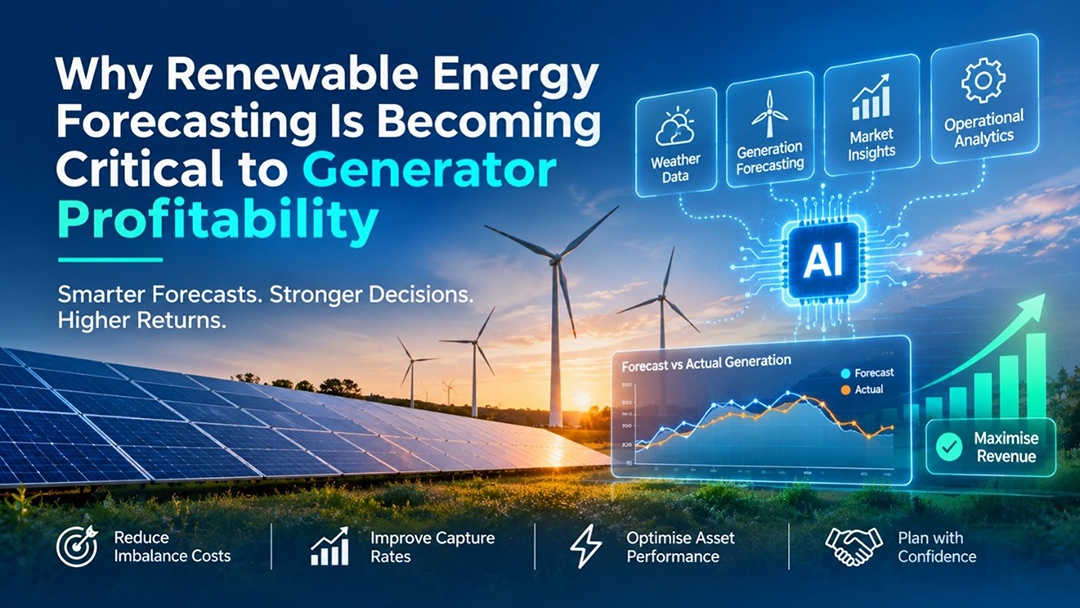

Accurate forecasting is no longer just an operational requirement for renewable energy generators. It is becoming a key factor in revenue protection, market participation, and long-term asset profitability.
Wind and solar power have transformed the energy landscape, but generating electricity is only one part of running a profitable renewable energy business. Generators must also predict how much electricity their assets will produce, understand when market prices are likely to change, manage grid constraints, and make timely decisions about energy sales.
These responsibilities are becoming more important as renewable energy businesses operate with greater exposure to merchant markets and hybrid revenue arrangements. When actual generation differs from the volume committed to the market, generators can face imbalance charges. When production coincides with periods of lower electricity prices, the revenue earned per megawatt-hour can also decline.
The challenge is that many renewable energy operators still depend on generic forecasts, disconnected data sources, and manual processes. Weather information, SCADA systems, asset availability records, and market prices may sit across different platforms, making it difficult to develop a timely and reliable view of expected generation.
This is where AI-powered forecasting, machine learning, and integrated data platforms can make a difference. By combining weather, operational, and market information, renewable energy companies can improve generation predictions, respond to changing conditions, and make better-informed commercial decisions.
Why Is Forecasting Becoming So Important for Renewable Energy Generators?
Renewable energy generation depends on environmental conditions that can change throughout the day. Solar output is affected by cloud cover, irradiance, and temperature, while wind generation depends on wind speed, direction, and turbine operating conditions.
Unlike conventional power plants that can often schedule generation within defined operating limits, renewable energy generators manage a greater degree of production variability.
At the same time, the commercial environment is changing. As generators take on more merchant exposure or participate in hybrid arrangements involving corporate power purchase agreements (PPAs) and other market mechanisms, differences between expected and actual generation can have a direct financial impact.
Several factors make forecasting particularly important:
- Variable generation: Weather conditions can change expected output, creating differences between forecast and actual electricity generation.
- Imbalance exposure: Deviations between nominated and delivered electricity can result in imbalance settlement costs.
- Price cannibalization: When many renewable assets generate electricity simultaneously, increased supply can coincide with lower wholesale prices.
- Grid constraints: Congestion and network limitations can restrict how much electricity generators can export.
- Storage and flexibility decisions: Battery charging, discharging, and energy sales depend on expected generation and market conditions.
Forecasting helps connect these operational variables with commercial decisions. Instead of simply estimating how much electricity an asset will generate, businesses can use forecasts to understand when that electricity will be available, what market conditions may look like, and how they should respond.
Five Ways Inaccurate Forecasting Affects Renewable Energy Profitability
Forecasting errors do not affect only one part of renewable energy operations. They can influence trading, financial planning, asset management, and grid coordination.
- Higher Imbalance Charges from Generation Forecast Errors
Renewable energy generators typically need to communicate their expected generation or submit market positions within defined timelines. If actual output differs from the expected volume, the difference may need to be settled through the applicable balancing or imbalance mechanism.
For example, a solar farm may forecast a certain generation volume for the afternoon. Unexpected cloud cover reduces actual production, leaving the generator unable to deliver the volume it had anticipated. Alternatively, stronger-than-expected wind conditions may result in more generation than initially forecast.
When forecast updates are slow or inaccurate, energy traders have less time to adjust their positions before market deadlines.
Across a portfolio, even relatively small forecast deviations can become commercially significant, depending on the applicable market rules and imbalance prices.
How better forecasting helps
AI/ML-based generation forecasting can combine historical production, weather information, asset availability and other relevant variables to estimate expected output more accurately.
Automated intraday re-forecasting can also update predictions as new weather and operational data becomes available. This allows trading teams to review their positions and respond before relevant market deadlines.
The business objective is to reduce avoidable forecast deviations and improve the management of imbalance exposure.
- Lower Revenue When Generation Coincides with Unfavorable Market Prices
Generating more electricity does not always translate into higher revenue.
In markets with substantial renewable generation, solar and wind output can become concentrated in periods when many other assets are also producing electricity. This can increase supply and put downward pressure on wholesale prices during those hours.
As a result, a renewable energy generator may sell a large proportion of its output when market prices are relatively low.
This creates a gap between the revenue an asset can earn under average market conditions and the actual price it receives for its generation. This is commonly discussed through the concept of capture price.
For finance and trading teams, understanding this relationship is important when evaluating asset profitability, market exposure, and commercial strategies.
How price and generation forecasting helps
Generation forecasts become more valuable when evaluated alongside electricity price forecasts.
By analyzing expected production and market conditions together, renewable energy businesses can identify periods when:
- Generation is expected to coincide with lower market prices.
- Electricity prices may create more favorable selling opportunities.
- Battery storage could help shift energy sales to another period.
- Hedging or contractual arrangements may need closer evaluation.
These insights can support more informed trading, storage, and commercial planning decisions.
- Delayed Grid Decisions and Unexpected Curtailment
Grid congestion and network constraints can prevent renewable energy generators from exporting their fully available production.
When a grid cannot accommodate the electricity being generated in a particular location, operators may need to reduce output through curtailment or other network-management arrangements. Generators with flexible or non-firm connections may also need to account for changing export limitations.
Without timely information about expected generation and grid conditions, asset teams can find it difficult to plan around these restrictions.
The problem becomes more complex for hybrid renewable energy sites that combine solar or wind generation with battery storage. Teams need to coordinate expected output, export limits, storage availability, and operational requirements.
How forecasting helps
Short-term generation forecasting, demand forecasting, and grid constraint analysis can provide better visibility into potential supply and network conditions.
More advanced forecasting approaches can also provide probabilistic predictions rather than a single expected generation figure. This helps operators understand the range of possible outcomes and assess uncertainty when planning reserves, market positions or asset operations.
When combined with storage and operational data, these insights can support decisions about charging schedules, maintenance windows and participation in flexibility or balancing markets, subject to the relevant market and grid requirements.
- Slow Commercial and Investment Decisions
Forecasting also influences decisions made well beyond daily generation and trading operations.
Renewable energy companies regularly evaluate investments in new sites, repowering, battery storage, portfolio expansion and PPA arrangements. Each decision requires an understanding of expected generation, electricity prices, operating costs and potential risks.
However, if finance, trading and operations teams rely on different datasets, preparing a consistent investment analysis can take considerable time.
For example, a CFO may want to understand how a potential change in electricity prices could affect expected revenue. An investment team may need to compare the economics of adding battery storage to an existing solar site. A trading team may need generation-volume projections to support PPA negotiations.
When these answers require manual data collection and spreadsheet-based scenario modelling, decisions can be delayed.
How predictive analytics helps
A centralized forecasting and analytics environment can combine generation, price, and operational information to support scenario analysis.
Teams can use these capabilities to evaluate questions such as:
- How could lower wholesale prices affect expected portfolio revenue?
- What additional value could battery storage provide at a particular site?
- How might changing generation assumptions affect a PPA?
- Which assets are performing below their expected generation levels?
- How could different market conditions affect expansion plans?
With consistent data and reusable analytical models, management teams can spend less time reconciling numbers and more time evaluating business decisions.
- Inefficient Storage Dispatch and Asset Management
Renewable energy generators can lose value when surplus electricity is curtailed, sold during low-price periods, or not stored when storage capacity is available.
Battery systems can provide flexibility, but their commercial value depends on how effectively they are scheduled. Charging and discharging decisions need to consider expected generation, electricity prices, battery availability, export constraints, and operating limits.
Similarly, maintenance decisions can affect generation availability. If equipment faults or performance degradation are identified late, assets may remain below expected output for longer than necessary.
How AI-powered optimization helps
Combining generation forecasts with price predictions and asset-condition information can support better operational planning.
For storage, analytics can help identify suitable charging and discharging windows while accounting for battery constraints and applicable operating requirements.
For asset management, performance monitoring and predictive analytics can help identify unusual equipment behavior and prioritize maintenance investigations.
The result is a more coordinated approach to energy generation, storage and maintenance planning.
How AI and Machine Learning Are Improving Renewable Energy Forecasting
Traditional forecasting methods often rely on historical production patterns, weather forecasts and predefined assumptions. These methods can provide a useful baseline, but they may not capture every change in local weather, asset condition, or operating environment.
AI and machine learning can extend forecasting capabilities by identifying relationships across larger datasets and updating predictions as new information becomes available.
The following technologies can work together to support more responsive renewable energy forecasting.
- AI/ML-Based Generation Forecasting
Machine learning models can analyze historical generation data alongside weather conditions, asset characteristics and operational information to estimate expected electricity output.
For solar installations, relevant inputs may include:
- Solar irradiance and cloud-cover information.
- Temperature and other weather conditions.
- Historical generation patterns.
- Inverter performance and asset availability.
- Seasonal and site-specific production behavior.
For wind installations, forecasting inputs may include:
- Wind speed and direction.
- Historical turbine generation.
- Turbine operating conditions.
- Weather forecasts and atmospheric information.
- Asset availability and performance records.
The appropriate model depends on the generation technology, available data, forecast horizon, and accuracy requirements.
With ongoing evaluation and monitoring, machine learning models can be refined as new operational data becomes available.
- Weather Data Integration for More Contextual Predictions
Weather conditions are among the most important variables influencing renewable energy generation.
However, relying on a single weather source or generic forecast may not always provide sufficient detail for individual sites. Local weather conditions can differ across locations, while the same weather event may affect different assets in different ways.
Integrating weather information with historical generation and operational data helps create a more complete forecasting environment.
A suitable solution can bring together:
- Weather forecast feeds.
- Historical meteorological information.
- Site-level generation records.
- Asset performance data.
- Relevant operational and availability information.
Through data engineering and analytics, these datasets can be collected, validated and prepared for forecasting models.
This helps establish a consistent information foundation for site-specific predictions and portfolio-level analysis.
- SCADA Analytics for Asset-Level Forecasting
Supervisory Control and Data Acquisition (SCADA) systems provide operational information from renewable energy assets and equipment.
For forecasting, SCADA data can help teams understand how an asset is actually performing compared with its expected output.
Relevant information may include generation readings, equipment status, inverter or turbine performance, operating conditions, and fault indicators, depending on the system and available interfaces.
Combining SCADA information with weather data can help distinguish between generation changes caused by environmental conditions and those associated with equipment availability or performance.
For example, if a wind turbine generates less electricity than expected despite favourable wind conditions, operational data may help identify a possible performance issue.
Through Big Data and Data Science Services, organizations can build analytical systems that process operational datasets, identify patterns and support more informed asset-performance assessments.
- Electricity Price Forecasting Alongside Generation Forecasting
Knowing how much electricity an asset is expected to generate is only part of the commercial picture. Generators also need to understand the market conditions under which that electricity may be sold.
Electricity price forecasting can analyse historical market prices, demand patterns, expected renewable generation, and other relevant market variables.
When price and generation forecasts are evaluated together, renewable energy businesses can gain insights into:
- Expected revenue across different generation periods.
- Potential exposure to low or negative-price hours.
- Opportunities to evaluate storage dispatch.
- Market risks are associated with changing generation patterns.
- Commercial assumptions used in PPA and investment analysis.
These forecasts are decision-support tools, not guarantees of future prices or revenue. Their value depends on model quality, market conditions, and the way teams use the insights.
- Automated Intraday Re-Forecasting
Day-ahead forecasts provide an initial view of expected generation, but actual operating conditions can change as delivery approaches.
A cloud-based forecasting environment can support automated updates when new weather information, SCADA readings, or asset availability data becomes available.
Instead of waiting for a team member to download information and manually update a spreadsheet, automated data pipelines can refresh the relevant datasets and trigger forecasting workflows.
Intraday re-forecasting can help teams:
- Identify differences between expected and actual generation.
- Review updated generation positions.
- Highlight changes that may require trading attention.
- Flag unusual asset performance.
- Share revised forecasts with relevant operational and commercial teams.
The timing of these updates should be aligned with market deadlines, system capabilities and the organization’s operational processes.
Building a Connected Renewable Energy Forecasting Architecture
AI forecasting models are only as useful as the data and systems supporting them. If weather feeds, SCADA platforms, asset management tools and market information remain disconnected, teams may still struggle to produce consistent and timely forecasts.
Connected architecture brings these sources together and makes the resulting information available to forecasting applications, dashboards and decision-support workflows.
A typical implementation can include the following components:
| Component | Role in the forecasting environment |
| Weather data sources | Supply forecast and historical weather information |
| SCADA and asset systems | Provide generation, equipment and availability data |
| Market data platforms | Supply relevant electricity price and market information |
| Data integration layer | Connects sources through suitable APIs, interfaces or data pipelines |
| Cloud data platform | Stores and processes information for analytical use |
| AI/ML forecasting models | Estimate generation and support predictive analysis |
| Operational dashboards | Present forecasts, actual output, exceptions and performance trends |
| Workflow automation | Routes alerts, updates and reporting tasks to relevant teams |
This architecture can be developed around an organization’s existing systems rather than requiring every platform to be replaced.
Through custom software development and system integration, renewable energy businesses can connect relevant applications, standardize information flows and build forecasting capabilities that fit their operating environment.
How Sphinx Worldbiz Can Support AI-Powered Renewable Energy Forecasting
Renewable energy forecasting requires more than selecting a machine learning model. It involves understanding the available data, integrating operational systems, developing analytical workflows, and making the resulting insights accessible to business and technical teams.
Sphinx Worldbiz brings together capabilities in AI/ML, data engineering, software development, cloud technologies, and system integration to support these requirements.
The approach can be aligned with the specific needs of renewable energy generators, depending on their data availability, existing infrastructure, and project scope.
- Develop AI/ML Models for Generation Forecasting
Sphinx’s AI and Machine Learning Solutions can support the development of custom forecasting applications that use historical generation, weather information, and relevant asset data.
The work can include data preparation, feature engineering, model selection, training, evaluation, deployment, and performance monitoring.
For renewable energy applications, this can help build forecasting models suited to the characteristics of individual sites or asset portfolios.
- Build Data Pipelines Across Weather, SCADA and Market Sources
Reliable forecasting depends on bringing together information from different systems.
Through data engineering and analytics, Sphinx can help connect relevant data sources, improve data quality, and prepare datasets for analytical applications.
This can include developing pipelines to collect weather feeds, operational readings, asset information, and market data, subject to available interfaces and access permissions.
The objective is to reduce fragmented information and create a more consistent data foundation for forecasting and decision-making.
- Integrate Forecasting Applications with Existing Systems
Renewable energy operators may already use SCADA platforms, OEM portals, energy management applications, trading tools and enterprise systems.
Replacing these systems may not be practical or necessary.
Sphinx can support API integration and enterprise system integration to connect relevant platforms and make forecasting insights accessible within existing workflows.
This can help reduce manual data transfers and improve information exchange between operational, trading, and management teams.
- Use Cloud Platforms to Support Scalable Analytics
As renewable energy portfolios expand, the volume and complexity of operational information can increase.
Cloud services can provide an environment for scalable data storage, processing, application deployment, and analytics, depending on the architecture and security requirements.
Sphinx’s cloud engineering capabilities can support the development and deployment of data and AI workloads across suitable cloud environments.
This helps organizations build technology foundations that can evolve with their forecasting and operational requirements.
- Create Dashboards and Automated Decision-Support Workflows
Forecasting outputs need to reach the people responsible for acting on them.
Sphinx can develop custom applications and dashboards that bring together relevant information, such as:
- Forecast generation versus actual output.
- Weather-related changes in expected generation.
- Asset availability and performance indicators.
- Market price information.
- Forecast deviations and operational exceptions.
- Portfolio-level performance trends.
Workflow automation can also support alerts, reporting, and the routing of exceptions to relevant teams.
These capabilities help finance, trading and operations teams work from a more consistent view of portfolio performance.
- Monitor and Improve Forecasting Performance
Forecasting is not a one-time development exercise. Models need to be evaluated against actual results and monitored as operating conditions, asset characteristics and data sources change.
Sphinx’s AI development services can support model validation, deployment, monitoring and continuous optimization as part of an ongoing solution lifecycle.
The focus should be on measurable indicators such as forecast error, imbalance cost per MWh, reporting time and the usefulness of forecasts in operational and commercial decisions.
Measuring the Business Value of Better Renewable Energy Forecasting
To understand whether a forecasting initiative is delivering value, renewable energy businesses should measure both technical model performance and commercial outcomes.
A model with improved prediction accuracy may not automatically translate into higher profitability. Its business value depends on whether teams can act on the information and whether those actions improve market, asset or operational performance.
The following metrics can help evaluate progress:
| Performance indicator | What it helps measure |
| Forecast error | Difference between predicted and actual generation |
| Imbalance cost per MWh | Financial exposure associated with generation deviations |
| Capture rate | Revenue earned relative to the relevant market benchmark |
| Intraday forecast update time | How quickly updated generation predictions become available |
| Curtailment avoided | Potential generation preserved through improved planning |
| Analyst hours saved | Reduction in manual data preparation and reporting |
| Reporting cycle time | Time required to prepare operational and financial reports |
| Asset availability | Time assets remain capable of operating as expected |
These indicators should be assessed against an established baseline. Results will vary according to market structure, asset type, forecast horizon, data quality and the organization’s ability to act on forecast insights.
What Should Renewable Energy Companies Consider Before Implementing AI Forecasting?
A successful forecasting initiative begins with business problems, not the technology selection.
Before investing in a new platform or model, renewable energy companies should evaluate the following areas.
- Data availability and quality: Are historical generation, weather, SCADA, and market datasets accessible, consistent, and sufficiently complete?
- Forecasting requirements: Does the business need day-ahead, intraday, short-term or portfolio-level forecasts? Different use cases require different modelling approaches.
- Existing system compatibility: Can the proposed solution integrate with current SCADA platforms, OEM portals, trading systems, and data infrastructure?
- Model evaluation: How will forecast accuracy be measured across different weather conditions, assets and time horizons?
- Operational adoption: Can trading, finance and asset management teams access the information and incorporate it into their workflows?
- Security and scalability: Does the architecture account for data protection, access controls, system monitoring and future portfolio expansion?
A phased implementation can help organizations validate the data foundation, test forecasting models and demonstrate practical value before expanding the solution across more assets.
Conclusion: Better Forecasting Can Help Renewable Energy Generators Protect Commercial Value
As renewable energy markets evolve, profitability increasingly depends on how effectively generators predict, manage and sell their output.
Inaccurate forecasts can contribute to imbalance exposure, unfavorable market positions, inefficient storage decisions and delayed operational responses. Meanwhile, disconnected data and manual workflows make it harder for teams to act quickly when conditions change.
AI/ML-based generation forecasting, weather data integration, SCADA analytics, price forecasting and automated intraday updates can help address these challenges.
For renewable energy businesses, the opportunity is to move from isolated generation estimates towards a connected forecasting environment that supports trading, asset management, financial planning and operational decisions.
Sphinx Worldbiz brings together AI/ML development, data engineering and analytics, custom software development, system integration and cloud services to help renewable energy organizations build these capabilities around their existing technology environments.
Frequently Asked Questions
- Why is renewable energy forecasting important for profitability?
Renewable energy forecasting helps generators estimate how much electricity their assets will produce and when it will be available. More reliable forecasts can support better market nominations, reduce avoidable imbalance exposure, improve storage planning and strengthen commercial decision-making.
- How does AI improve renewable energy generation forecasting?
AI and machine learning models can analyze historical generation, weather conditions, asset performance, and other relevant information to identify patterns and estimate future output. Models can be evaluated and updated as new data becomes available, helping organisations adapt forecasts to changing operating conditions.
- What is the role of SCADA data in renewable energy forecasting?
SCADA data provides operational information from renewable energy assets and equipment. When combined with weather and historical generation data, forecasting systems can help account for asset availability, equipment performance and actual operating conditions.
- Can weather data integration improve solar and wind power forecasts?
Yes. Weather data provides important inputs for estimating solar irradiance, cloud cover, wind speed and other environmental conditions that influence generation. Integrating weather feeds with historical production and asset information can support more contextual, site-specific forecasts.
- What is intraday re-forecasting in renewable energy?
Intraday re-forecasting refers to updating generation predictions during the day as new weather, operational, or asset information becomes available. It helps trading and operations teams review changing generation expectations and respond before relevant market deadlines.
- How can price forecasting help renewable energy companies?
Electricity price forecasting helps generators evaluate expected market conditions alongside their generation forecasts. This can support trading strategies, storage scheduling, revenue analysis and commercial planning. However, forecasts remain estimates and cannot guarantee future market prices.
- How can renewable energy companies integrate AI forecasting with existing SCADA systems?
Integration can be achieved through suitable APIs, data interfaces, middleware, or data pipelines, depending on the SCADA platform and available access. The connected architecture can transfer relevant operational information into analytical systems and make forecast outputs available through dashboards or existing applications.
- How can Sphinx Worldbiz support renewable energy forecasting initiatives?
Sphinx Worldbiz offers capabilities in AI/ML, data engineering and analytics, custom software development, cloud services and system integration. These capabilities can support the development of forecasting applications, data pipelines, operational dashboards, and connected technology environments for renewable energy businesses.