



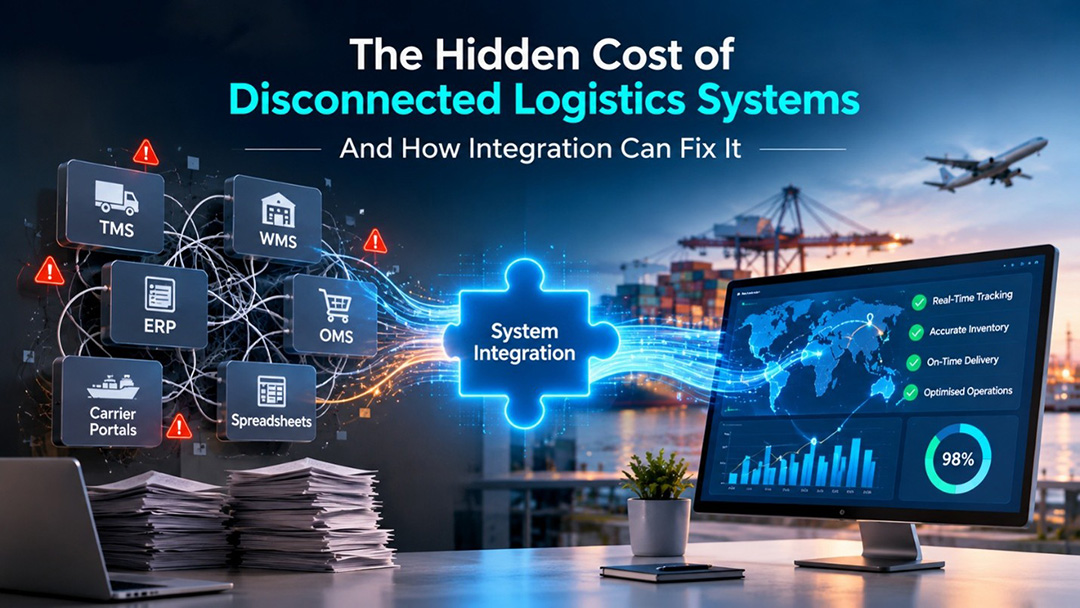

Logistics operations depend on multiple systems working together. Transportation management systems (TMS), warehouse management systems (WMS), enterprise resource planning (ERP), order management systems (OMS), carrier portals, and spreadsheets each manage different parts of the supply chain.
But when these platforms operate in isolation, information becomes fragmented. Teams enter the same data repeatedly, shipment updates do not match, inventory records become inconsistent, and decisions are made using incomplete information.
The result is more than an IT inconvenience. Disconnected systems can increase operating costs, delay deliveries, affect customer communication, and limit supply chain visibility.
For logistics businesses, the answer is not necessarily to replace existing platforms. A more practical approach is to connect them through system integration, API and EDI interfaces, reliable data pipelines, and shared operational dashboards.
This is where logistics IT solutions and custom software development can help businesses create a more connected technology environment.
What Are Disconnected Logistics Systems?
Disconnected logistics systems are software applications and platforms that manage operational activities but do not exchange information consistently.
For example, a transportation team may use a TMS to manage shipments, while warehouse employees update inventory in a WMS. The finance team may rely on an ERP platform, and customer service representatives may check order status through a separate OMS or carrier portal.
If these systems do not communicate effectively, employees often depend on spreadsheets, emails, manual updates, or duplicate data entry to fill information gaps.
A connected logistics environment allows relevant systems to exchange information through APIs, EDI, middleware, or data integration platforms. This helps teams access more consistent operational information without depending on manual reconciliation.
Six Hidden Costs of Disconnected Logistics Systems
Disconnected platforms create operational problems that may not appear directly in IT budgets. Their impact often becomes visible through additional labor, delayed decisions, inaccurate information, and avoidable operational expenses.
- Duplicate Data Entry and Increased Administrative Work
When systems do not exchange information automatically, employees must enter the same details into multiple applications.
For example, an order received through an OMS may need to be manually updated in the ERP, warehouse platform, and transportation system. If shipment details change, the same information may need to be corrected across several applications.
This increases administrative effort and leaves less time for activities that require human judgement.
How integration helps: API and EDI integration can automate the exchange of relevant information between systems. With the right custom software development approach, businesses can reduce repetitive data entry and streamline workflows.
- Inconsistent Shipment and Inventory Information
Different systems may store shipment identifiers, product codes, customer details, and inventory records in different formats.
A warehouse may show an order as dispatched while the transportation system still displays it as pending. Similarly, inventory records may not reflect recent warehouse movements.
These inconsistencies make it difficult for teams to establish which information is accurate.
How integration helps: Master-data standardization creates common definitions and formats for important business information. Data validation and quality monitoring can help identify missing, duplicate, or inconsistent records before they affect downstream processes.
- Delayed Decisions and Limited Operational Visibility
Logistics decisions depend on timely information. Teams need to understand shipment progress, warehouse capacity, inventory availability, and delivery exceptions.
When data is scattered across different platforms, employees may need to collect information manually before they can assess a situation. By the time the information is consolidated, an opportunity to respond may already have passed.
How integration helps: Connected data pipelines and operational dashboards bring relevant information into a more consistent view. Through data engineering and analytics, businesses can monitor operational performance, identify exceptions, and support faster decisions.
- Poor Coordination Between Logistics Partners
Logistics operations frequently involve carriers, suppliers, warehouse operators, distributors, and customers. Each participant may use a different system and communication method.
Without consistent data exchange, shipment updates can arrive late or in different formats. Employees may need to follow up through emails and phone calls to confirm the latest status.
How integration helps: API and EDI interfaces support structured information exchange between internal platforms and external partners. Businesses can connect carrier portals, order systems, and transportation applications to improve information flow across the supply chain.
- Higher Operating Costs and Billing Errors
Disconnected systems can create inconsistencies between shipment records, delivery confirmations, purchase orders, and invoices.
For example, a carrier invoice may contain charges that are difficult to reconcile with the shipment details stored in the transportation system. Manual verification increases processing time and can delay payment approvals.
How integration helps: Connected workflows can exchange shipment, order, and billing information between relevant applications. Automated validation can help flag mismatches for review, helping finance and operations teams investigate discrepancies more efficiently.
- Greater Security and Maintenance Complexity
Every disconnected application adds another environment to manage. Separate user permissions, inconsistent security controls, outdated interfaces, and third-party connections can increase the complexity of maintaining a secure technology landscape.
As organizations add more platforms, the number of connections and potential points of failure can also increase.
How integration helps: A structured integration architecture can centralize monitoring, establish consistent access controls, and improve visibility into data exchange. Appropriate cybersecurity services help protect applications, infrastructure, and information moving between connected systems.
How Can Logistics System Integration Solve These Challenges?
Logistics system integration connects applications, data sources, and business workflows so that information can move between them in a controlled and consistent manner.
The objective is not simply to connect to every application. It is to establish reliable information flows around business processes, ensuring that the right teams and systems can access the information they need.
Here are five important components of an effective integration strategy.
- API Integration for Real-Time Data Exchange
Application Programming Interfaces (APIs) allow software applications to exchange information and trigger actions through defined interfaces.
For example, an OMS can send order details to a WMS, which can update the TMS when an order is ready for dispatch. Shipment status changes can then be shared with customer-facing applications.
API integration can support:
- Order and shipment information exchange.
- Inventory availability updates.
- Carrier and tracking integrations.
- Customer notification workflows.
- Connections between ERP, TMS, WMS, and OMS platforms.
A well-designed API integration strategy helps reduce manual information exchange while allowing existing applications to continue performing their core functions.
- EDI Integration for Standardized Partner Communication
Electronic Data Interchange (EDI) enables organizations to exchange structured business documents electronically.
In logistics, EDI is commonly used for documents such as purchase orders, shipment notifications, invoices, and transport-related updates.
It helps standardize communication between businesses that may operate different software platforms.
EDI integration can support:
- Purchase order exchange.
- Advance shipment notifications.
- Shipment status messages.
- Invoice and billing information.
- Communication with carriers and suppliers.
Many logistics environments use both APIs and EDI. The appropriate choice depends on partner requirements, existing infrastructure, data formats, and the speed of information exchange required.
- Cloud-Based Data Platforms for Connected Information
As logistics businesses operate across multiple locations and partners, collecting and processing information from different applications becomes increasingly important.
A cloud-based data platform can bring information from ERP, TMS, WMS, OMS, carrier systems, and other sources into a more centralized data environment.
With appropriate data pipelines and governance, organizations can use this information for reporting, operational analysis, and forecasting.
Key capabilities include:
- Data ingestion from multiple applications.
- Data transformation and standardization.
- Centralized storage and data management.
- Data quality checks and monitoring.
- Analytics and reporting.
Cloud services can also support scalable infrastructure as data volumes, integration requirements, and business operations evolve.
- Master-Data Standardization and Data Quality Monitoring
Connecting systems is only part of the solution. If applications exchange inconsistent information, integration alone will not resolve the underlying data problems.
Master-data standardization establishes consistent definitions for important information such as product codes, shipment identifiers, customer records, warehouse locations, and carrier details.
Data quality monitoring helps identify:
- Duplicate records.
- Missing mandatory fields.
- Invalid identifiers.
- Inconsistent formats.
- Failed or incomplete data transfers.
These checks help businesses maintain more reliable information across connected applications.
- Operational Dashboards for Better Decision-Making
Once relevant data is connected and standardized, businesses can use operational dashboards to monitor performance across different functions.
Instead of checking multiple applications, teams can access a consolidated view of selected operational information.
Depending on business requirements, dashboards may track:
| Operational area | Example metrics |
| Transportation | Shipment status, delivery performance, transit time |
| Warehouse | Inventory accuracy, order fulfilment, dispatch status |
| Order management | Order processing time, pending orders, exceptions |
| Carrier performance | On-time delivery, delay frequency, service performance |
| Finance | Invoice discrepancies, freight costs, billing status |
Through data engineering and analytics, these dashboards can turn information from disconnected platforms into more useful operational insights.
A Practical Roadmap for Integrating Logistics Systems
System integration should begin with business requirements rather than technology selection. A phased approach can help organizations address immediate information gaps while avoiding unnecessary disruption to existing operations.
Step 1: Assess the Existing Technology Landscape
Identify the applications used across transportation, warehousing, order processing, finance, and partner communication.
Document the data each system manages, how information moves between them, and where manual intervention is required.
Step 2: Identify Critical Data and Integration Gaps
Prioritize information that needs to move between systems, such as order details, shipment identifiers, inventory updates, delivery status, and invoices.
Identify duplicate records, inconsistent formats, delayed updates, and failed data transfers.
Step 3: Define Integration Architecture
Determine whether APIs, EDI, middleware, data pipelines, or a combination of approaches best meets the requirements.
Consider scalability, security, existing application capabilities, partner connectivity, and long-term maintenance.
Step 4: Standardize and Validate Data
Establish common data definitions, mapping rules, validation checks, and ownership responsibilities.
This helps ensure that connected applications exchange information in a consistent format.
Step 5: Develop, Test, and Deploy Integrations
Implement integrations in manageable phases. Test data accuracy, error handling, performance, access controls, and recovery procedures before expanding to additional systems.
Step 6: Monitor and Improve
Monitor integration health, failed connections, data quality, and operational performance. Use feedback and agreed KPIs to identify where further improvements are required.
How Sphinx Worldbiz Supports Logistics System Integration
Sphinx Worldbiz supports logistics technology modernization through logistics IT solutions, custom software development, system integration, data engineering and analytics, cloud services, and cybersecurity services.
Rather than if every existing platform needs replacement, businesses can assess opportunities to connect and extend their current technology environment.
Sphinx’s capabilities can support initiatives such as:
Connecting Existing Logistics Platforms
Develop integration solutions that enable information exchange between TMS, WMS, ERP, OMS, carrier portals, and other business applications.
Building API and Data Integration Solutions
Develop API integrations, data pipelines, and application connections to support more consistent information exchange across operational systems.
Standardizing Operational Data
Implement data transformation, mapping, and validation processes to improve consistency across business applications.
Developing Operational Dashboards
Create reporting and analytics solutions that bring relevant operational information into a more accessible view for logistics and management teams.
Modernizing Legacy Applications
Assess existing applications and integration limitations, then support modernization approaches that improve connectivity, scalability, and maintainability.
Strengthening Integration Security
Apply appropriate security practices around application access, data exchange, infrastructure, and third-party connections.
By combining software engineering, data, cloud, and cybersecurity expertise, Sphinx Worldbiz can help logistics organizations build more connected technology environments around their operational requirements.
What Should Logistics Businesses Consider Before Investing in Integration?
Before starting an integration initiative, organizations should evaluate several practical considerations:
- Business priorities: Which information gaps create the greatest operational impact?
- Existing system capabilities: Do current applications support APIs, EDI, or other integration methods?
- Data ownership: Which teams are responsible for maintaining master records?
- Data quality: Are identifiers, formats, and records consistent enough to exchange?
- Security: How will access, authentication, and sensitive information be protected?
- Scalability: Can architecture support additional systems, partners, and data volumes?
- Monitoring: How will failed connections and incomplete data transfers be identified?
- Business continuity: What happens when an integration or connected application becomes unavailable?
Answering these questions helps organizations develop a practical integration strategy rather than creating another layer of disconnected technology.
Conclusion: Connected Systems Create a Stronger Logistics Foundation
Disconnected logistics systems create hidden costs through duplicate work, inconsistent information, delayed decisions, and limited operational visibility. These problems can affect transportation, warehouse operations, customer communication, and financial processes.
The solution does not always require replacing existing platforms. API and EDI integration, data standardization, cloud-based data platforms, and operational dashboards can help organizations connect their technology environments and improve information flow.
For logistics businesses planning digital transformation services, integration is an important foundation for more connected and adaptable operations.
With the right combination of logistics IT solutions, custom software development, data engineering and analytics, and cybersecurity services, organizations can make better use of their existing technology investments while preparing for future operational requirements.
Looking to connect your logistics systems and improve operational visibility? Explore how Sphinx Worldbiz can support your integration and technology modernization initiatives.
Frequently Asked Questions
- What is system integration in logistics?
System integration in logistics is the process of connecting applications such as TMS, WMS, ERP, OMS, and carrier platforms so they can exchange information. It helps reduce manual data entry, improve information consistency, and support better coordination across logistics operations.
- Why are disconnected logistics systems a problem?
Disconnected logistics systems can create duplicate data entry, inconsistent shipment records, delayed updates, inventory inaccuracies, and limited operational visibility. These issues can increase administrative effort and make it harder for teams to respond to operational changes.
- What is the difference between API and EDI integration?
API integration enables applications to exchange data and trigger actions through defined software interfaces. EDI enables businesses to exchange structured electronic documents using standardized formats. Both approaches can support logistics integration, depending on system and partner requirements.
- Can TMS, WMS, and ERP systems be integrated?
Yes. TMS, WMS, and ERP systems can often be connected using APIs, EDI, middleware, or data integration platforms. The suitable approach depends on the software capabilities, available interfaces, data formats, and security requirements of each system.
- How does cloud integration improve logistics operations?
Cloud integration can help businesses collect information from multiple applications, process data centrally, and support scalable reporting and analytics. It can improve access to operational information if data quality, security, and governance are properly managed.
- How can logistics companies improve data accuracy?
Businesses can improve data accuracy through master-data standardization, validation rules, duplicate detection, consistent identifiers, and ongoing data quality monitoring. These practices help maintain reliable information across connected applications.
- What are the benefits of logistics dashboards?
Logistics dashboards consolidate selected operational information into a single reporting view. They can help teams monitor shipment status, inventory, delivery performance, order processing, carrier performance, and operational exceptions.
- How can Sphinx Worldbiz help with logistics system integration?
Sphinx Worldbiz provides capabilities in logistics IT solutions, custom software development, system integration, API development, data engineering and analytics, cloud services, and cybersecurity services. These capabilities can support businesses in connecting existing applications, improving data flows, and developing operational reporting solutions.