




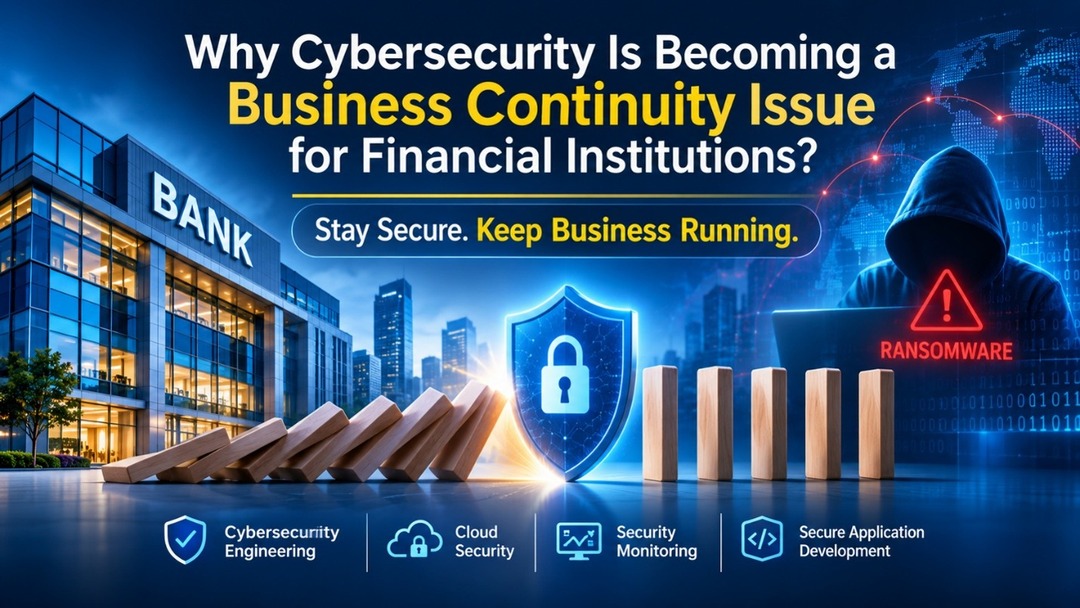

A ransomware attack can halt banking operations. A compromised third-party application can expose sensitive customer information. A vulnerability in a cloud-connected system can disrupt payment processing, customer portals, and internal financial operations.
For financial institutions, these incidents are no longer isolated IT problems. They can affect transaction processing, customer access, regulatory obligations, revenue, and business reputation.
As banks, insurance companies, fintech businesses, and other financial service providers become increasingly dependent on interconnected digital platforms, cybersecurity is becoming a fundamental part of business continuity planning.
Traditional security measures that focus mainly on protecting networks and endpoints are no longer sufficient. Financial institutions need a broader approach that combines cybersecurity services, cloud infrastructure protection, continuous security monitoring, secure application development, and effective risk management.
The objective is not simply to prevent cyberattacks. The goal is to keep essential services available, protect sensitive information, and enable rapid recovery when disruptions occur.
Why Is Cybersecurity Now a Business Continuity Priority for Financial Institutions?
Cybersecurity is a business continuity priority because financial institutions depend on uninterrupted access to digital systems for transactions, customer services, data processing, and regulatory operations. A successful cyberattack can disrupt several connected services simultaneously, making security incidents a direct threat to business operations.
BFSI Industries operate complex technology environments that include core banking platforms, payment gateways, cloud infrastructure, customer-facing applications, APIs, and third-party services. A weakness in one component can create exposure across the wider ecosystem.
This makes financial services cybersecurity an essential part of operational resilience rather than a standalone technology function.
Consider what happens when a financial institution experiences a serious cyber incident:
- Customers may be unable to access online banking or payment services.
- Transaction processing and settlement activities may be delayed.
- Employees may lose access to critical business applications.
- Sensitive financial and customer information may be exposed.
- Third-party integrations may become unavailable.
- Recovery efforts may increase operational costs and affect customer confidence.
These consequences demonstrate why cyber risk management must involve technology leaders, business continuity teams, compliance professionals, and senior management.
A resilient financial institution needs to prepare for three scenarios: preventing security incidents where possible, containing their impact when they occur, and restoring critical operations without unnecessary delays.
Ransomware Attacks: When Security Incidents Stop Financial Operations
Ransomware remains a serious concern for financial institutions because it can disrupt access to critical applications, databases, files, and infrastructure.
Attackers may gain access through compromised credentials, phishing campaigns, unpatched systems, exposed remote access services, or vulnerabilities in connected applications. Once inside an environment, they may encrypt data, disrupt services, steal sensitive information, or attempt to pressure the organization through extortion.
For a bank or financial services provider, the impact can extend far beyond the affected systems.
How ransomware affects business continuity
A ransomware incident can interrupt:
- Customer-facing digital banking services.
- Payment processing and transaction management.
- Financial reporting and reconciliation.
- Internal communication and employee workflows.
- Access to customer records and business-critical data.
- Connections with external service providers.
Even when backup systems are available, restoring operations can take time. Organizations must also establish whether backups are unaffected, verify data integrity, investigate the incident, and ensure compromised access points are secured before reconnecting systems.
Strengthening ransomware protection
Effective ransomware protection requires multiple security controls working together.
Financial institutions should consider:
- Endpoint detection and protection to identify suspicious activity.
- Regular vulnerability assessments and timely security patching.
- Multi-factor authentication and privileged access controls.
- Network segmentation to restrict unauthorized movement between systems.
- Secure, tested, and isolated backups.
- Incident response procedures with clearly assigned responsibilities.
- Continuous monitoring for unusual access and data activity.
A strong cybersecurity solutions strategy should also include recovery planning. Preventing an attack is important, but the ability to restore essential services safely is equally critical.
Third-Party Risks: The Security Exposure Beyond Internal Systems
Financial institutions increasingly depend on external technology providers, cloud platforms, payment processors, software vendors, data services, and other business partners.
These relationships improve efficiency and enable digital innovation. However, they also expand the organization’s security perimeter.
A third-party provider may have access to customer information, internal applications, transaction data, or infrastructure components. If that provider experiences a security breach, the financial institution may face operational disruption or data exposure even when its own systems have not been directly compromised.
This makes third-party risk management a critical part of modern financial sector security.
Why interconnected vendor ecosystems create vulnerabilities
Third-party risks can emerge through several channels:
- Vendors with excessive access permissions.
- Insecure APIs connecting financial applications.
- Outdated software components and dependencies.
- Weak authentication across integrated platforms.
- Insufficient visibility into vendor security practices.
- Cloud services with misconfigured access or storage permissions.
For example, a financial institution may use an external payment service integrated with its transaction platform. If the provider experiences an outage or a security incident, payment operations could be affected.
Similarly, a vulnerability in a software dependency could expose multiple applications that rely on the same component.
Building stronger third-party security controls
Financial institutions should assess the security posture of vendors before onboarding them and continue monitoring risks throughout the relationship.
Useful measures include:
- Conducting vendor security assessments before granting system access.
- Reviewing data access permissions and integration requirements.
- Applying encryption and secure authentication to data exchanges.
- Monitoring API activity and unusual system behavior.
- Defining incident notification and response responsibilities in vendor agreements.
- Maintaining contingency arrangements for critical third-party services.
A comprehensive cyber risk management framework should account for vendor dependencies, technology integrations, and the potential impact of external disruptions.
Organizations should also consider how system integration services can support secure connections between enterprise applications, financial platforms, and external providers.
Cloud Security: Protecting Financial Services in Connected Environments
Cloud adoption has changed how financial institutions develop, deploy, and manage digital services. Cloud infrastructure supports application hosting, data analytics, digital banking, collaboration, disaster recovery, and scalable computing.
However, moving workloads to the cloud does not automatically make them secure.
Misconfigured storage, excessive permissions, weak identity controls, exposed interfaces, and insufficient monitoring can create vulnerabilities. Hybrid and multi-cloud environments may introduce additional complexity because security policies and visibility need to remain consistent across different platforms.
This is why cloud security must be integrated into the wider business continuity strategy.
Common cloud security challenges
Financial institutions may encounter:
- Misconfigured cloud storage and databases.
- Weak identity and access management.
- Inadequate encryption of sensitive information.
- Unsecured connections between cloud and on-premises systems.
- Limited visibility into cloud workloads.
- Inconsistent security policies across environments.
- Insufficient backup and recovery arrangements.
These issues can affect service availability, confidentiality, and data integrity.
How financial institutions can strengthen cloud security
A structured cloud security approach should include:
- Identity and access management with least-privilege permissions.
- Encryption for sensitive data at rest and in transit.
- Continuous configuration assessments.
- Network segmentation and secure connectivity.
- Cloud workload protection and vulnerability management.
- Centralized logging and security event monitoring.
- Tested backup and disaster recovery procedures.
Organizations should also implement security controls throughout cloud adoption and modernization projects instead of treating security as a final deployment activity.
For institutions modernizing legacy infrastructure, cloud security services can help establish secure architectures, strengthen access controls, and improve visibility across connected environments.
Effective cybersecurity services should support both the protection of existing infrastructure and the secure adoption of new cloud technologies.
Security Monitoring: Detecting Threats Before They Escalate
Preventive security controls are essential, but they cannot guarantee that every attack will be stopped.
Financial institutions need to identify suspicious activity quickly, understand its potential impact, and respond before an incident occurs across critical systems.
This is where continuous security monitoring becomes important.
Without adequate visibility, unusual login activity, unauthorized access attempts, malware behavior, or unexpected data transfers may remain undetected until significant damage has occurred.
What should financial institutions monitor?
A practical monitoring strategy should cover:
- User authentication and access activity.
- Privileged accounts and administrative actions.
- Network traffic and unusual connections.
- Cloud workloads and configuration changes.
- Application logs and API activity.
- Endpoint behavior and suspicious processes.
- Data access and unexpected transfers.
- Security events across third-party integrations.
From monitoring to faster incident response
Security monitoring services can help organizations collect and analyze security events across their technology environments.
Depending on the operating model, this may involve centralized logging, security information and event management (SIEM), endpoint detection and response (EDR), threat intelligence, and security operations centre (SOC) capabilities.
The goal is to identify patterns that may indicate a threat, prioritize alerts, and support timely investigation.
A mature monitoring approach should also define escalation procedures. Security teams need to know which incidents require immediate containment, which business services may be affected, and who is responsible for coordinating the response.
Strong ransomware protection and threat detection measures become more effective when monitoring is connected to incident response and recovery processes.
For financial institutions, faster detection can reduce the time an attacker remains inside an environment and help limit operational disruption.
Application Security: Securing the Digital Services Customers Depend On
Financial institutions increasingly deliver services through mobile banking applications, internet banking portals, payment platforms, lending systems, customer management applications, and partner integrations.
These applications handle sensitive information and support business-critical transactions. A vulnerability in an application can therefore affect both data security and service availability.
Common application security risks include:
- Weak authentication and authorization.
- Insecure APIs and integrations.
- Improper input validation.
- Exposure of sensitive information.
- Vulnerable third-party libraries.
- Inadequate session management.
- Security weaknesses introduced during software updates.
Why secure application development matters
Security should be incorporated throughout the software development lifecycle rather than added after an application is built.
This approach includes secure architecture design, code reviews, dependency checks, security testing, access control validation, and ongoing vulnerability remediation.
Application security also needs to account for how applications communicate with other systems. A secure customer portal may still be exposed if its APIs, connected databases, or external dependencies are not properly protected.
Financial institutions can strengthen this area through:
- Secure coding standards.
- Static and dynamic application security testing.
- API security assessments.
- Software dependency and vulnerability scanning.
- Authentication and authorization testing.
- Regular penetration testing.
- Secure release and deployment practices.
Combining application security with custom software development helps organizations build digital solutions with security requirements considered from the beginning.
It also supports safer application modernization, integration, and the introduction of new digital financial services.
Business Continuity Requires More Than Cyberattack Prevention
A strong security framework must prepare financial institutions for situations where preventive controls are bypassed, or services become unavailable.
This means aligning cybersecurity with business continuity management, disaster recovery, and operational resilience planning.
An organization may have advanced firewalls, endpoint protection, and monitoring tools, but recovery can still be delayed if responsibilities, backup procedures, system dependencies, and communication plans are unclear.
Four areas to strengthen operational resilience
- Identify critical business services
Determine which systems support essential activities such as payments, customer access, transaction processing, settlement, and regulatory reporting. Understand the technology dependencies behind each service.
- Define recovery priorities
Establish recovery time objectives (RTOs) and recovery point objectives (RPOs) based on business requirements. These help determine how quickly services should be restored and how much data loss is tolerable.
- Test incident response and recovery plans
Conduct realistic exercises covering ransomware, cloud outages, compromised vendor access, and application vulnerabilities. Testing should include technical teams and business stakeholders.
- Improve visibility across the technology environment
Maintain an up-to-date view of applications, infrastructure, data flows, third-party connections, and security controls. This helps teams assess the wider impact of an incident.
These activities turn cyber risk management into an operational discipline that supports business continuity, not just compliance.
How Integrated Cybersecurity Engineering Supports Financial Institutions
Financial institutions need security measures that work across infrastructure, applications, cloud platforms, and connected enterprise systems.
Implementing isolated tools may address individual vulnerabilities, but it does not always provide the visibility and coordination needed to protect complex environments.
An integrated engineering approach can help organizations connect security controls with the systems and workflows that support daily operations.
- Cybersecurity engineering
Cybersecurity engineering focuses on designing, implementing, and strengthening security controls across enterprise technology environments.
This may include secure architecture, vulnerability management, identity controls, network protection, security assessments, and risk-based remediation.
It helps organizations address weaknesses before they become larger operational problems.
- Cloud security
Cloud security focuses on protecting cloud infrastructure, workloads, identities, data, and connections between cloud and on-premises environments.
It supports secure cloud adoption, infrastructure modernization, and the availability of critical digital services.
- Security monitoring
Security monitoring helps organizations improve visibility into user activity, network events, applications, endpoints, and cloud environments.
When combined with incident response procedures, it supports earlier threat identification and more coordinated action.
- Secure application development
Secure application development incorporates security into application architecture, coding, testing, integration, and deployment.
It helps reduce vulnerabilities in customer-facing platforms, enterprise applications, APIs, and connected financial systems.
Together, these capabilities form a more comprehensive approach to cybersecurity solutions for financial institutions.
They also complement broader digital transformation services, ensuring that modernization initiatives account for security, resilience, and operational requirements.
How Sphinx Worldbiz Helps Strengthen Cybersecurity and Operational Resilience
As financial institutions modernize their technology environments, they need engineering capabilities that address security across infrastructure, applications, and digital operations.
Sphinx Worldbiz supports enterprise technology initiatives through cybersecurity engineering, cloud services, software development, and digital transformation capabilities.
Its approach can be aligned with the security and continuity requirements of financial organizations through four key areas:
Cybersecurity engineering: Strengthening enterprise environments through security-focused engineering, vulnerability identification, and risk-based improvements.
Cloud security: Supporting secure cloud environments through infrastructure protection, access management, and security considerations across cloud modernization initiatives.
Security monitoring: Helping improve visibility into technology environments and supporting the identification and investigation of suspicious activity through appropriate monitoring capabilities.
Secure application development: Building and modernizing applications with security considerations across architecture, development, testing, and integration.
By connecting these capabilities, Sphinx Worldbiz can help organizations address technology risks as part of wider modernization and resilience initiatives.
For financial institutions evaluating cybersecurity services, the priority should be to understand where vulnerabilities exist, which business services depend on affected systems, and how security improvements can support continuity.
The right engineering approach should address immediate security concerns while creating a stronger foundation for future digital operations.
The Future of Financial Services Depends on Cyber Resilience
Financial institutions will continue to adopt cloud platforms, connected applications, automation, digital payments, and data-driven services. These developments create new opportunities, but they also increase the importance of security across the technology ecosystem.
Cybersecurity can no longer be treated as a separate technical responsibility. It needs to be part of infrastructure planning, software development, vendor management, cloud adoption, and business continuity preparation.
A resilient institution is not simply one that has never experienced a cyber incident. It is one that understands its exposure, detects threats, limits disruption, and restores critical services effectively.
Investing in financial services cybersecurity, strengthening cloud security, improving security monitoring services, and prioritizing application security can help organizations build that resilience.
Ultimately, effective cybersecurity services protect more than technology assets. They help safeguard customer confidence, operational stability, and the ability to deliver essential financial services.
Is your financial institution prepared to maintain critical operations when its technology environment faces a cyber disruption?
Sphinx Worldbiz can support your cybersecurity and digital modernization initiatives with engineering-led capabilities across cybersecurity, cloud, and secure application development.
Frequently Asked Questions (FAQs)
-
Why is cybersecurity important for business continuity in financial institutions?
Cybersecurity protects the digital systems and information that financial institutions rely on to deliver essential services. A cyberattack can disrupt payment processing, customer access, transaction management, and internal operations. Strong security controls, incident response, and recovery planning help organizations reduce disruption and restore services.
-
What are the biggest cybersecurity threats facing financial institutions?
Major threats include ransomware, phishing, credential theft, cloud misconfigurations, application vulnerabilities, insider threats, and third-party security incidents. These risks can affect sensitive data, digital banking platforms, payment systems, and connected enterprise applications.
-
How does ransomware affect banking operations?
Ransomware can encrypt business-critical files, disrupt applications, restrict access to databases, and interrupt essential services. Depending on the affected systems, it may delay transactions, prevent customers from accessing services, and increase recovery costs. Effective ransomware protection requires preventive controls, monitoring, secure backups, and tested incident response procedures.
-
What is third-party risk management in financial services?
Third-party risk management involves identifying, assessing, and monitoring security risks associated with external vendors, technology providers, cloud platforms, and service partners. It helps financial institutions understand how vendor vulnerabilities or disruptions could affect their own systems, data, and operations.
-
How does cloud security help financial institutions?
Cloud security protects financial data, applications, infrastructure, and workloads hosted in cloud environments. It uses controls such as identity management, encryption, access restrictions, configuration monitoring, and secure connectivity to reduce the risk of data exposure and service disruption.
-
What role does security monitoring play in cyber resilience?
Security monitoring helps identify suspicious activities, unusual access patterns, and potential threats across networks, endpoints, applications, and cloud environments. It enables security teams to investigate incidents, prioritize alerts, and respond before threats cause wider disruption.
-
How can financial institutions improve application security?
Financial institutions can improve application security by adopting secure coding practices, performing regular vulnerability assessments, testing APIs, reviewing third-party software dependencies, and incorporating security checks throughout the software development lifecycle.
-
What is the difference between cybersecurity and business continuity?
Cybersecurity focuses on protecting systems, networks, applications, and data from digital threats. Business continuity focuses on maintaining essential business operations during disruptions. The two are closely connected because cyber incidents can interrupt critical services, making security an important component of continuity planning.
-
How can financial institutions build stronger cyber resilience?
They can strengthen cyber resilience by identifying critical services, assessing technology and third-party risks, implementing layered security controls, monitoring systems continuously, testing incident response plans, and maintaining reliable backup and recovery processes.
-
How can Sphinx Worldbiz support financial institutions with cybersecurity?
Sphinx Worldbiz supports enterprise technology initiatives through cybersecurity engineering, cloud services, secure application development, and digital transformation capabilities. These services can help financial organizations strengthen their technology environments and address security considerations during modernization initiatives.