



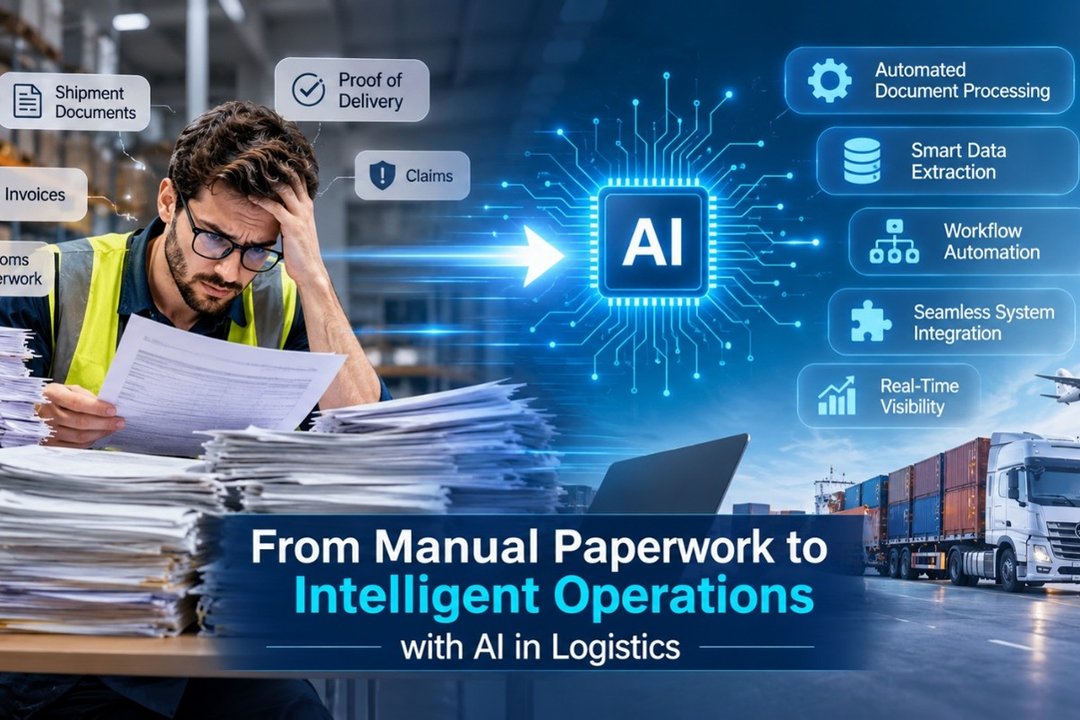

Logistics operations run on documents. Every shipment generates paperwork, from bills of lading and delivery receipts to invoices, customs declarations, freight documents, and claims. While these records are essential for keeping goods moving, managing them manually can slow down even the most efficient logistics operations.
Consider a shipment that has reached its destination. The proof of delivery (POD) needs to be collected, shipment details must be verified, the corresponding invoice needs to be matched, and the finance team must update its records. If any information is missing or inconsistent, the process may require additional emails, calls, document reviews, and manual corrections.
Now multiply this process across hundreds or thousands of shipments.
For logistics companies, repetitive document handling creates an operational burden that extends beyond administrative work. It can delay billing, increase processing costs, create disputes, affect cash flow, and limit the time employees can spend on higher-value activities.
This is where AI-powered logistics solutions can make a measurable difference. By combining intelligent document processing, optical character recognition (OCR), automated data validation, custom software development and workflow automation, logistics businesses can move from paper-heavy processes to more connected and intelligent operations.
The objective is not to eliminate human involvement. It is to automate repetitive work, improve information accuracy, and ensure that exceptions receive the attention they need.This is a practical use case for AI-powered logistics solutions.
Why Manual Document Management Is Holding Back Logistics Operations
Logistics companies handle multiple documents across transportation, warehousing, freight management, customs clearance, and financial operations. These documents often arrive through different channels, including emails, scanned PDFs, mobile applications, customer portals, and paper-based submissions.
Managing this information manually introduces several operational challenges.
- Repetitive Document Collection and Data Entry
Shipment-related documents frequently contain overlapping information, such as shipment IDs, vehicle numbers, delivery dates, consignee details, quantities, and freight charges.
Employees may need to enter the same information into multiple systems, increasing administrative effort and creating opportunities for data-entry errors.
When shipment volumes increase, these repetitive activities can consume a significant amount of employees’ working hours.
- Missing or Mismatched Shipment Records
A proof of delivery may contain a different shipment reference from the corresponding invoice. An invoice may list quantities that do not match the delivery receipt. Customs documents may have incomplete shipment details.
These discrepancies require manual verification before teams can proceed.
Without consistent validation processes, even small documentation errors can delay billing, trigger disputes, and complicate shipment reconciliation.
- Delayed Invoice Processing and Billing
Finance teams often depend on verified shipment documents before approving invoices or processing customer payments.
If delivery receipts are missing, freight charges do not match agreed rates, or supporting documents are incomplete, invoice approval can get delayed.
These bottlenecks can affect billing cycles, increase follow-up activities, and put pressure on working capital.
- Complex Customs and Compliance Documentation
International logistics involves several documentation requirements, depending on the shipment, commodity, destination, and applicable regulations.
Commercial invoices, packing lists, certificates of origin, customs declarations, and other supporting records must contain consistent and accurate information.
Manually reviewing these documents can become time-consuming, particularly for businesses handling cross-border shipments across multiple markets.
- Limited Visibility Across Operational Workflows
When documents are stored across emails, shared folders, spreadsheets, and disconnected enterprise applications, teams may struggle to understand the status of a shipment or its associated paperwork.
Operations managers may need to contact multiple departments to find out whether a document has been received, reviewed, approved, or processed.
This fragmented approach limits operational visibility and makes it difficult to identify recurring bottlenecks.
How AI-Powered Document Processing Can Improve Logistics Workflows
Traditional document management systems primarily store and organize files. AI development services can go further by interpreting document contents, extracting relevant information, identifying document types, and supporting downstream business processes.
AI-powered document processing for logistics combines technologies such as OCR, machine learning, natural language processing, and intelligent automation to reduce the effort involved in handling business documents.These capabilities are increasingly relevant to AI in logistics.
Here is how the technology can improve key logistics activities.
- Intelligent Document Recognition and Classification
Logistics companies receive documents in different layouts, formats, and structures. An AI-enabled document processing solution can help identify and classify these files based on their content.They can form part of broader logistics automation initiatives.
For example, incoming documents can be categorized as:
- Bills of lading
- Proofs of delivery
- Commercial invoices
- Packing lists
- Freight bills
- Customs declarations
- Delivery notes
- Insurance and claims documents
Machine learning models and document classification techniques can identify relevant document types and direct them to the appropriate processing workflows.
This reduces the need for employees to manually open, inspect, rename, and categorize every incoming file.
- Automated Data Extraction Using OCR and AI
Once a document is identified, OCR technology can convert printed or scanned text into machine-readable information.
AI-based extraction can then help identify specific fields, including:
- Shipment and tracking numbers
- Consignor and consignee information
- Vehicle and container numbers
- Invoice numbers and dates
- Product descriptions and quantities
- Freight charges and taxes
- Delivery dates and signatures
Unlike basic text recognition, intelligent document processing in logistics can use document structure and contextual information to identify relevant fields.This functionality can be incorporated into purpose-built logistics software.
For instance, an invoice may contain several numerical values, including purchase order numbers, quantities, taxes, and total charges. AI-assisted extraction helps distinguish these fields based on their context.
The extracted information can then be structured for further validation and processing.
- Automated Proof of Delivery Processing
Proof of delivery documents are important for confirming shipment completion and supporting billing activities.
However, collecting and reviewing PODs manually can delay invoice generation and customer confirmation.
An automated workflow can:
- Receive delivery documents through configured channels.
- Identify and classify the proof of delivery.
- Extract shipment references, delivery dates, and other relevant fields.
- Compare extracted details with available shipment records.
- Flag missing information or mismatched references.
- Route verified records to the next stage of the workflow.These checks are an important component of AI-powered logistics solutions.
When signature verification, image quality assessment, or damage identification is required, teams can incorporate additional computer vision capabilities.
This can help logistics teams reduce repetitive document handling while improving the availability of delivery-related information.
- AI Invoice Processing and Automated Matching
Invoice processing is another area where document automation can improve operational efficiency.
Logistics invoices often need to be compared against shipment records, purchase orders, freight agreements, delivery confirmations, and other supporting documents.
AI invoice processing automation can help extract invoice information, organize relevant fields, and compare them against existing business records.
A typical workflow may include:
- Extracting invoice numbers, dates, vendor details, and amounts.
- Identifying shipment references and associated charges.
- Matching invoices with purchase orders or shipment records.
- Checking quantities, rates, taxes, and other relevant fields.This is one operational area where AI in logistics can reduce avoidable delays.
- Flagging discrepancies for further investigation.
- Routing validated invoices for approval.
For example, if a freight invoice contains a charge that differs from the agreed transportation rate, the system can flag the discrepancy instead of automatically approving the invoice.
This approach helps finance teams prioritize exceptions rather than manually checking every document from the beginning.
- Automated Customs Documentation Checks
Customs documentation requires careful verification because missing or inconsistent information can delay shipment clearance.
AI development services ensure intelligent document processing can help extract information from commercial invoices, packing lists, certificates, and other relevant records.
Automated validation rules can then check whether essential fields are present and whether selected details are consistent across documents.
For example, product descriptions, quantities, shipment references, and declared values can be compared across relevant records.
These checks can help identify potential documentation gaps before submission. However, AI should support rather than replace customs expertise and regulatory review. Final compliance decisions must follow applicable requirements and authorized procedures.
Why AI Extraction Must Include Data Validation and Human Review
These checks can be supported through logistics automation workflows.
Automating document extraction does not automatically guarantee accurate information.
Scanned documents may be unclear, handwritten entries can be difficult to interpret, and different document layouts can affect extraction quality. AI models may also misinterpret numbers, dates, currency values, or shipment references.
For logistics businesses, accepting every extracted value without verification can introduce new operational risks.
A reliable intelligent document processing solution should include multiple layers of validation.
- Confidence-Based Data Verification
AI models can assign confidence scores to extracted fields, depending on the solution and model capabilities.Connected records are easier to manage when teams use integrated logistics software.
Fields with high confidence may proceed through configured validation rules, while low-confidence values can be sent for human review.
For example, if the system extracts a shipment number but cannot confidently interpret one or more characters, the record should be flagged instead of being accepted automatically.
- Cross-Document Data Matching
Extracted information should be compared against relevant business records and supporting documents.
This may include checking:
- Shipment IDs against TMS records.
- Invoice amounts against agreed freight rates.
- Delivered quantities against shipment records.
- Delivery dates against operational timelines.This also creates opportunities to apply AI in logistics beyond basic document storage.
- Vendor details against approved supplier records.
These checks help identify inconsistencies before they move into financial or operational systems.
- Exception-Based Human Review
Not every document requires manual intervention. However, documents containing missing fields, conflicting values, unusual charges, or uncertain extractions should be routed to authorized reviewers.
A human-in-the-loop approach allows employees to investigate exceptions, correct extracted information, and approve high-impact transactions.
- Audit Trails and Processing History
Every important document-processing action should be traceable.
A suitable solution should maintain records of:
- Original documents and their source. Together, these technologies are central to practical AI-powered logistics solutions.
- Extracted information.
- Validation results.
- Changes made by users.
- Approval and rejection decisions.
- Processing timestamps.
- Exception handling and resolution history.
These audit trails help businesses investigate discrepancies, maintain accountability, and support internal audits.
The principle is straightforward: automate routine processing, validate extracted information, and keep humans involved wherever judgment or accountability is required.This is one way AI in logistics can support document-heavy operations.
How Workflow Automation Connects Logistics Documents with Business Systems
Document processing delivers greater value when extracted information can move directly into the applications used by logistics and finance teams.
Without system connectivity, employees may still need to transfer extracted information manually into transportation management systems, enterprise resource planning platforms, accounting software, and other applications.
This is where workflow automation and API-based integration become important.Configured rules are a key part of effective logistics automation.
- Connecting Document Processing with Transportation Management Systems
A Transportation Management System (TMS) stores important shipment information, including carrier details, route data, shipment references, delivery status, and transportation charges.
Integrating document-processing workflows with TMS platforms can help transfer validated information into relevant shipment records.
For example, extracted POD details can be linked to the corresponding shipment, making delivery confirmation information more accessible to operations and finance teams.
- Integrating Finance and ERP Applications
Validated invoice information can be transferred to connected finance or ERP applications for further reconciliation, approval, and payment processing.
This reduces duplicate data entry and helps maintain consistency between shipment documentation and financial records.
- Automating Approval and Exception Workflows
Not all documents follow the same processing path.
Some invoices may pass validation, while others may require additional approvals. Certain customs documents may need compliance review, and claims involving damaged shipments may require supporting evidence.
Logistics workflow automation solutions can route documents based on predefined business rules, document type, validation results, and approval requirements.These workflows can be built into existing or newly developed logistics software.
This ensures that routine cases follow standard workflows while exceptions reach the right employees.
Business Benefits of Intelligent Document Processing in Logistics
Moving from manual document handling to connected, AI-enabled workflows can create benefits across multiple business functions.This is where well-designed AI-powered logistics solutions can support operational improvement.
- Reduced Administrative Workload
Automating document classification, data extraction, and routine validation can reduce repetitive activities and allow employees to focus on exception handling and operational coordination.
- Faster Invoice Processing
Automated information extraction and matching can help identify missing documents and discrepancies earlier, supporting smoother invoice verification and approval.
- Improved Data Consistency
Standardized extraction, validation rules, and cross-system matching can help reduce inconsistencies across shipment, delivery, and financial records.
- Better Operational VisibilityThese capabilities can support wider adoption of AI in logistics.
When document information is connected between TMS and finance applications, teams can access relevant records without repeatedly searching through emails and spreadsheets.A scalable approach to logistics automation can help teams manage growing document volumes.
- More Scalable Operations
Automated workflows can support increasing shipment and document volumes without requiring every additional transaction to be managed through the same level of manual effort.
- Stronger Process Traceability
Audit trails, validation records, and approval histories provide greater visibility into how documents and transactions move through the organization.
The actual results depend on document quality, integration complexity, workflow design, data availability, and the level of automation implemented.
How Sphinx Worldbiz Helps Build Intelligent Logistics Workflows
At Sphinx Worldbiz, we help businesses address complex operational challenges through AI development services, custom software development, system integration, and automation capabilities. Our work can include technology foundations for logistics automation.
For logistics organizations managing large volumes of shipment documents, invoices, delivery records, and customs paperwork, our AI engineers can help develop connected document-processing workflows that reduce repetitive manual effort while maintaining appropriate validation and human oversight.
Our approach can include:
AI-Powered Document Processing: Develop solutions that use OCR, machine learning, and intelligent document processing techniques to classify documents and extract relevant information from structured and unstructured files.These capabilities can be delivered as part of integrated logistics software.
Custom Document Processing Workflows: Build tailored applications and processing workflows aligned with specific logistics operations, document formats, approval requirements, and business rules.
TMS and Finance System Integration: Connect document-processing solutions with transportation management systems, ERP platforms, accounting applications, and other enterprise tools through suitable APIs and integration methods.
Automated Data Validation: Implement business rules and cross-document checks to identify missing fields, inconsistent values, and potential discrepancies before information moves to downstream systems.
Workflow Automation: Automate routine document routing, approval requests, exception notifications, and information transfers to reduce repetitive administrative activities.This supports practical adoption of AI in logistics across document workflows.
Human-in-the-Loop Processing: Configure review workflows that route uncertain extractions, conflicting records, and high-impact cases to authorized employees for verification and approval. These integrations can connect intelligent workflows with existing logistics software.
By combining these capabilities, Sphinx can help logistics businesses establish more connected document operations, improve information accessibility, and build a stronger foundation for wider automation initiatives.
Moving from Manual Paperwork to Intelligent Logistics Operations
A connected technology foundation can bring together logistics automation and document intelligence.
The logistics industry does not have a document shortage. It has a document management challenge.
Shipment records, invoices, proof of delivery, and customs paperwork contain information that directly influences operational coordination, financial processing, and customer service. Yet when this information remains trapped in disconnected files and manual workflows, businesses struggle to use it effectively.
AI-powered document processing offers a practical way forward. By combining OCR, intelligent data extraction, automated validation, system integration, and exception-based human review, logistics companies can simplify document-heavy processes without compromising accuracy or accountability.This approach is one application of AI-powered logistics solutions.
This is an important part of broader digital transformation services for the logistics sector. The objective is not to automate every decision, but to build workflows where information moves efficiently, discrepancies are identified early, and employees can focus on decisions that require their expertise.
For logistics businesses looking to improve operational efficiency, the transition from manual paperwork to intelligent operations starts with making documents work as connected business data.
Frequently Asked Questions About AI in Logistics
1. What are AI-powered logistics solutions?
AI-powered logistics solutions use artificial intelligence, machine learning, OCR and workflow automation to improve logistics operations. They help businesses automate document processing, shipment tracking, invoice verification, proof of delivery management and operational workflows.
2. How can AI improve logistics operations?
AI can improve logistics operations by automating repetitive tasks, extracting information from shipment documents, identifying data discrepancies, streamlining invoice processing and connecting business systems. This helps logistics teams reduce manual effort and improve operational visibility.
3. What is AI document processing in logistics?
AI document processing in logistics uses OCR, machine learning and intelligent automation to identify, classify and extract information from documents such as bills of lading, invoices, proof of delivery, packing lists and customs declarations.
4. Can AI automate freight invoice processing?
Yes. AI can extract invoice details, identify shipment references, compare freight charges against agreed rates and flag discrepancies. Validated invoices can then be routed for approval, while unusual charges are sent to finance teams for review.
5. How does AI automate proof of delivery (POD) processing?
AI automates POD processing by identifying delivery documents, extracting shipment references and delivery dates, matching information against shipment records and flagging missing or inconsistent details. This helps logistics companies improve document availability and billing workflows.
6. Can AI document processing integrate with TMS and ERP systems?
Yes. AI document processing solutions can integrate with Transportation Management Systems (TMS), Enterprise Resource Planning (ERP) platforms and finance applications through APIs and integration services. This allows validated document information to move into existing business workflows.
7. How can logistics companies reduce manual paperwork using AI?
Logistics companies can reduce manual paperwork by implementing OCR-based document extraction, automated document classification, invoice matching, digital approval workflows and automated data validation. Human review should remain available for uncertain or high-impact transactions.
8. How can Sphinx Worldbiz help businesses implement AI-powered logistics solutions?
Sphinx Worldbiz provides AI development, custom software development, system integration and workflow automation capabilities. Businesses can work with its technology teams to develop intelligent document processing workflows, automate document validation and connect logistics applications with TMS, ERP and finance systems.
Ready to make document-heavy logistics operations more intelligent?
Connect with Sphinx Worldbiz to explore AI-driven document processing, custom workflow automation, and system integration solutions for your logistics business.The right combination of integration and logistics software can help teams move forward.