




Your next technology partner could determine how competitive your business will be over the next five years.
European businesses are investing in artificial intelligence, cloud infrastructure, intelligent automation and modern enterprise applications. Yet many organisations still struggle with disconnected systems, rising IT costs, manual operations and technology that cannot keep pace with business growth.
The problem is not always a lack of technology.
It is choosing the right partner to bring everything together.
A digital transformation project is much more than implementing new software or migrating applications to the cloud. It involves changing how a business operates, makes decisions, serves customers and creates value.
For CIOs, CTOs, COOs and business leaders, selecting the right digital transformation partner in Europe is a strategic business decision.
But how do you identify a partner that understands your business, has the engineering capabilities to execute complex projects, and can deliver measurable outcomes?
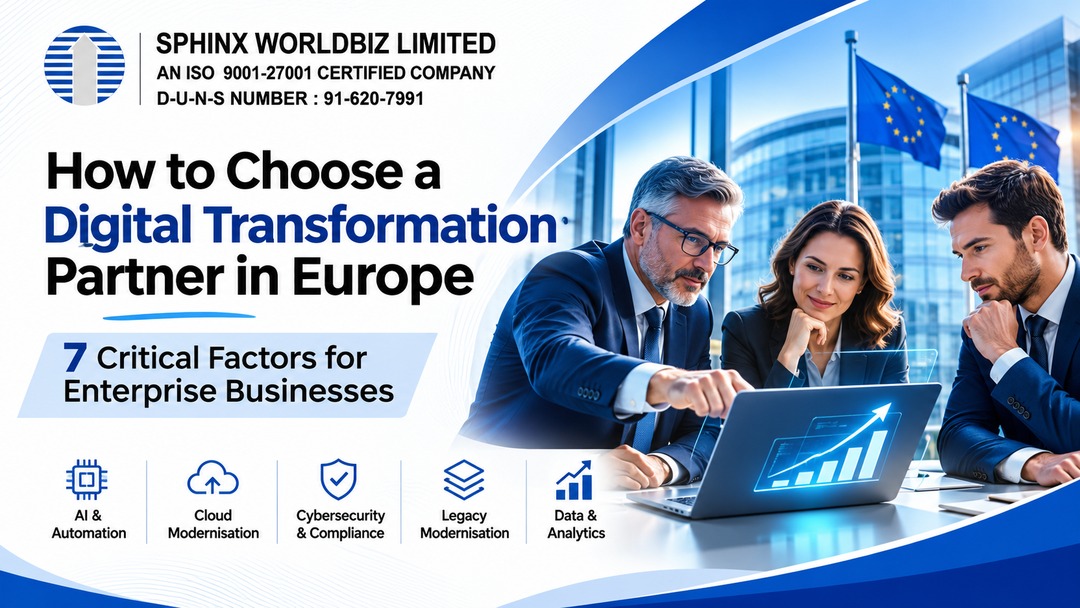
This guide explains seven critical factors European enterprises should evaluate before choosing a digital transformation company.
Why European Businesses Need a Different Approach to Digital Transformation
Imagine running a manufacturing business with production systems that cannot communicate with inventory software.
Your finance team maintains separate spreadsheets. Your operations managers rely on manual reporting. Customer information sits across different platforms. Meanwhile, leadership expects faster decisions and lower operating costs.
Adding another software platform will not automatically solve these problems.
The real opportunity is to connect your technology, data and business processes into one coordinated operating environment.
European enterprises face several interconnected challenges:
- Legacy technology: Older applications and infrastructure make integration, maintenance and innovation increasingly difficult.
- Rising operational costs: Manual processes, fragmented systems and inefficient infrastructure consume valuable resources.
- AI adoption challenges: Many organisations experiment with AI but struggle to move beyond isolated pilots.
- Data fragmentation: Business intelligence becomes unreliable when information is distributed across disconnected systems.
- Cybersecurity and compliance: Digital programmes must consider GDPR, NIS2, DORA and applicable EU AI Act requirements.
- Skills shortages: Organisations need access to specialised engineering, cloud, cybersecurity and AI capabilities.
A successful digital transformation strategy addresses these challenges together rather than treating every technology investment as an independent project.
Explore how Sphinx Worldbiz approaches digital transformation for European enterprises.
7 Factors to Consider When Choosing a Digital Transformation Partner in Europe
Choosing a transformation partner should never be based on the cheapest proposal or the longest list of technologies.
The right partner must understand the commercial problem, recommend an appropriate solution, implement it responsibly and measure the results.
Here are seven factors worth evaluating.
1. Enterprise AI and Intelligent Automation Expertise
Artificial intelligence has moved beyond experimentation. Businesses are exploring practical applications across finance, customer service, procurement, manufacturing, supply chains and internal operations.
However, deploying an AI chatbot is not the same as implementing enterprise AI.
A capable digital transformation partner should understand:
- Generative AI and enterprise AI integration.
- AI agents and intelligent digital workers.
- Machine learning and predictive analytics.
- Enterprise copilots and knowledge management.
- AI-powered business process automation.
- AI governance, human oversight and security.
For example, a European logistics company might use AI to analyse delivery information, identify potential delays and help operations teams make faster decisions.
A manufacturing business could use predictive analytics to identify equipment performance patterns and support proactive maintenance.
The objective should always be business improvement, not implementing AI simply because it is popular.
Businesses exploring these capabilities can learn more about AI and Machine Learning solutions and Generative AI Development Services.
For organisations looking to automate more complex business workflows, AI Agent Development Services can also be relevant.
Questions to ask a potential AI transformation partner:
- Can you integrate AI with our existing enterprise applications?
- How do you protect confidential business information?
- How do you evaluate AI accuracy and performance?
- Can you move an AI proof of concept into production?
- How will we measure the financial and operational impact?
A partner that understands both AI engineering and business operations is better positioned to deliver meaningful results.
2. Proven Legacy System Modernisation Capabilities
Many established European businesses depend on applications that were developed years or even decades ago.
These systems may still support essential operations, but they often create technical limitations.
Common warning signs include:
- Expensive maintenance and infrastructure.
- Limited integration with modern applications.
- Slow software release cycles.
- Difficulty scaling across business locations.
- Dependency on outdated technologies.
- Increasing security and operational risks.
Replacing every legacy system at once is rarely the best approach.
A good modernisation partner should first understand the existing technology environment and identify which systems need migration, integration, redevelopment or optimisation.
Depending on business requirements, modernisation could involve API-led integration, application redevelopment, microservices, cloud-native architecture or phased migration.
The most important consideration is business continuity.
Your organisation should be able to modernise its technology without unnecessarily disrupting customers, employees or daily operations.
Discover how Legacy Application Modernisation can help businesses address outdated technology and application limitations.
Where existing software cannot meet specific business requirements, Custom Software Development Services can help build applications around enterprise workflows, integrations and scalability requirements.
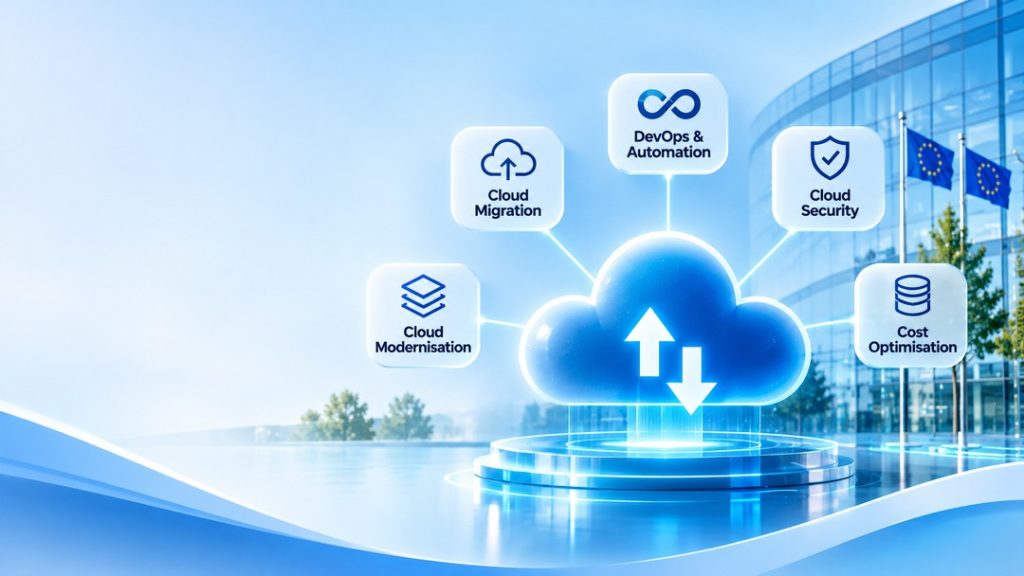
3. Cloud, DevOps and Infrastructure Engineering
Cloud migration is often a major part of enterprise digital transformation.
But moving applications to the cloud without a proper strategy can simply transfer existing inefficiencies into a different environment.
European businesses should evaluate whether a partner can support:
- Cloud migration and modernisation.
- Cloud-native application development.
- Infrastructure automation.
- DevOps and CI/CD implementation.
- Cloud security and resilience.
- Infrastructure monitoring.
- FinOps and cost optimisation.
For example, a growing European retailer may need infrastructure that can handle seasonal traffic without paying for unnecessary resources throughout the year.
Similarly, a logistics organisation operating across multiple countries may require reliable applications, integrated systems and scalable infrastructure.
The right cloud strategy should balance performance, security, scalability and long-term operating costs.
Explore Cloud Services for European Enterprises to understand how cloud consulting, migration, DevOps, security and managed cloud services support business modernisation.
You can also explore Cloud Consulting Services and Cloud Migration Services for specific infrastructure requirements.
4. Data Engineering and Business Intelligence Capabilities
Businesses cannot make reliable decisions when their data is incomplete, inconsistent or scattered across departments.
This is particularly important for organisations operating across several countries, locations and business units.
A digital transformation partner should be able to build an integrated data environment that supports:
- Enterprise data integration.
- Data engineering and data pipelines.
- Data governance and quality.
- Business intelligence dashboards.
- Predictive analytics.
- Real-time reporting.
- AI-ready data platforms.
Consider a manufacturing company operating multiple production facilities.
If each facility maintains separate production records, leadership may struggle to compare performance, identify inefficiencies or forecast demand.
A unified data platform can help bring operational information together and give management a clearer view of business performance.
The goal is simple: turn disconnected information into useful business intelligence.
Explore Big Data and Data Science Services to understand how enterprise data can support analytics, predictive insights and better decision-making.
5. European Cybersecurity and Regulatory Awareness
Technology modernisation creates opportunities, but it also introduces new security and governance considerations.
For European organisations, compliance cannot be treated as an afterthought.
Depending on the organisation, industry and use case, relevant frameworks and regulations may include:
- GDPR: Personal data protection and privacy obligations.
- NIS2: Cybersecurity and risk-management requirements for entities within its scope.
- DORA: Digital operational resilience requirements for financial entities within its scope.
- EU AI Act: Requirements relating to AI systems, depending on their classification and use.
A capable transformation partner should understand how security, privacy, governance and risk management fit into technology architecture.
Look for experience with:
- Secure-by-design engineering.
- Zero Trust architecture.
- Identity and access management.
- Data protection and encryption.
- Security monitoring.
- AI governance.
- Regulatory readiness assessments.
For organisations operating in financial services, manufacturing, automotive and critical infrastructure, these considerations can significantly influence technology decisions.
Explore Cybersecurity Services in Europe for enterprise cybersecurity, security assessments, cloud security and regulatory readiness capabilities.
Businesses specifically evaluating their cybersecurity obligations can also explore:
- NIS2 Compliance Services
- DORA Compliance Services
- GDPR Compliance Services
- Cybersecurity Consulting Services
For official regulatory information, consult the European Commission’s AI Act resources, GDPR information and NIS2 Directive resources.
A technology partner should support implementation and technical controls, while legal and compliance teams determine the organisation’s specific obligations.
6. Industry Experience and Engineering Capabilities
A technology provider may understand software development but still lack experience with the operational challenges of your industry.
This distinction matters.
A manufacturing business has different requirements from a bank. A logistics enterprise has different workflows from a retail organisation.
Before selecting a partner, evaluate its experience in your sector.
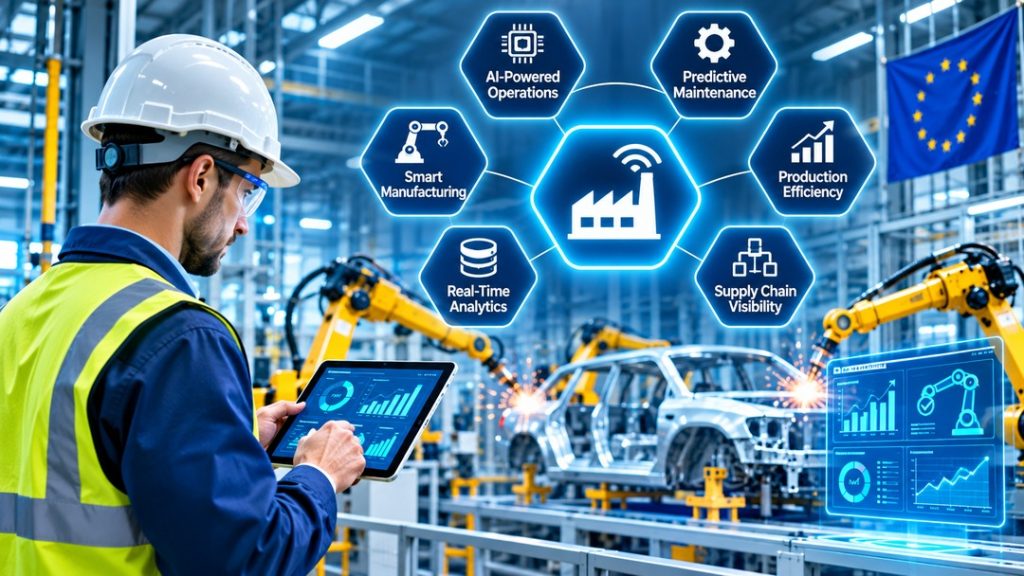
Manufacturing and automotive
Look for experience with production systems, engineering applications, predictive maintenance, industrial data and process automation.
Explore Manufacturing Industry IT Solutions for manufacturing technology capabilities.
Financial services
Evaluate data governance, application modernisation, cybersecurity, operational resilience and regulatory requirements.
Explore BFSI Industry Solutions for technology capabilities relevant to financial organisations.
Logistics and supply chain
Prioritise system integration, real-time visibility, workflow automation, cloud infrastructure and analytics.
Explore Logistics IT Solutions for logistics and supply chain technology solutions.
Energy and utilities
Look for capabilities in infrastructure modernisation, operational data, security and resilient enterprise applications.
Explore Renewable Energy Technology Solutions for relevant industry capabilities.
The strongest partners combine software engineering with an understanding of how businesses actually operate.
7. Measurable ROI, Delivery Transparency and Long-Term Support
Digital transformation should produce measurable business outcomes.
Before signing a contract, ask how the provider will evaluate project success.
Possible KPIs include:
- Reduction in manual processing time.
- Lower infrastructure and maintenance costs.
- Faster application release cycles.
- Improved system availability.
- Reduced operational downtime.
- Better data accuracy.
- Faster customer response times.
- Improved employee productivity.
For example, a company automating invoice processing should measure processing time, exception rates and cost per invoice before and after implementation.
A cloud migration project should evaluate infrastructure spending, availability, performance and operational resilience.
Avoid accepting vague promises such as guaranteed productivity improvements without a clear baseline, measurement methodology and agreed project scope.
The right partner should explain what will be delivered, when it will be delivered, how success will be measured and what happens after implementation.
Digital Transformation Partner vs Traditional IT Outsourcing: What Is the Difference?
These two models are not interchangeable.
Traditional IT outsourcing generally focuses on providing technical resources, application maintenance, support or specific development services.
A digital transformation partner takes a broader view. The engagement can include business assessment, technology strategy, architecture, engineering, integration, implementation and continuous optimisation.
The distinction is not that one model is universally better. It is whether the engagement matches the business problem.
For example, if your organisation only needs additional developers for an existing project, Resource Augmentation Services may be sufficient.
If you need to modernise multiple business systems, integrate enterprise AI, improve data infrastructure and redesign workflows, a broader transformation partnership may be more appropriate.
What Does Digital Transformation Cost for a European Enterprise?
There is no reliable universal price for enterprise digital transformation.
The investment depends on the size of the organisation, the number of applications involved, existing technical debt, integration requirements, security considerations and the scope of implementation.
A small workflow automation initiative and a multi-country enterprise modernisation programme should not be compared using the same budget assumptions.
Before evaluating proposals, establish:
- The current technology environment.
- The business processes that need improvement.
- The applications and systems requiring integration.
- The security and compliance requirements.
- The expected business outcomes.
- The implementation phases and resource requirements.
Ask potential partners to separate discovery, architecture, implementation, infrastructure and ongoing support costs.
A phased roadmap can help leadership prioritise high-value initiatives before committing to a larger transformation programme.
How Sphinx Worldbiz Helps European Enterprises Transform
Choosing a digital transformation partner is ultimately about finding a team that can connect business strategy with practical engineering execution.
Sphinx Worldbiz works across AI, cloud, cybersecurity, data engineering, application modernisation and custom software development to help organisations address complex technology and operational challenges.
With 29+ years of engineering and IT expertise, 800+ pre-vetted engineers and technologists, and a published client retention rate of 86%, Sphinx positions itself as an engineering-led technology transformation partner.
Its approach is built around understanding existing business environments, identifying opportunities and implementing solutions that support measurable outcomes.
End-to-End Digital Transformation Capabilities
Enterprise AI and Machine Learning
Build enterprise AI capabilities through Generative AI, AI agents, machine learning, intelligent automation and enterprise copilots.
Explore AI and Machine Learning, Generative AI Development and AI Agent Development.
Legacy and Application Modernisation
Modernise existing applications and enterprise systems through integration, redevelopment and scalable architectures.
Explore Legacy Application Modernisation and Custom Software Development.
Cloud and DevOps Engineering
Support cloud adoption, infrastructure modernisation, platform engineering, deployment automation and cloud optimisation.
Explore Cloud Services Europe and Cloud Consulting.
Data and Analytics Engineering
Connect fragmented data environments and build integrated platforms for reporting, analytics and informed business decisions.
Explore Big Data and Data Science.
Cybersecurity and Digital Resilience
Integrate cybersecurity, Zero Trust principles and security-conscious engineering into digital transformation programmes.
Explore European Cybersecurity Services and NIS2 Compliance Services.
Digital Transformation Strategy and Consulting
Assess existing technology environments, identify opportunities and create a phased transformation roadmap aligned with business priorities.
Discover Digital Transformation Services.
What Makes Sphinx Worldbiz Different?
Sphinx combines engineering expertise with a transformation-focused approach.
Its differentiators include:
- Almost three decades of engineering and IT experience.
- Access to 800+ pre-vetted engineers and technologists.
- European presence in Germany and Sweden.
- TISAX® assessed, ISO-certified and TÜV-recognised positioning as stated on its website.
- GDPR-conscious delivery and EU AI Act-aligned governance positioning.
- Experience across manufacturing, automotive, engineering and enterprise technology.
- A vendor-neutral, outcome-focused approach.
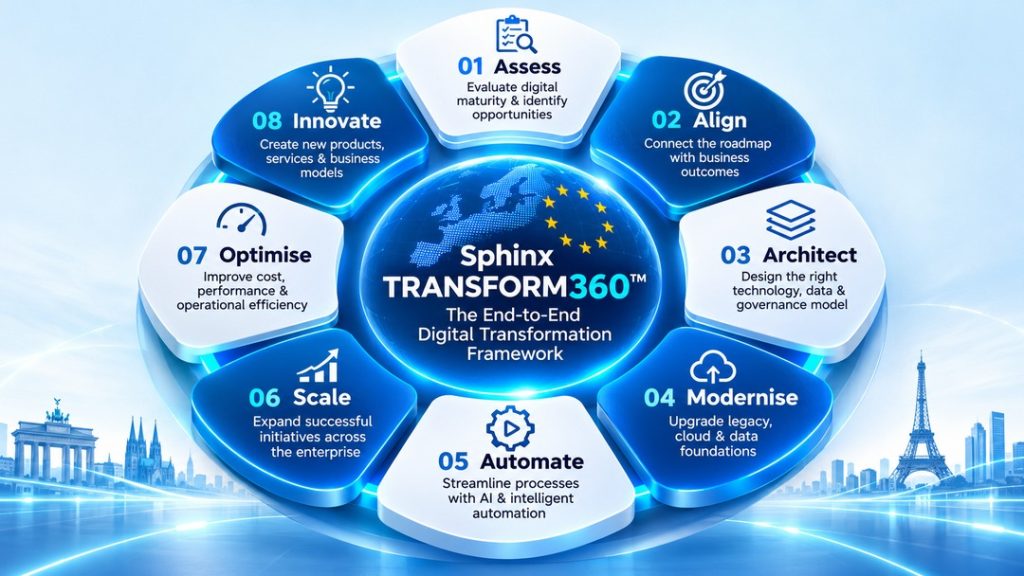
The company also uses its Sphinx TRANSFORM360™ methodology to structure the transformation journey.
The eight stages are:
- Assess: Understand digital maturity and business opportunities.
- Align: Connect the roadmap with business outcomes.
- Architect: Define the future technology architecture and governance.
- Modernise: Improve legacy, cloud and data foundations.
- Automate: Prioritise high-value workflows.
- Scale: Expand successful initiatives across the organisation.
- Optimise: Improve cost, performance and efficiency.
- Innovate: Support new products, services and business models.
Rather than treating transformation as a one-time technology implementation, the approach focuses on continuous business improvement.
European Enterprise Transformation: Examples of Business Outcomes
The Sphinx Worldbiz Europe landing page presents several transformation case studies.
These examples illustrate how different technology investments can address specific operational challenges.
AI-powered manufacturing transformation for a German OEM
The published case study describes AI-powered predictive maintenance, a unified manufacturing data platform and real-time analytics.
Reported outcomes include:
- 38% reduction in unplanned downtime.
- 27% improvement in production efficiency.
- ROI within 14 months.
Cloud and application modernisation for a European logistics enterprise
The published case study describes cloud-native application modernisation, DevOps automation and migration of core applications.
Reported outcomes include:
- 32% reduction in infrastructure costs.
- 60% faster release cycles.
- 99.95% platform availability.
Cyber resilience and data modernisation for a European financial services provider
The published case study describes enterprise data modernisation, Zero Trust security architecture and automated threat monitoring.
Reported outcomes include:
- 65% reduction in security incident response time.
- 45% improvement in reporting accuracy.
- Regulatory readiness in nine months.
These are outcomes reported on the Sphinx Worldbiz Europe Digital Transformation page. Organisations evaluating similar projects should request the relevant full case studies and methodology to understand the scope and measurement behind each result.
Questions to Ask Before Choosing Your Digital Transformation Partner
Before signing a transformation agreement, make sure your leadership team can answer these questions:
- Does the partner understand our industry and existing technology environment?
- Can they implement enterprise AI beyond proof-of-concept projects?
- Can they modernise legacy systems without unnecessarily disrupting operations?
- Do they have the cloud, cybersecurity and data engineering capabilities we need?
- How will they address applicable European data protection and regulatory requirements?
- Can they demonstrate relevant project outcomes?
- How will project performance, costs and ROI be measured?
- Will they support the organisation after implementation?
A partner that can answer these questions clearly is more likely to be prepared for the realities of enterprise transformation.
Frequently Asked Questions
What is a digital transformation partner?
A digital transformation partner helps businesses modernise technology, improve business processes and adopt digital capabilities such as enterprise AI, cloud computing, data engineering and intelligent automation. The engagement can cover strategy, architecture, development, implementation and ongoing optimisation.
How do I choose a digital transformation company in Europe?
Evaluate the company’s engineering expertise, industry experience, AI capabilities, cloud and application modernisation services, cybersecurity knowledge, delivery model and measurable project outcomes. Also consider its understanding of European business and regulatory requirements.
What services should a digital transformation partner provide?
Depending on your requirements, services may include digital transformation consulting, enterprise AI, machine learning, application modernisation, cloud migration, DevOps, data engineering, business intelligence, cybersecurity and workflow automation.
How long does an enterprise digital transformation project take?
The duration depends on the scope and complexity. A focused automation initiative may take considerably less time than a multi-system enterprise transformation. Large programmes are often delivered in phases, with milestones and measurable outcomes established throughout the project.
Can businesses modernise legacy systems without replacing everything?
Yes. Modernisation can involve API integration, application redevelopment, cloud migration, architecture improvements or selective replacement. The right approach depends on the existing systems, operational dependencies, cost and business priorities.
Why is AI important for digital transformation?
AI can help automate repetitive tasks, analyse business information, support forecasting, improve customer interactions and assist employees with decision-making. Its value depends on suitable data, integration, governance and clearly defined business use cases.
How do GDPR, NIS2, DORA and the EU AI Act affect digital transformation?
These regulations create different obligations for organisations and technology use cases within their respective scopes. Digital transformation programmes should consider data protection, cybersecurity, operational resilience and AI governance during architecture and implementation rather than addressing them only at the end.
Why consider Sphinx Worldbiz for digital transformation?
Sphinx Worldbiz offers capabilities across enterprise AI, cloud, cybersecurity, data engineering, application modernisation and custom software development. Its engineering-led approach, European presence, published industry case studies and TRANSFORM360™ methodology provide a foundation for evaluating it as a potential transformation partner.
Your Next Digital Transformation Decision Starts with the Right Roadmap
Technology investments should solve business problems, not create more complexity.
If your organisation is dealing with legacy applications, fragmented data, rising IT costs, manual workflows or uncertainty around enterprise AI adoption, the next step should be understanding where transformation can deliver the greatest business value.
Sphinx Worldbiz offers a complimentary Executive Digital Transformation Strategy Workshop for European CIOs, CTOs, COOs and transformation leaders.
The workshop is designed to help your team:
- Identify opportunities for enterprise AI and intelligent automation.
- Evaluate legacy modernisation and cloud requirements.
- Prioritise technology investments.
- Explore operational efficiency and ROI opportunities.
- Understand relevant cybersecurity and governance considerations.
- Develop a practical transformation roadmap.
No cost. No obligation. You keep every deliverable.
Ready to Move from Technology Challenges to Business Advantage?
Partner with an engineering-led team that understands the connection between technology, operations and business growth.
Book Your Free Executive Transformation Strategy Workshop with Sphinx Worldbiz.
Explore Digital Transformation Services in Europe
Start with a conversation. Build a roadmap. Transform with purpose.