







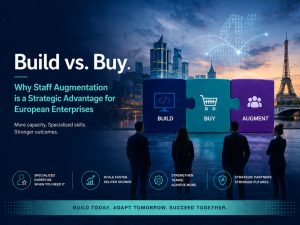
European companies are investing heavily in the fields of AI, Cloud, Data, Cybersecurity, and Digital Transformation. However, the greatest challenge isn’t merely one of choosing technology for implementation; for many organizations, it’s the question of whether to implement it. It’s identification of the right people to bring in with the right skill sets to execute it within a timely and effective manner.
It’s presenting a new challenge for tech leaders.
Is it better for an organisation to develop its own capacity or not? Should it buy an existing solution? Or should it complement its existing engineering staff with expert service?
For years, the build versus buy question has been the enterprise technology strategy question. There is a third option, however, that should be far more considered today, and that’s strategic staff augmentation.
Staff augmentation can be an effective solution for complex transformation projects that require additional technology skill sets and are under tight timelines and delivery targets in today’s fast-paced business environment, particularly for European companies.
The question is not whether:
Should we build or buy?
It is increasing:
What skills should we have, what skills should we learn and where should we place the right skills?
Europe’s Digital Ambition Is Growing Faster Than Its Talent Pool
There is a close correlation between the need for flexible technology talent and Europe’s overall digital transformation agenda.
The European Commission’s 2025 State of the Digital Decade report noted that, while businesses across Europe are increasing the use of AI, cloud and big data, there is still a need for the progress to step up a gear. Meanwhile, less than half of Europeans possessed at least the basic digital skills, and the number of ICT ‘experts’ (with higher skills) was low, raising concerns in the areas of artificial intelligence and cybersecurity.
The latest European Commission 2026 State of the Digital Decade update shows the scale of the challenge even more clearly. Nearly 20% of EU enterprises are now deploying AI, while 46.7% use cloud computing and 39.9% use data analytics. Yet ICT specialists represented only around 5% of EU employment in 2025, approximately half of the EU’s 2030 target of 10%.
The result is a growing gap between technology ambition and execution capacity.
Build vs. Buy: The Traditional Enterprise Technology Decision
It is not a new concept that the build or buy approach is being considered. Enterprise technology leaders have always considered two big decisions.
Build
Build in-house when capability is strategically significant, highly differentiated and tightly connected with proprietary IP.
For instance, an enterprise can decide to construct:
- An AI application designed by the company itself
- An industry-specific platform
A truly personalized experience for the customer captures custom data and analytics features
- Proprietary business logic
- Specialized engineering solutions
The benefit is that you will have control. The organization owns the architecture, the IP and product direction.
But software isn’t the only thing you need to build. It demands high-level engineers, solution architects, product managers, cybersecurity experts, DevOps skills, testing and continual maintenance.
The cost of building is not solely restricted to the commencement of development. This accounts for the ongoing expense of sustaining and extending the capability.
Buy
Buy when the capability is already available as a mature, scalable product or service.
Examples include:
- Enterprise SaaS
- CRM platforms
- ERP systems
- Cloud infrastructure
- Collaboration platforms
- Standard cybersecurity tools
- Observability platforms
By purchasing, implementation time can be shortened and there is no need to re-invent existing capabilities that are already available in the market.
But buying doesn’t eliminate the need for engineering talent.
Someone still needs to:
- Integrate systems
- Configure platforms
- Migrate data
- Build APIs
- Customize workflows
- Manage cloud infrastructure
- Secure environments
- Maintain integrations
That is why the build vs. buy decision isn’t the answer to enterprise talent issues.
Despite the organization’s purchasing technology, it is also required to have staff who can make that technology functional in the organization’s context.
The Missing Third Option: Augment
This is where staff augmentation becomes strategically relevant.
Staff augmentation is the solution where an organization adds external people to their existing team to provide expertise, skills, and experience to complement their in-house capabilities.
The goal isn’t to replace the internal workforce.
It is to increase the organization’s capacity to execute.
Imagine a European enterprise preparing for a major cloud migration.
It has an in-house team that is well-versed in business, architecture and operational environment. The company, however, does not have enough AWS professionals, DevOps, and cloud security professionals to meet its migration schedule.
The organization has several choices.
It could hire permanent employees.
It could outsource the entire project.
It could also supplement its staff of engineers with specialized engineers who can participate in the delivery for a period.
The third option provides something increasingly valuable:
Access to specialized engineering capacity when business needs it.
This is particularly relevant in a technology environment where skill requirements change rapidly.
Why Staff Augmentation Is Becoming Strategic
Previously, the concept of staff augmentation was limited to filling in temporary vacancies as a temporary measure.
That’s all changing.
In the modern business landscape, augmentation can be part of a bigger workforce and technology strategy.
- Access Specialized Skills Faster
Nowadays, technology is changing quicker than the hiring process.
There is special expertise required for AI, cloud consulting, cybersecurity, data engineering, and platform engineering.
If there simply isn’t enough staff to meet the demands of a project, staff augmentation can help companies gain the necessary skills sooner.
This is particularly true where the inability to quickly identify talent can slow down a whole transformation program.
- Scale Engineering Capacity Around Business Demand
Technology workloads are rarely constant.
A company may require a larger team during:
- Cloud migration
- Product development
- Application modernization
- AI implementation
- ERP transformation
- Cybersecurity programs
Once the project reaches a different phase, the required team composition may change.
With strategic augmentation, businesses can scale their staffing up or down based on the demand for delivery, rather than keeping a similar workforce even when there is no such need.
This results in a more flexible engineering team.
- Reduce the Pressure of Permanent Hiring
For many critical jobs, it is important to hire permanent workers.
But not all technology demands must be a long-term hiring decision.
For instance, one organisation could be looking for five more cloud engineers to complete a big migration program but do not need all five roles once migration has been completed.
Organizations can turn to staff augmentation to obtain those skills for the length of time they need them.
The strategic part is flexibility.
The organization keeps its basic in-house skills and has the flexibility to acquire special skills when necessary.
Where Staff Augmentation Creates the Most Value
One of the most useful applications of staff augmentation is in technology projects where niche expertise is limited or the needs of the project are constantly evolving.
- AI and Machine Learning
Organizations may need AI engineers, ML specialists, data scientists, MLOps engineers and GenAI experts to move from experimentation to production.
- Cloud and DevOps
Cloud migration and modernization require expertise across architecture, infrastructure-as-code, Kubernetes, CI/CD, observability and cloud security.
- Application Modernization
Legacy systems are frequently composed of a mixture of domain and contemporary engineering expertise.
- Cybersecurity
Cloud security, SOC operations, identity, threat detection and Zero Trust architecture are some of the skills that may be needed for security transformation programs.
- Data Engineering
Data expertise is needed for data architecture, pipelines, analytics, and data governance and readiness for AI.
- Product Engineering
In the case of a digital product, a company that is launching or scaling up in size may require more software engineers, more QA specialists, more UX professionals, and more technical architects without expanding all the functions.
Why European Enterprises Choose Sphinx for Strategic Staff Augmentation
For Sphinx, the process of staff augmentation isn’t just about providing extra resources.
It’s about closing the technology ambition/engineering capacity gap within enterprises.
European organisations can use Sphinx to augment their teams of specialized technology experts to meet the project and transformation needs of the specific situation.
The focus is on enabling organizations to:
- Access Specialized Engineering Talent
Hire specialists from software engineering, cloud, DevOps, AI/ML, data, cybersecurity and other technology fields as needed for the project.
- Scale Teams Faster
Expand engineering capacity, when necessary, due to project deadlines or transformation programs or product roadmaps.
- Work Alongside Existing Teams
Sphinx’s augmented professionals can work within the current delivery structure, engineering processes and collaboration practices instead of being an outside entity.
- Support Complex Transformation Programs
Extending teams for cloud modernization, application development, legacy transformation, AI adoption, cybersecurity initiatives and other technology programs.
- Maintain Greater Delivery Control
Organizations retain ownership of product direction, architecture and strategic decisions while gaining access to additional engineering capacity.
- Build Long-Term Engineering Capability
Effective augmentation shouldn’t only solve today’s resource gap. It should assist organizations to build delivery capacity, create knowledge sharing and technical maturity with time.
Concluding Thoughts
Build vs. Buy is not the only issue in enterprise technology’s future. Staff augmentation is a flexible solution that provides businesses in Europe with access to specialized skills, rapid staffing and the ability to speed up digital transformation.
The smartest strategy is simple: Build what differentiates you, Buy what is already solved, and Augment where additional expertise can help you move faster.
When combined with the right partner, staff augmentation is more than just a hiring model; it’s a strategic asset for realizing technology vision into business results.