







Cloud computing is the driver of the digital economy in Europe. Organizations, from financial institutions and healthcare providers to manufacturing firms and government bodies, are quickly turning to the cloud to gain scalability, save infrastructure expenses, and speed up their digital transformation.
Several factors are shaping the market to a new growth stage, including artificial intelligence (AI), edge computing, data sovereignty enforcement, and growing enterprise cloud adoption. Europe is one of the world’s swiftest cloud markets as organizations move to modernize their legacy IT infrastructure.
The Europe cloud services market is projected to grow significantly in the coming years, driven by growing investments in digital infrastructure and enterprise cloud adoption, according to recent industry research.
Europe Cloud Computing Market Size
Industry estimates are that strong double-digit growth is expected for the European cloud market in the forecast period.
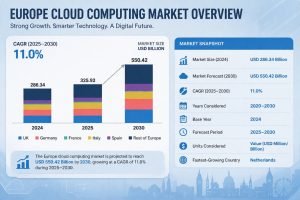
According to MarketsandMarkets the market is expected to expand from about USD 325.92 billion in 2025 to USD 550.42 billion by 2030 at a Compound Annual Growth Rate (CAGR) of 11.0% during the forecast period.
According to Fortune Business Insights, the market is projected to grow from USD 177.14 billion in 2025 to USD 525.42 billion by 2032, growing by 16.8% CAGR. The variation in the market values is due to different research techniques, different definitions of the markets and different market segmentation.
No matter what approach, both reports show that growth is continuing and planned for the long term, in response to enterprise cloud adoption and the use of AI to transform digital.
Key Drivers Fuelling Market Growth
- Enterprise Digital Transformation
Organizations in Europe are transforming their IT infrastructure for increased agility, resilience and operation efficiency. Cloud platforms provide an ability to deploy applications rapidly, scale resources when needed, and lower capital expenses.
Industries leading to cloud adoption include:
- Banking and Financial Services (BFSI)
- Healthcare
- Manufacturing
- Retail
- Government
- Telecommunications
- Education
- Artificial Intelligence is Accelerating Cloud Demand
Generative AI has become one of the strongest catalysts for cloud adoption which can’t be denied seeing the progress of prominent brands.
AI applications require:
- Massive computing power
- GPU infrastructure
- High-performance storage
- Real-time data processing
As businesses deploy AI-powered analytics, chatbots, automation platforms, and machine learning models, demand for scalable cloud infrastructure continues to rise. Fortune Business Insights highlights AI integration and edge expansion as major growth drivers.
- Rising Adoption of Hybrid and Multi-Cloud Strategies
Organizations are increasingly adopting hybrid and multi-cloud environments rather than relying on a single provider.
Benefits include:
- Improved business continuity
- Reduced vendor lock-in
- Better compliance
- Workload optimization
- Enhanced disaster recovery
This strategy is particularly attractive for highly regulated industries where certain workloads must remain on private infrastructure while others leverage public cloud services.
- Strong Focus on Data Sovereignty
Europe has some of the world’s strictest privacy and data protection regulations, including GDPR.
Read more to know more about GDPR. [GDPR Compliance AI Business]
As a result, enterprises increasingly seek:
- Sovereign cloud solutions
- Local data centers
- Regional cloud infrastructure
- Enhanced compliance capabilities
MarketsandMarkets identifies regulatory compliance and sovereign cloud adoption as important factors supporting market growth.
Service Models Driving Growth
The market is broadly segmented into three major service models.
- Infrastructure as a Service (IaaS)
IaaS continues to dominate enterprise infrastructure modernization by providing:
- Virtual servers
- Compute resources
- Storage
- Networking
- Disaster recovery
Organizations benefit from reduced hardware investments while maintaining flexibility.
- Platform as a Service (PaaS)
PaaS enables developers to build, deploy, and manage applications without maintaining underlying infrastructure.
Common applications include:
- Application development
- API management
- Database services
- AI development
- Data analytics
- Software as a Service (SaaS)
SaaS remains one of the fastest-adopted cloud segments.
Popular business applications include:
- CRM
- ERP
- Collaboration software
- HR management
- Productivity tools
- Email platforms
Its subscription-based pricing model makes SaaS particularly attractive for SMEs.
Some of the Most Promising Deployment Models
- Public Cloud
Public cloud continues to dominate due to:
- Lower costs
- Easy scalability
- Faster deployment
- Broad service availability
Fortune Business Insights notes that public cloud accounted for the largest share of the European market in 2024.
- Private Cloud
Private cloud remains essential for organizations requiring:
- High security
- Regulatory compliance
- Dedicated infrastructure
- Greater control over sensitive workloads
Industries such as banking, healthcare, and government continue to invest heavily in private cloud solutions.
- Hybrid Cloud
Hybrid cloud adoption is increasing rapidly because it combines the flexibility of public cloud with the control of private infrastructure.
How Cloud is an Integral Part of Industry Adoption
- Banking & Financial Services (BFSI)
Cloud computing is now being widely used in Banks and Financial Services in Europe. With cloud platforms, financial institutions can improve customer experience, bolster security measures, optimize operations, and harness the power of artificial intelligence to drive insights, all while meeting regulatory demands.
- Fraud detection
- Digital banking
- AI-powered customer support
- Risk management
- Payment processing
- Healthcare
The impact of cloud computing in the healthcare sector is reshaping the industry, facilitating secure data management, healthcare provider collaboration and advanced technology, such as AI and telemedicine. Hospitals and healthcare providers are adopting cloud solutions to provide patient care and increase efficiency.
- Electronic Health Records (EHR)
- Medical imaging
- Telemedicine
- AI diagnostics
- Patient analytics
- Manufacturing
Cloud technologies are being used by manufacturers to drive Industry 4.0 efforts, optimize production, and gain insights in their supply chains. Cloud-based analytics and IoT connectivity provide manufacturers with enhanced efficiency, lower downtime and smarter decision making.
- Smart factories
- IoT monitoring
- Predictive maintenance
- Supply chain optimization
- Digital twins
- Retail & E-commerce
Cloud computing helps retailers provide more individualized shopping experience, better inventory management, and facilitate omnichannel operations. In the case of cloud-based analytics, businesses can leverage real-time customer data to enhance customer engagement and sales.
- Personalized recommendations
- Inventory optimization
- Omnichannel commerce
- Customer analytics
- Real-time pricing
Cloud Emerging Trends to Watch Out For
- Edge Computing
As IoT devices generate enormous volumes of data, edge computing reduces latency by processing data closer to users.
Applications include:
- Autonomous vehicles
- Industrial automation
- Smart cities
- Manufacturing
- Healthcare
- AI-Powered Cloud Services
Cloud providers increasingly offer integrated AI services such as:
- Large Language Models
- AI assistants
- Automated analytics
- Machine learning platforms
- Intelligent document processing
- Sustainability
European enterprises are prioritizing green cloud initiatives through:
- Energy-efficient data centers
- Renewable energy usage
- Carbon footprint reduction
- Sustainable IT operations
Challenges Facing the Market
Despite strong growth prospects, several challenges remain:
- Cybersecurity
Organizations continue investing in different cybersecurity services to safeguard their business operations.
- Zero Trust architecture
- Identity management
- Cloud security platforms
- Encryption
- Threat detection
- Compliance Complexity
Along with GDPR, businesses that want to conduct their operations in several European countries are required to follow the national regulations of each country.
- Skills Gap
There is still a high demand for cloud architects, DevOps engineers, cyber security specialists, and AI professionals.
- Vendor Lock-In
For many businesses, they can use multiple cloud services to avoid relying on a single provider and to have more flexibility.
Conclusion
The European cloud computing market is poised for a transformative growth stage. Across all industries, companies are adopting cloud solutions to enhance their productivity, speed up their innovation and enable digital transformation with AI. Despite ongoing hurdles like cybersecurity, compliance and talent shortages, the market continues to be impressive, with continued investments in cloud infrastructure, sovereign cloud solutions and AI capabilities anticipated to keep the momentum going well into the next decade.
The way forward in Europe’s highly dynamic digital economy is those who are focused on scalable, intelligent, and secure cloud architecture as a strategic business need.