




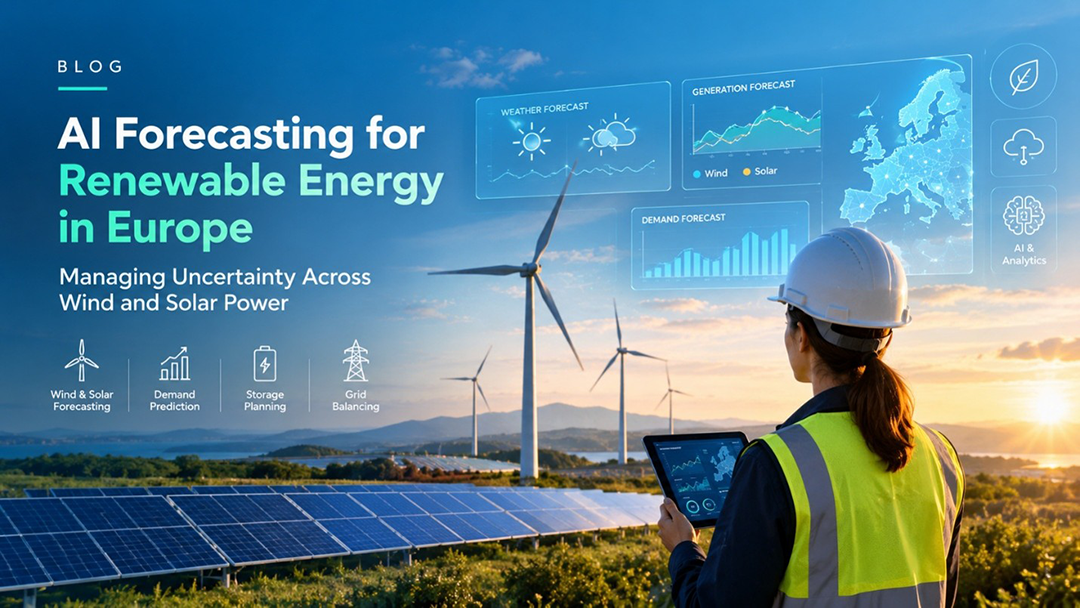

Europe’s transition towards renewable energy is changing how electricity is generated, distributed, stored, and consumed. As wind and solar power account for a growing share of the energy mix, renewable energy companies face an increasingly important challenge: predicting how much electricity will be available, when it will be generated, and how demand will change.
Weather-dependent generation, fluctuating electricity demand, grid constraints, and fragmented operational data can make these decisions difficult. Forecasting errors can complicate energy planning, increase balancing requirements, affect asset utilization, and create challenges for operators managing renewable energy portfolios across multiple locations.
Artificial intelligence (AI) and machine learning (ML) offer new ways to address these challenges. By analyzing weather forecasts, historical generation, sensor readings, and consumption patterns, AI-powered forecasting solutions can help energy companies anticipate changes, improve planning, and make more informed operational decisions.
However, successful AI adoption requires more than a forecasting model. Reliable data infrastructure, integration with existing systems, continuous model validation, and well-defined operational workflows are equally important.
For renewable energy companies across Europe, the opportunity lies in combining advanced AI technologies with digital transformation to build more responsive, data-driven energy operations.
Why Renewable Energy Forecasting Is Becoming More Important in Europe
Wind and solar energy production depends heavily on environmental conditions. Wind speed, cloud cover, solar irradiance, temperature, and seasonal variations all influence the amount of electricity renewable assets can generate.
Unlike conventional generation that can often be scheduled within defined operational limits, wind and solar output can change as weather conditions evolve. At the same time, electricity demand fluctuates with industrial activity, temperature, time of day, and consumer behavior.
This creates a forecasting challenge for renewable energy producers, grid operators, utilities, and energy traders.
Several factors make forecasting increasingly important for Europe’s energy sector.
- Increasing Dependence on Weather-Driven Generation
As renewable generation expands, operators need dependable estimates of future wind and solar output. An unexpected reduction in wind speeds or a change in cloud cover can alter expected production and affect operational planning.
Forecasts that fail to capture these changes can leave operators with an inaccurate picture of available generation.
- Greater Complexity in Energy Balancing
Electricity supply and demand must remain balanced across the power system. Forecasting errors can make this task more difficult, particularly when renewable generation changes rapidly or demand deviates from expectations.
Better forecasts can help energy market participants and system operators prepare for expected imbalances and evaluate appropriate responses.
- Grid Constraints and Renewable Energy Curtailment
In some locations, renewable energy production can exceed the capacity available to transport or accommodate it. Network congestion and connection limitations can result in renewable electricity being curtailed.
AI forecasting cannot resolve grid capacity constraints on its own. However, improved visibility into expected generation, demand, and asset availability can support planning, flexibility management, and better-informed operational decisions.
- Growing Need for Energy Storage Coordination
Battery storage and other flexibility resources can help manage differences between renewable generation and electricity demand. Their effectiveness depends partly on anticipating when surplus energy may be available and when additional supply may be required.
Forecasting solutions can support storage scheduling by estimating future generation and demand, subject to market conditions, battery constraints, and grid requirements.
- Fragmented Operational Data
Renewable energy companies often collect information through multiple systems, including supervisory control and data acquisition (SCADA) platforms, weather services, IoT sensors, asset management software, and enterprise applications.
When these systems operate in silos, teams may struggle to build a consistent, timely view of energy production and operational conditions.
Connecting these data sources is an important step towards effective AI adoption.
How AI Improves Renewable Energy Forecasting
AI-powered renewable energy forecasting uses algorithms to analyze historical and real-time information, identify patterns, and estimate future outcomes.
Traditional forecasting methods remain valuable, particularly when supported by established physical models and meteorological expertise. AI can complement these methods by learning complex relationships across multiple variables and adapting as new data becomes available.
Depending on the use case, a forecasting solution may combine machine learning, time-series analysis, numerical weather prediction data, statistical models, and domain-specific rules.
The following applications illustrate how these capabilities can support renewable energy operations.
- AI-Powered Wind and Solar Generation Forecasting
Wind and solar operators need accurate estimates of future electricity production to plan operations, manage market commitments, and coordinate with other energy resources.
AI models can analyze historical generation data alongside weather forecasts, wind speed, solar irradiance, temperature, equipment characteristics, and current operating conditions.
For wind farms, these models can help estimate output under changing wind conditions. For solar installations, they can analyze the relationship between irradiance, cloud cover, temperature, and expected generation.
Forecasting systems can produce estimates for different time horizons, from short-term operational planning to longer-term scheduling and portfolio analysis.
How AI can help:
- Estimate expected wind and solar generation.
- Identify patterns associated with forecasting errors.
- Update predictions as new weather and sensor data becomes available.
- Compare expected output with actual generation.
- Provide uncertainty ranges to help teams evaluate different operational scenarios.
Forecasting performance depends on the quality and resolution of input data, the characteristics of individual assets, and the time horizon being predicted. Models should therefore be validated against actual operating conditions and reviewed as performance changes.
- Electricity Demand Forecasting and Consumption Analysis
Renewable energy planning requires an understanding of both available generation and expected demand.
Electricity consumption varies according to weather, industrial activity, occupancy patterns, seasonal changes, and other factors. These variations can affect the timing and volume of electricity required from different sources.
AI-based demand forecasting can analyze historical consumption, weather information, calendar patterns, and other relevant variables to estimate future demand.
For utilities and energy providers, these forecasts can support demand planning, procurement decisions, resource allocation, and the evaluation of flexibility requirements.
For renewable energy producers, demand insights can help contextualize generation forecasts and improve coordination with energy market participants.
Potential applications include:
- Short-term electricity demand prediction.
- Consumption pattern analysis across customer segments.
- Identification of unusual demand variations.
- Scenario modelling for changing weather conditions.
- Integration of demand forecasts with generation and storage planning.
Demand forecasts should be treated as decision-support inputs. Their usefulness depends on how well the models reflect the market, customer base, and operational conditions in which they are deployed.
- AI for Energy Storage Planning and Optimization
Battery energy storage systems can help address differences between renewable generation and demand. For example, surplus solar generation during the day may create an opportunity to store electricity for later use, depending on market prices, grid conditions, and storage availability.
AI forecasting can support these decisions by estimating future generation, consumption, and relevant market conditions.
When integrated with an optimization system, these forecasts can help operators evaluate charging and discharging schedules, expected storage requirements, and alternative operating scenarios.
AI-enabled storage planning can support:
- Forecast-based battery scheduling.
- Assessment of potential surplus renewable generation.
- Estimation of future storage requirements.
- Evaluation of alternative operating strategies.
- Coordination between generation forecasts and storage availability.
Forecasting alone does not determine the optimal storage schedule. Effective optimization also requires consideration of battery capacity, degradation, efficiency, operating constraints, market rules, and grid requirements.
- Grid Balancing and Renewable Energy Flexibility
Maintaining a balance between electricity supply and demand becomes more complex when generation and consumption change unpredictably.
AI forecasting can help operators anticipate changes in renewable output and demand before they occur. These estimates can support planning for balancing resources, evaluating flexibility options, and identifying periods when additional attention may be required.
For example, a forecast indicating a likely reduction in wind generation could help relevant teams assess alternative supply arrangements or flexibility resources. Similarly, expected surplus generation could inform decisions about storage or other available demand-side flexibility.
The practical value of AI lies in providing earlier and more useful information for operational decisions.
AI forecasting should complement established grid-management processes and validated control systems. Critical operational decisions must continue to follow applicable safety requirements, grid codes, and the authority of responsible operators.
- Predictive Analytics for Renewable Energy Asset Performance
Forecasting challenges are not limited to weather and electricity demand. Equipment availability and asset performance also influence how much electricity can be generated.
A wind turbine operating below expected performance, a solar inverter experiencing faults, or a component approaching failure can create a gap between forecast generation and actual output.
AI-based predictive analytics can combine equipment telemetry, maintenance history, alarms, and performance data to identify anomalies or patterns that may indicate emerging issues.
These insights can help maintenance teams investigate potential problems and prioritise inspections.
When generation forecasting and asset analytics are connected, operators can distinguish between output changes caused by weather and those potentially associated with equipment performance.
This can improve the quality of operational planning and help teams make more informed maintenance decisions.
The Data Foundation Behind Effective AI Forecasting
Even sophisticated AI models cannot compensate for consistently poor or incomplete data. Renewable energy companies need a reliable data foundation before forecasting solutions can deliver sustained operational value.
This is particularly important for organizations managing multiple wind farms, solar installations, storage assets, and legacy operational systems.
Connecting Data Across Energy Systems
Forecasting solutions may require information from:
- SCADA systems and operational sensors.
- Historical wind and solar generation records.
- Weather forecasts and meteorological datasets.
- Electricity consumption and demand records.
- Asset management and maintenance systems.
- Battery storage and energy management platforms.
- Relevant electricity market and pricing information.
These sources may use different data formats, update frequencies, identifiers, and integration methods. Data engineering can help standardize and connect them so forecasting models receive information in a consistent, usable format.
Improving Data Quality and Availability
Missing sensor readings, inconsistent timestamps, incorrect asset identifiers, and delayed weather updates can affect forecasting reliability.
Data validation, anomaly detection, timestamp alignment, and automated quality checks can help identify these issues before they affect model outputs.
Organizations should also establish appropriate controls for data access, lineage, retention, and monitoring.
Building Scalable Data Platforms
As forecasting expands across sites and asset portfolios, the underlying infrastructure must support larger datasets, repeatable processing, and reliable model deployment.
Cloud-based data platforms and well-designed integration architectures can help organisations scale these capabilities where appropriate, while accounting for data residency, cybersecurity, latency, cost, and operational requirements.
The objective is to create a dependable foundation on which AI models can be developed, evaluated, and maintained.
From AI Forecasts to Operational Decisions: Why Digital Transformation Matters
A forecasting model creates limited value if its output remains isolated in a technical dashboard or a standalone analytics environment.
To make AI useful, renewable energy companies need to connect predictions with the systems and workflows used by planners, engineers, asset managers, and operations teams.
Digital transformation helps establish this connection.
For example, a generation forecast could feed into an operational planning dashboard. A predicted deviation between expected and actual output could trigger an investigation. A demand forecast could inform a storage-planning workflow, while asset-performance insights could help maintenance teams prioritize inspections.
Achieving this requires integration between data platforms, AI models, operational applications, reporting tools, and business processes.
A practical digital transformation program should address three areas:
System integration: Connect relevant data sources and applications so teams can access consistent information.
Workflow integration: Make AI-generated insights available at the point where decisions are made, with appropriate review and approval processes.
Performance monitoring: Track forecasting accuracy, data quality, model drift, and the operational usefulness of predictions.
This approach helps renewable energy companies move from experimenting with AI to embedding data-driven capabilities into everyday operations.
How Sphinx Worldbiz Can Help Renewable Energy Companies Apply Advanced AI
For renewable energy organizations across Europe, adopting AI forecasting requires a combination of AI engineering, data integration, analytics, and digital modernization. The challenge is not simply developing a predictive model; it is making that model work with the organization’s existing systems, available data, and operational requirements.
Sphinx Worldbiz can support this journey through its AI, data, cloud, and digital transformation capabilities, helping organizations build technology solutions aligned with their business objectives.
AI and Machine Learning Development
Sphinx can help organizations evaluate forecasting use cases and develop AI/ML solutions suited to their data and operational needs.
Potential applications include wind and solar generation forecasting, electricity demand prediction, anomaly detection, and predictive analytics.
The approach should begin with a clearly defined business problem, an assessment of available data, and measurable evaluation criteria. Models can then be tested against historical observations and validated using data that was not used during training.
Data Engineering and Platform Integration
Sphinx can help connect information from operational systems, IoT devices, weather datasets, and enterprise applications to support AI-driven analysis.
Data engineering initiatives can include data pipelines, transformation processes, quality validation, and the integration of relevant sources into analytics-ready platforms.
This creates a stronger foundation for forecasting solutions and helps reduce the fragmentation that can limit AI adoption.
Advanced Analytics and Decision Support
AI predictions become more useful when decision makers can interpret them and understand their implications.
Sphinx can support the development of analytics solutions and dashboards that help teams examine generation forecasts, compare expected and actual performance, identify patterns, and evaluate operational scenarios.
Depending on the use case, these capabilities can support energy planning, asset management, and storage-related decisions.
Cloud and Digital Transformation
Renewable energy organizations may need to modernize data infrastructure, integrate legacy applications, or deploy scalable analytics capabilities across distributed operations.
Sphinx can support digital transformation initiatives that connect AI applications with enterprise systems and appropriate cloud infrastructure.
This may include application integration, data platform modernization, workflow automation, and the technical foundations required to operate and maintain AI solutions.
From Proof of Concept to Sustainable Adoption
An AI proof of concept can demonstrate technical feasibility, but operational adoption requires additional work.
Models must be monitored, data pipelines maintained, integrations tested, and outputs evaluated as weather patterns, equipment, and operational conditions change.
Sphinx can help organizations plan this progression by connecting AI development with integration, deployment, monitoring, and ongoing improvement requirements.
The appropriate solution will depend on each organization’s existing technology environment, data maturity, security requirements, and operational priorities.
The objective is to help renewable energy companies turn available data into practical intelligence that supports better forecasting, more informed planning, and stronger operational decision-making.
A Practical Roadmap for AI Forecasting in Renewable Energy
Renewable energy companies do not need to transform every forecasting process at once. A phased approach can help them demonstrate value, understand implementation requirements, and expand successful use cases.
Step 1: Identify the Highest-Value Forecasting Challenge
Begin by defining the problem. Is the priority improving short-term solar generation forecasts, anticipating wind output, predicting demand, or supporting storage planning?
A clearly defined use case makes it easier to select the required data, establish success criteria, and evaluate the potential business value.
Step 2: Assess Data Readiness
Review data availability, historical coverage, quality, update frequency, and integration requirements.
Determine whether the organization has sufficient data to train and evaluate a model and whether additional weather, sensor, or operational data is needed.
Step 3: Establish a Baseline
Compare existing forecasting methods with the proposed AI approach.
Select suitable evaluation metrics based on the use case. These may include mean absolute error, root mean squared error, or other measures that account for operational requirements and the consequences of forecasting errors.
Where possible, evaluate performance across different weather conditions, seasons, and forecast horizons rather than relying on a single overall accuracy score.
Step 4: Develop and Validate the Model
Build and test the model using appropriate historical datasets. Ensure that the evaluation process avoids data leakage and reflects the conditions under which the solution will operate.
Compare AI-based predictions with established forecasting approaches to determine whether the new model provides a meaningful improvement.
Step 5: Integrate Forecasts into Workflows
Connect model outputs to relevant dashboards, planning tools, and operational applications.
Define who will use the forecasts, how exceptions will be reviewed, and what decisions the outputs are intended to support.
Step 6: Monitor and Improve
Track forecast performance, data quality, and model behavior after deployment. Investigate changes in accuracy and retrain or adjust models when justified by evidence.
Regular reviews help ensure that the solution remains useful as assets, operating conditions, and data sources evolve.
Measuring the Business Value of AI Forecasting
The success of an AI forecasting initiative should be measured through operational outcomes, not simply model performance.
Depending on the application, renewable energy companies may monitor:
- Forecast accuracy: How closely predicted generation or demand matches observed outcomes.
- Planning effectiveness: Whether forecasts improve scheduling and operational preparation.
- Asset availability: Whether better-informed maintenance decisions contribute to reducing avoidable downtime.
- Storage utilization: Whether forecasts help improve storage scheduling within operational and market constraints.
- Decision-making time: Whether integrated data and analytics reduce manual effort in planning and reporting.
- Operational efficiency: Whether the solution contributes to measurable improvements in resource allocation or workflow execution.
The baseline, target, and measurement period should be defined before deployment. Any claimed improvement in cost, revenue, or operational performance should be validated against actual results and relevant external factors.
This discipline helps organizations distinguish technical progress from business value.
Conclusion: Building a More Predictable Renewable Energy Future in Europe
Europe’s renewable energy transition requires energy companies to manage a more dynamic relationship between generation, demand, storage, and grid capacity.
AI forecasting can help organizations anticipate changes in wind and solar output, estimate electricity demand, evaluate storage requirements, and support better-informed operational decisions. However, its effectiveness depends on reliable data, appropriate model validation, secure infrastructure, and integration with existing workflows.
For renewable energy companies, the next step is to identify where better forecasting can make a measurable difference and build the capabilities needed to put those insights into practice.
By combining AI/ML development, data engineering, advanced analytics, and digital transformation, Sphinx Worldbiz can help renewable energy organizations explore and implement solutions aligned with their operational needs.
The future of renewable energy is not only about generating cleaner electricity. It is also about using data intelligently to understand what comes next and prepare for it.
For energy producers, utilities, and renewable asset operators across Europe, AI forecasting can become an important part of that journey.
Frequently Asked Questions
- How is AI used in renewable energy forecasting?
AI analyses historical generation, weather forecasts, sensor data, and other relevant variables to estimate future wind and solar output. It can also support demand forecasting, asset-performance analysis, and energy storage planning.
- Why is renewable energy forecasting important in Europe?
Wind and solar generation depend on weather conditions, while electricity demand and grid constraints change over time. Better forecasting helps energy companies plan operations, assess flexibility requirements, and make more informed decisions about generation and storage.
- Can AI improve wind and solar power forecasting accuracy?
AI can improve forecasting performance in suitable use cases by identifying patterns across weather, generation, and operational data. Results depend on data quality, model design, forecasting horizon, and operating conditions, so performance must be validated against an appropriate baseline.
- How does AI forecasting support energy storage?
Forecasts of renewable generation, demand, and relevant market conditions can help operators evaluate when to charge or discharge batteries. Storage decisions must also account for battery constraints, efficiency, degradation, grid requirements, and market rules.
- What data is required for AI-based renewable energy forecasting?
Depending on the application, data may include historical generation, weather forecasts, wind speed, solar irradiance, temperature, operational sensor readings, electricity demand, asset information, and storage data. The required sources depend on the forecasting objective and the assets being managed.
- How can digital transformation support AI adoption in renewable energy?
Digital transformation connects operational data, AI models, enterprise applications, and decision-making workflows. It can help renewable energy companies integrate forecasts into planning processes, improve data availability, and monitor the performance of AI-driven solutions.
- How can Sphinx Worldbiz support AI adoption for renewable energy companies?
Sphinx Worldbiz can support renewable energy organizations through AI/ML development, data engineering, advanced analytics, cloud and application integration, and digital transformation. The scope of support depends on the organization’s specific use case, data readiness, and technology requirements.