






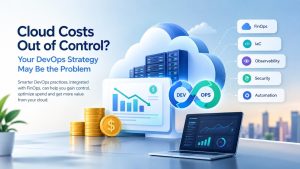
Moving workloads to the cloud can improve scalability, deployment speed, and operational flexibility. But there is another side to cloud adoption that organizations often discover later: rising and unpredictable infrastructure costs.
A cloud environment can scale in seconds. Resources can be provisioned automatically, applications can run across multiple regions, and development teams can create infrastructure whenever they need it. Without the right controls, however, this flexibility can also create idle resources, over-provisioned infrastructure, unnecessary storage, inefficient workloads, and unexpected cloud bills.
This is why cloud cost optimization should not be treated as a finance exercise performed at the end of the month.
It should be built into the DevOps strategy, cloud architecture, deployment process, and day-to-day engineering decisions.
What Is Cloud Cost Optimization?
Cloud cost optimization is the process of controlling and improving cloud infrastructure spending while maintaining the required performance, availability, security, and scalability.
It involves understanding where cloud resources are being consumed, identifying inefficiencies, and continuously adjusting infrastructure to match actual business and application requirements.
The objective is not simply to use fewer cloud resources.
The objective is to achieve the right balance between cost, performance, reliability, security, and scalability.
This distinction is important. Cutting infrastructure without considering application requirements can create performance problems. A mature cloud consulting services instead asks:
- Are resources being used efficiently?
- Are workloads correctly sized?
- Can infrastructure be scaled according to demand?
- Are unused resources being removed?
- Are development and testing environments running unnecessarily?
- Does every cloud resource have a clear owner?
- Can engineering teams see the cost impact of their infrastructure decisions?
Why DevOps Has a Direct Impact on Cloud Costs
DevOps is often associated with faster releases, automation, CI/CD, Infrastructure as Code, and operational reliability.
But every one of these practices can influence cloud consumption.
For example, automated deployment makes it easier to create environments. Infrastructure as Code makes infrastructure reproducible. Auto-scaling allows applications to respond to traffic. Containers make workloads portable and scalable.
These capabilities are valuable, but without appropriate governance they can also increase resource consumption.
Consider a simple scenario.
A development team creates a cloud environment for testing. The environment is needed for eight hours a day, but nobody configures an automated shutdown. The infrastructure remains active overnight, throughout weekends, and sometimes for weeks after the project changes.
The problem is not the cloud platform.
The problem is the DevOps process surrounding resource management.
This is where cloud cost optimization becomes an engineering responsibility.
7 DevOps Practices That Can Help Reduce Cloud Costs
- Right-Size Cloud Resources
One of the most common sources of cloud waste is running infrastructure that is larger than the workload requires.
A virtual machine may have significantly more CPU or memory than an application uses. Kubernetes’ workload may have unnecessarily high resource requests. Databases may be provisioned for peak capacity even when that level of usage is rare.
Right-sizing means continuously comparing:
Provisioned capacity → Actual utilization → Business requirement
Instead of selecting infrastructure based purely on maximum possible demand, teams can use usage data to determine what resources are actually required.
Right-sizing should be ongoing practice rather than a one-time optimization exercise.
- Use Auto-Scaling Intelligently
Cloud platforms make it possible to automatically increase or decrease resources based on demand.
This can help organizations avoid maintaining peak infrastructure capacity throughout the day.
For example:
Low traffic → Fewer resources
High traffic → More resources
Traffic decreases → Resources scale down
However, simply enabling auto-scaling does not guarantee cost efficiency.
Poorly configured scaling thresholds, excessive minimum capacity, inefficient workloads, or scaling based on the wrong metrics can still result in unnecessary spending.
DevOps teams should therefore monitor both performance and cost when designing scaling policies.
- Identify and Remove Idle Resources
Unused infrastructure can quietly accumulate in growing cloud environments.
Examples include:
- Unused virtual machines
- Orphaned disks
- Old snapshots
- Unused load balancers
- Forgotten development environments
- Unused IP addresses
- Abandoned Kubernetes resources
- Temporary storage
- Old database instances
Individually, these resources may appear insignificant.
Across multiple teams, environments, and cloud accounts, however, the accumulated cost can become substantial.
Automated discovery and cleanup policies can help prevent this type of infrastructure sprawl.
- Make Infrastructure as Code Part of Cost Governance
Infrastructure as Code (IaC) is commonly used to automate and standardize cloud provisioning.
Tools such as Terraform and cloud-native infrastructure automation can also support cost governance.
Infrastructure changes can be reviewed before deployment rather than being created manually without visibility.
Teams can introduce policies such as:
- Mandatory resource tagging
- Approved instance types
- Environment-specific limits
- Region restrictions
- Budget thresholds
- Automated policy checks
- Standard infrastructure templates
This creates a more controlled path from infrastructure request → approval → deployment → monitoring.
- Bring FinOps into the DevOps Process
FinOps brings financial accountability into cloud operations by encouraging collaboration between engineering, finance, and business teams.
But FinOps should not become another reporting layer that only produces monthly cloud-spend dashboards.
Its real value comes when cost information influences engineering decisions.
For example:
Developer: Which architecture should we deploy?
Architect: Which option provides the required performance and scalability?
DevOps: How will it operate and scale?
FinOps: What will the consumption pattern and cost look like?
Business: What value will the workload generate?
This creates a more complete decision-making process.
The goal is not simply to spend less.
The goal is to spend intelligently.
- Connect Observability with Cost
Traditional observability focuses on metrics such as:
- CPU utilization
- Memory
- Latency
- Errors
- Availability
- Traffic
- Application performance
Cloud cost should increasingly become another operational signal.
For example, a sudden increase in compute consumption could be caused by:
- Higher customer traffic
- A new application release
- An inefficient query
- Incorrect auto-scaling
- A resource leak
- A configuration change
When engineering teams can correlate application performance with infrastructure consumption, they can investigate the business and technical reasons behind cost changes rather than simply reacting to the invoice.
- Introduce Cost Visibility Into CI/CD
A deployment pipeline should not only answer:
“Can we deploy this application?”
It should increasingly help answer:
“What infrastructure will this deployment create, and what could it cost?”
Cost-aware CI/CD can incorporate:
- Infrastructure policy checks
- Resource limits
- Tag validation
- Budget controls
- Infrastructure change reviews
- Cost estimation
- Automated alerts
This creates an important shift:
Cost optimization moves from post-deployment analysis to pre-deployment decision-making.
The Role of AI in Cloud Cost Optimization
AI and machine learning can add another layer to cloud cost management.
Instead of relying entirely on manual analysis, organizations can use intelligent systems to identify unusual spending patterns, detect resource anomalies, forecast consumption, and recommend optimization opportunities.
Potential use cases include:
- Detecting unusual cloud expenditure
- Identifying underutilized resources
- Forecasting infrastructure requirements
- Recommending rightsizing opportunities
- Predicting workload demand
- Detecting abnormal resource consumption
- Supporting automated remediation
This moves cloud cost management from a primarily reactive model toward a more predictive and automated approach.
A Practical Cloud Cost Optimization Framework
Organizations looking to improve cloud efficiency can start with a simple five-step process.
Step 1: Discover
Create visibility across cloud accounts, workloads, environments, resources, and owners.
Step 2: Measure
Track utilization, spending patterns, application performance, and cost by workload, team, project, or environment.
Step 3: Optimize
Identify opportunities involving rightsizing, autoscaling, storage, idle resources, architecture, and workload placement.
Step 4: Govern
Introduce tagging, policies, budgets, access controls, infrastructure standards, and approval mechanisms.
Step 5: Continuously Improve
Cloud environments change constantly. New workloads are deployed, traffic patterns shift, applications evolve, and infrastructure requirements change.
Optimization should therefore become continuous engineering practice rather than a quarterly cleanup exercise.
Signs Your DevOps Strategy Needs Better Cloud Cost Controls
Your organization may need to revisit its approach if:
- Cloud bills continue increasing without corresponding business growth.
- Teams cannot clearly explain which workloads drive cloud spending.
- Development environments remain active when they are not being used.
- Infrastructure is routinely over-provisioned.
- Cloud resources do not have clear ownership.
- Cost optimization happens only after receiving the monthly bill.
- Engineering teams have little visibility into infrastructure costs.
- Different teams provision infrastructure using inconsistent standards.
- Cloud spending is difficult to predict.
- Performance, security, and cost are managed as completely separate concerns.
These are not necessarily signs that the organization is using the wrong cloud provider.
In many cases, they indicate that cloud operations and engineering governance need to mature.
How Sphinx Can Help with Cloud Cost Optimization
Sphinx helps organizations assess and modernize their cloud and DevOps environments with a focus on performance, scalability, security, automation, and cost efficiency.
Our cloud and DevOps services can support organizations across areas such as:
- Cloud infrastructure assessment
- AWS, Azure, and Google Cloud environments
- DevOps consulting and implementation
- Infrastructure as Code
- CI/CD automation
- Kubernetes and containerization
- Cloud migration and modernization
- Monitoring and observability
- Cloud security and governance
- Cloud cost optimization
The starting point is not always migration or adding more technology.
Sometimes, the better first step is understanding where your existing cloud environment is inefficient and why.
Frequently Asked Questions
What is cloud cost optimization?
Cloud cost optimization is the continuous process of improving cloud resource usage and spending while maintaining required performance, scalability, security, and reliability.
How does DevOps help reduce cloud costs?
DevOps can help control cloud costs through automation, Infrastructure as Code, right-sizing, autoscaling, environment management, monitoring, and standardized infrastructure policies.
Is cloud cost optimization only a finance responsibility?
No. Finance can provide financial visibility, but engineering and DevOps decisions directly influence cloud consumption. Effective optimization requires collaboration across technical and business teams.
How can organizations reduce unnecessary cloud spending?
Organizations can start by identifying idle resources, right-sizing infrastructure, improving autoscaling, optimizing storage, enforcing resource tagging, monitoring usage, and introducing cloud governance.
Does reducing cloud costs mean using fewer resources?
Not necessarily. The goal is to use the right resources for the required workload. Cost reduction should not compromise application performance, reliability, security, or scalability.
Final Takeaway
Cloud makes it easier than ever to scale technology.
But scalability without cost visibility can create a growing infrastructure bill.
The organizations that manage clouds effectively do not wait until finance reports a cost increase. They build cost awareness into architecture, DevOps, Infrastructure as Code, deployment pipelines, observability, and operational governance.
Cloud cost optimization is therefore not simply about finding cheaper infrastructure.
It is about engineering a cloud environment that delivers the required business value at the right level of cost, performance, security, and reliability.
If your cloud spending increases faster than expected, the first question may not be “Which cloud provider should we switch to?”
It may be:
“What is our DevOps strategy doing to our cloud costs?”