






SaaS companies gather, handle, keep, analyze and share large volumes of personal information via applications, APIs, databases, analytics platforms and cloud infrastructure. That’s why data protection is more of a product, engineering, security and governance issue than a legal one.
The Digital Personal Data Protection Act, 2023 (DPDP Act) provides a framework to handle digital personal data in India. The other operational requirements, such as notices, security safeguards, breach management, other compliance mechanisms, are included in the Digital Personal Data Protection Rules 2025.
For SaaS businesses, compliance therefore needs to be embedded into the technology lifecycle.
A practical DPDP compliance program should address five areas:
- Data discovery and classification
- Consent and notice management
- Security and privacy controls
- Data lifecycle and retention
- Governance, accountability and incident response
By tackling these areas early, SaaS businesses can not only lower compliance risk but also enhance data visibility and security maturity and gain customers’ trust.
What Is the DPDP Act and Why Does It Matter to SaaS Companies?
The Digital Personal Data Protection Act, 2023 governs the processing of digital personal data and lays down the responsibilities of organizations when it comes to determining the purpose and means of processing data. Data Fiduciaries are mentioned in the Act.
A SaaS company can operate in several different roles, and this difference is important to them.
For example, a SaaS platform may:
- Collect customer information directly from users.
- Process employee or customer data on behalf of enterprise clients.
- Store personal data in cloud databases.
- Send information to analytics or communication providers.
- Use APIs to exchange data with third-party systems.
- Process user activity for product analytics.
- Maintain customer information for billing and account management.
Compliance responsibility is based on the role of the company and the processing activity.
A SaaS provider should, therefore, determine who provides the data, why is it processed, where is it stored, who can access it, which third parties get access to it, and when should it be deleted.
This is where technology architecture plays a key role in complying with DPDP.
DPDP Compliance Architecture for SaaS Companies
A practical architecture can be organized into six layers:
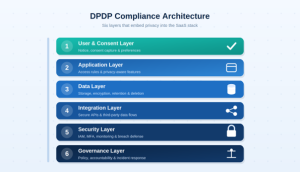
- User & Consent Layer
The User & Consent Layer regulates the way SaaS applications share privacy data with the user and gather their choice. It should facilitate understanding, traceability and enforceability of consent, not be a “checkbox question”.
- Application Layer
The Application Layer translates privacy requirements into application-level controls. This is where the SaaS product determines who can access personal data, what they can do with it, and whether a particular processing activity is permitted. Applications should implement privacy and security controls directly within business workflows instead of relying entirely on infrastructure-level protection.
- Data Layer
The Data Layer is responsible for protecting personal data throughout its lifecycle from collection and storage to modification, archival and deletion. Personal data on SaaS platforms is often spread out into relational databases, NoSQL databases, data warehouses, object storage, backups, logs and analytics environments. To meet the requirements of the DPDP, this architecture should afford visibility over these repositories.
- Integration Layer
Typically, modern SaaS platforms don’t work alone. They communicate with payment systems, CRM systems, analytics software, communication providers, identity systems, cloud applications and other third-party software. The Integration Layer manages these data flows and enables the organization to know where personal data goes once it leaves the core SaaS application.
- Security Layer
The Security Layer offers technical security to ensure that personal data is not subject to any unauthorized access, misuse, loss or security incident. In SaaS companies, this layer should span applications, cloud infrastructure, endpoints, databases, identities and networks.
- Governance Layer
The Governance Layer ties technology controls to organizational policies, accountability and compliance processes. But if the company isn’t governed, it could have great security technologies and a lack of accountability for personal data processing, vendor risk, retention decisions and compliance evidence.
DPDP Act Compliance: Common SaaS Mistakes to Avoid
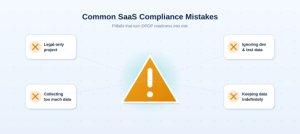
- Treating DPDP as a Legal-Only Project
Compliance requirements eventually need to become technical controls. Legal documentation without implementation creates operational gaps.
- Collecting More Data Than Necessary
Excessive data collection increases both privacy exposure and cybersecurity risk.
- Ignoring Development and Testing Environments
Production databases are not the only concern. Personal data copied into development, QA or analytics environments can create additional exposure.
- Assuming Cloud Providers Handle Compliance
Cloud providers secure their underlying platforms, but SaaS companies remain responsible for configuring and operating their own applications and environments appropriately.
- Keeping Data Indefinitely
Data that no longer serves a legitimate purpose can increase security and compliance risk.
- Ignoring Third-Party Integrations
A SaaS platform could provide personal information to many external platforms. A need for visibility and governance of these data flows is always needed.
- Relying Entirely on Manual Processes
Manual consent, access-review and deletion processes become difficult to maintain at scale.
- Waiting Until the Deadline
Compliance architecture can require changes to applications, databases, APIs, cloud infrastructure and organizational processes. Starting early reduces implementation pressure.
How SaaS Companies Can Prepare for DPDP Compliance
A practical implementation roadmap can be divided into six stages.
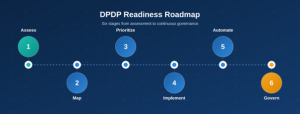
Stage 1: Assess
Know about personal data processing activities, systems, stakeholders and compliance gaps.
Stage 2: Map
Design data-flow diagrams for applications, databases, cloud-based structures, APIs and third-party processors.
Stage 3: Prioritize
Prioritize risks based on risk data sensitivity, risk data exposure, business risk and regulatory needs.
Stage 4: Implement
Implement technical measures for consent, IAM, encryption, monitoring, retention and deletion.
Stage 5: Automate
Enable data discovery, access reviews, consent synchronization and retention workflows and security monitoring as automated tasks when feasible.
Stage 6: Govern
Ongoing compliance monitoring, vendor reviews, controls testing and policy updates as required.
This way, DPDP readiness becomes a continuous capability and not a compliance exercise.
How Sphinx Can Help SaaS Companies with DPDP Readiness
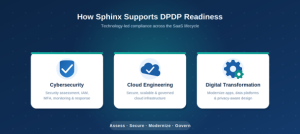
DPDP compliance increasingly requires coordination between privacy, cybersecurity, cloud infrastructure, software engineering and enterprise architecture.
Sphinx can support organizations across these technology areas through cybersecurity services, cloud engineering and digital transformation services.
Our technology-led approach can help SaaS organizations:
- Assess application and infrastructure security.
- Map personal-data flows across technology environments.
- Strengthen identity and access management.
- Secure cloud infrastructure.
- Modernize legacy applications.
- Implement secure APIs and integrations.
- Improve data governance.
- Automate security monitoring.
- Build privacy-aware application architectures.
- Strengthen incident-response capabilities.
For organizations that require their own security expertise, they may also hire cybersecurity experts to augment their internal security squaddies with cloud security, compliance engineering, incident response and vulnerability management.
Likewise, organizations looking to upgrade their infrastructure can leverage cloud services to create scalable, secure and governance compliant cloud environments.
Digital transformation services can also enable compliance to be embedded in application modernization, data platforms, cloud migration, and workflows as part of broader modernization programs.
Frequently Asked Questions About DPDP Act Compliance for SaaS Companies
Is the DPDP Act applicable to SaaS companies?
Yes, SaaS companies can be within the scope of DPDP if digital personal data is processed in situations that fall within the scope of the Act. These obligations are specific to the company’s role, processing activities and provisions.
What personal data should SaaS companies identify for DPDP compliance?
SaaS companies need to understand what all personal data they are collecting, processing, storing, transferring, or otherwise handling is digital personal data. This can encompass names, e-mail addresses, phone numbers, identifiers, account information, IP related information and other information within the ambit of the Act.
Does DPDP compliance require data to be stored in India?
The DPDP concept should not be interpreted as “all data should remain in India. SaaS companies are advised to review relevant provisions and government requirements regarding transfers and processing, and put in place suitable contractual, technical and organizational measures.
How does DPDP affect SaaS consent management?
SaaS platforms need to provide appropriate notices and mechanisms for valid consent where processing relies on consent. They should also maintain consent records and support withdrawal mechanisms. The 2025 Rules provide additional requirements concerning how notices are presented.
What security controls should SaaS companies implement for DPDP?
A SaaS security program should consider IAM, MFA, least privilege, encryption, secure APIs, vulnerability management, logging, monitoring, backup security, incident response and other appropriate technical and organizational measures. The Act expressly requires reasonable security safeguards to prevent personal data breaches.
Does DPDP apply to SaaS companies using AWS, Azure or Google Cloud?
Adopting a public cloud platform is not a cure-all for a SaaS company’s compliance obligations. The SaaS provider should review the methods of personal data collection, processing, storage and security in its cloud environment and through its connected services.
Should SaaS companies use automated data deletion?
Where deletion obligations apply, automation can significantly reduce operational risk. SaaS companies should design retention and deletion workflows that account for production databases, backups, analytics systems and relevant data processors.
Can cybersecurity services support DPDP compliance?
Yes. Cybersecurity services can be used for areas like security assessment, IAM, cloud security, vulnerability management, monitoring, incident response, security architecture. But cybersecurity is not the only part of a DPDP compliance program.
Should SaaS companies hire cybersecurity experts for DPDP readiness?
Organizations with complex applications, cloud infrastructure or limited internal security capacity may hire cybersecurity experts to strengthen security architecture, compliance engineering, vulnerability management and incident response.
How does digital transformation relate to DPDP compliance?
Modernization initiatives can help organizations eliminate legacy data silos, improve data governance, automate workflows and strengthen security controls. This makes digital transformation services relevant when DPDP readiness requires changes across applications, data platforms, cloud infrastructure and business processes.
Concluding Thoughts
Compliance with the DPDP Act for SaaS companies isn’t just a matter of publishing a privacy policy or checkbox for consent. It requires control over the complete personal-data lifecycle. The best way to do this is to embed privacy, cyber security, cloud security and data governance into the SaaS architecture itself.
It is therefore the most successful DPDP approach for SaaS companies that it is not merely a compliance initiative. Is a technology and governance capability that is embedded within the product, infrastructure, data architecture and operating model.
With the phased implementation of the DPDP Act and the 2025 Rules, SaaS companies can take advantage of the lead-up period to map out data flows, address security vulnerabilities, implement governance, and automate privacy measures. The Rules have different commencement dates in each of their provisions, and it is important for the businesses to plan in accordance with the provisions of the Rules that are applicable as of the date of the coming into force of each provision, instead of regarding compliance as one only deadline.