



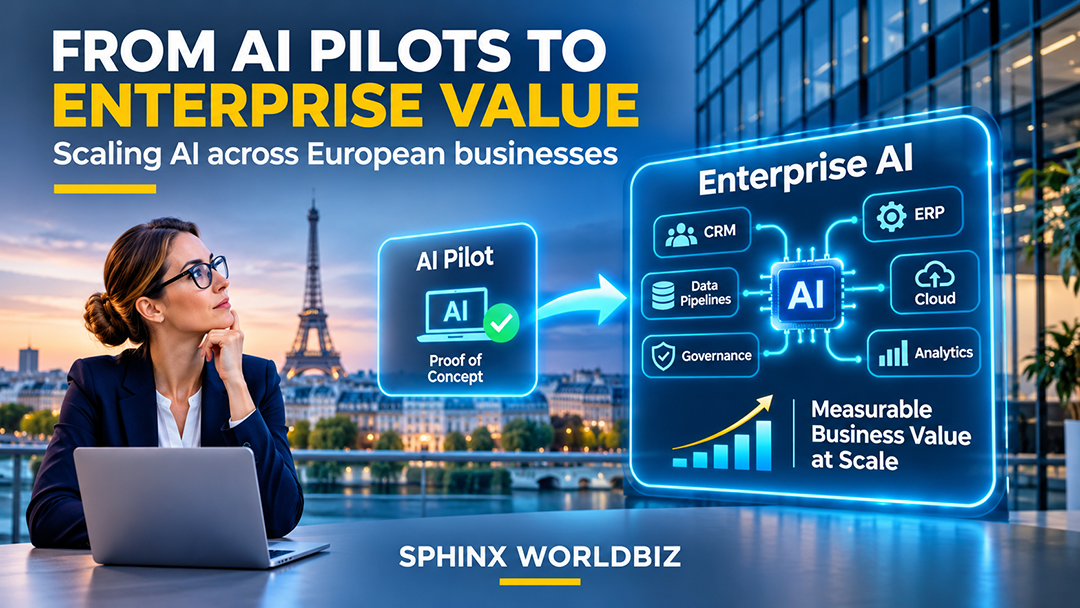

An AI pilot can produce impressive results. It may summarize complex documents in seconds, automate repetitive tasks, improve information retrieval, or help employees make faster decisions. But what happens when an organization tries to introduce the same capability across multiple departments, business units, or locations?
This is where many enterprise AI initiatives encounter difficulties.
A solution that works well in a controlled environment may struggle when connected to legacy applications, large datasets, complex workflows and thousands of users. Data quality issues, security requirements, infrastructure limitations, and employee adoption can all affect the transition from experimentation to everyday business use.
For European enterprises, the challenge also includes navigating data protection obligations, sector-specific regulations and responsible AI requirements while maintaining operational efficiency.
The real opportunity is not simply to launch more AI pilots. It is to develop a clear strategy for turning promising experiments into reliable business capabilities.
Scaling Enterprise AI requires more than choosing a powerful model. It involves business alignment, engineering, data readiness, AI integration, security, governance, and continuous improvement. With the right AI development services, organizations can move beyond isolated experiments and build AI solutions that support measurable business objectives.
Why Successful AI Pilots Fail to Scale Across Enterprises
A proof of concept (PoC) is designed to test whether an idea is technically feasible and potentially useful. Production deployment has a different purpose: delivering consistent value within actual business operations.
Several challenges can create a gap between these two stages.
- AI Pilots Are Not Always Connected to Business Priorities
Some organizations begin experimenting with AI because a technology is gaining attention rather than because a clearly defined business problem needs solving.
A chatbot may demonstrate impressive conversational abilities, but its business contribution remains uncertain if it does not improve customer support, employee productivity, or information access.
Before scaling Enterprise AI, organizations need to identify:
- Which business process requires improvement?
- Who will use the solution?
- What measurable outcome should it deliver?
- How will the organization evaluate its performance?
- What operational changes will be necessary?
A strong business case gives AI solutions a clear purpose and helps decision-makers prioritize investments based on impact, feasibility, and implementation complexity.
- Fragmented Data Limits AI Performance
AI applications depend on relevant, accessible and reliable information. However, enterprise data often sits across databases, documents, CRM platforms, ERP systems, SharePoint environments and departmental applications.
A pilot may use a small, prepared dataset. Production applications must often retrieve and process information from multiple sources while respecting access permissions and data governance requirements.
For example, an AI knowledge assistant may work effectively with a limited collection of documents. When deployed across an organization, it may need to retrieve information from different departments, identify the latest approved documents, and prevent unauthorized users from accessing restricted content.
This makes data engineering an important part of Enterprise AI adoption.
Organizations need suitable data pipelines, validation processes, access controls, and integration architecture. Without these foundations, even advanced models may produce incomplete or unreliable results.
- Existing Applications Are Difficult to Integrate
Many enterprise AI pilots operate independently from the systems employees use every day.
This creates an additional step in business processes. Employees may need to copy information between applications, upload documents manually, or switch platforms to access AI-generated recommendations.
Such friction can limit adoption and reduce the practical value of the technology.
Effective AI integration connects AI capabilities with existing applications, databases, APIs, and business workflows. Depending on the requirements, this may involve:
- API development and integration.
- Connecting AI applications with CRM and ERP platforms.
- Integrating enterprise knowledge repositories.
- Developing custom application interfaces.
- Automating information exchange between systems.
For organizations planning to scale Enterprise AI, integration should be considered during solution architecture rather than postponed until after the pilot.
- Infrastructure and Performance Requirements Change at Scale
A pilot involving a small group of users does not necessarily reflect the demands of an enterprise-wide deployment.
Production environments may need to support:
- Higher volumes of simultaneous requests.
- Consistent response times.
- Reliable application availability.
- Secure access across locations and departments.
- Model and application updates.
- Infrastructure and model cost management.
Generative AI applications also introduce considerations such as context-window limits, response quality, model selection, retrieval performance, and token consumption.
A scalable architecture should account for these requirements from the beginning. Cloud infrastructure, containerization, monitoring, and suitable deployment practices can help organizations manage growing workloads.
This is where production-focused AI development services become important: the objective is to engineer applications for real operating conditions, not just successful demonstrations.
- Security, Governance and Compliance Are Treated as Afterthoughts
European enterprises must consider privacy, information security, accountability and responsible AI throughout implementation.
The EU AI Act introduces a risk-based regulatory framework, with requirements and obligations that depend on the AI system, its intended use and the role of the organization. GDPR also remains relevant when personal data is processed.
An AI pilot may not expose every governance issue. Wider deployment can raise questions about:
- Who can access the data used by an AI application?
- Where is information processed and stored?
- Can outputs be reviewed and audited?
- How are sensitive business records protected?
- What happens when an AI system produces an incorrect response?
- Which decisions require human review?
Governance should be built into the architecture, development process and operating model. Organizations should assess applicable legal obligations for each use case rather than assume that one compliance approach fits every AI application.
- Employee Adoption Does Not Happen Automatically
Even technically capable AI solutions may fail to deliver value when employees do not understand or trust them.
Users may question the accuracy of AI-generated information, lack confidence in automated recommendations, or continue using familiar manual processes.
Successful adoption requires more than providing access to a new tool. Employees need to understand how it fits into their work, what it can and cannot do, and when human judgment is necessary.
Organizations should involve users during planning and testing, provide practical training, collect feedback and establish clear escalation procedures.
From AI Pilot to Production: What Enterprises Need to Get Right
Moving from experimentation to scalable deployment requires a structured approach. Instead of treating AI as an isolated technology project, enterprises should connect business objectives, data, applications, infrastructure, and governance.
- Prioritize Use Cases Based on Business Value
Start by identifying processes where AI can address a specific operational challenge.
Potential opportunities include:
- Automating document-heavy workflows.
- Improving enterprise knowledge discovery.
- Supporting customer service teams.
- Analyzing operational and financial information.
- Assisting employees with research and reporting.
- Improving software engineering workflows.
Evaluate each use case based on expected business impact, data readiness, technical feasibility, implementation complexity and risk.
This helps organizations direct AI development services towards applications with a clear purpose instead of expanding pilots without a defined outcome.
- Establish a Reliable Data Foundation
Review the data required by each application before expanding its deployment.
This involves identifying relevant sources, assessing data quality, defining ownership, establishing access permissions, and building appropriate data pipelines.
For Generative AI applications, retrieval-augmented generation (RAG) can connect models with approved enterprise information. It allows an application to retrieve relevant content from designated sources and use it as context when generating responses.
However, RAG does not automatically guarantee accuracy. Retrieval quality, source freshness, access controls, and output evaluation remain important.
- Design for Integration from the Start
AI should become part of the business process rather than another disconnected application.
A suitable AI integration strategy can connect models and applications with enterprise databases, APIs, document repositories and existing business platforms.
For example, an AI assistant used by a customer service team could retrieve authorized customer information, search approved knowledge resources and support employees within their existing service application.
The right integration approach depends on the organization’s current architecture, security requirements and operational needs.
- Engineer for Production, Not Just Demonstration
A production-ready application requires systematic development, testing and monitoring.
Depending on the use case, this may include:
- Model and application evaluation.
- Performance and load testing.
- Security testing and access management.
- Monitoring response quality and application availability.
- Version control and deployment management.
- Error handling and fallback mechanisms.
- Cost and infrastructure monitoring.
For organizations adopting Enterprise AI, these practices help turn an experimental application into a maintainable business system.
- Measure Outcomes and Improve Continuously
AI performance should be evaluated against business objectives, not just technical metrics.
Useful indicators may include:
| Business objective | Possible KPI |
| Improve employee productivity | Time saved per task |
| Automate document processing | Percentage of documents processed without manual intervention |
| Improve customer service | Resolution time and customer satisfaction |
| Improve knowledge access | Time required to find relevant information |
| Improve application performance | Response time and system availability |
| Manage operating costs | Cost per request or completed workflow |
| Improve output quality | Accuracy, relevance and exception rates |
These indicators should be established before deployment so that organizations can compare actual performance with their initial business case.
Continuous evaluation also helps identify when models, prompts, data sources, workflows or infrastructure need improvement.
The Role of Generative AI, AI Agents and Intelligent Automation
The next phase of enterprise adoption is not limited to conversational interfaces. Organisations are exploring ways to connect AI capabilities with information systems and business workflows.
Generative AI for Enterprise Knowledge and Productivity
Generative AI development can support applications such as knowledge assistants, document analysis tools, internal copilots, content generation, and conversational search.
When connected to approved enterprise information through RAG and suitable access controls, these applications can help employees retrieve relevant knowledge and complete information-intensive tasks.
However, organizations should evaluate response quality, source relevance, privacy, and human oversight before expanding usage.
AI Agents for Multi-Step Business Workflows
AI agents can combine reasoning, access to authorized tools, and defined actions to support multi-step processes.
For example, an enterprise agent may retrieve information, summarize records, prepare a workflow request, and route it for human approval.
Scaling agent-based AI solutions requires clear permissions, controlled access, monitoring, exception handling, and appropriate human intervention.
The objective is not to give every agent unrestricted control over enterprise systems. It is to automate defined tasks within an approved operating framework.
Intelligent Automation for Connected Operations
AI becomes more useful when its outputs can trigger or support the next step in a business process.
Combining AI with workflow automation, APIs, and enterprise applications can reduce repetitive manual activities and improve process continuity.
This is where AI integration and application engineering play an important role in connecting intelligent capabilities with day-to-day operations.
How Sphinx Worldbiz Helps Enterprises Scale AI in Europe
Moving from a successful pilot to an enterprise-wide implementation requires a combination of AI expertise, data engineering, software development, integration and cloud capabilities.
Sphinx Worldbiz brings these capabilities together to help organizations plan, develop, and integrate AI applications around their business requirements.
Its approach focuses on connecting AI technology with existing enterprise environments rather than building standalone applications without considering their operational context.
Depending on the project scope, Sphinx can support the following areas:
- AI Consulting and Use-Case Assessment
Sphinx helps organizations evaluate AI opportunities, assess technical and data readiness, prioritize use cases, and define implementation roadmaps.
This provides a structured starting point for Enterprise AI initiatives, with attention to business objectives and implementation feasibility.
- Custom AI and Generative AI Development
Through its AI development services, Sphinx can develop business-specific applications using machine learning, Generative AI, large language models, RAG, AI assistants and other relevant technologies.
Its Generative AI development capabilities include custom application development, LLM integration, enterprise knowledge assistants and intelligent document processing.
Technology selection depends on the intended use case, data environment, performance requirements, and security considerations.
- Enterprise Data and System Integration
AI applications need access to relevant information and business systems.
Sphinx can help connect data sources, APIs, databases and enterprise applications to support reliable information exchange and workflow integration.
This makes AI integration an important part of its broader software engineering and digital transformation capabilities.
- Cloud and Application Engineering
Sphinx supports cloud and application modernization initiatives that can help organizations establish suitable environments for AI workloads.
Depending on the architecture, this may involve cloud deployment, API development, microservices, DevOps practices, and application modernization.
These engineering foundations help AI solutions operate within existing enterprise technology environments and adapt as requirements change.
- AI Agents and Intelligent Workflows
Sphinx also develops AI agent capabilities that can interact with authorized enterprise data sources, applications, and workflows.
These applications can support task delegation, information retrieval and controlled process execution, with appropriate access permissions and human escalation.
- Security and Responsible AI Considerations
Security and governance need to be considered throughout the AI lifecycle.
Sphinx can incorporate access controls, data protection, secure integrations, evaluation, monitoring and human oversight based on project requirements.
For European organizations, implementation planning should also consider relevant GDPR obligations and applicable EU AI Act requirements.
Through this combination of capabilities, Sphinx helps enterprises approach Enterprise AI as a business transformation initiative supported by engineering, integration and operational planning.
A Practical Roadmap for Scaling Enterprise AI
Enterprises do not need to move every AI pilot into production at once. A phased approach can help teams prioritize investments and manage implementation risks.
| Stage | Key activities | Expected output |
| 1. Assess | Review business goals, use cases, data and existing systems | Prioritized AI opportunities |
| 2. Plan | Define architecture, governance, security and success metrics | Implementation roadmap |
| 3. Build | Develop and validate the application | Tested AI solution |
| 4. Integrate | Connect enterprise data, APIs and workflows | Operational application |
| 5. Deploy | Introduce production infrastructure, access controls and monitoring | Production deployment |
| 6. Optimize | Evaluate performance, adoption, cost and business outcomes | Continuous improvement |
This roadmap helps organizations decide which applications to scale, which need further development, and which should remain limited experiments.
Conclusion: The Real Value of AI Begins After the Pilot
A successful AI pilot demonstrates potential. Sustainable business value comes from making that capability reliable, secure, accessible, and useful within everyday operations.
For European enterprises, scaling Enterprise AI means addressing data readiness, system integration, infrastructure, governance and employee adoption together.
The right AI development services can help bridge the gap between experimentation and production. Similarly, well-planned Generative AI development can connect advanced models with enterprise knowledge and business processes, while effective AI integration makes those capabilities accessible within existing applications.
Ultimately, organizations need AI solutions designed around measurable business needs, supported by sound engineering and continuously evaluated after deployment.
At Sphinx Worldbiz, we combine AI, data, cloud and software engineering capabilities to help businesses move from isolated AI experiments towards connected, production-ready applications.
Have you moved beyond AI experimentation, or are your pilots still waiting to scale?
Connect with Sphinx Worldbiz to explore how a structured AI strategy, enterprise engineering, and integration can support your next stage of AI adoption.
Frequently Asked Questions (FAQs)
- Why do successful AI pilots fail to scale in enterprises?
AI pilots may fail to scale because they use limited datasets, operate separately from enterprise applications, or lack production-level security, infrastructure and monitoring. Unclear business objectives and low employee adoption can also prevent organizations from achieving meaningful value.
- What does scaling Enterprise AI mean?
Scaling Enterprise AI means expanding an AI application beyond a controlled pilot so it can operate reliably across business processes, departments, or locations. It involves data readiness, application integration, infrastructure, governance, security, monitoring and user adoption.
- How can businesses move AI projects from proof of concept to production?
Businesses should establish measurable objectives, assess data readiness, design scalable architecture, integrate existing applications, conduct performance and security testing, and introduce ongoing monitoring. A phased rollout with user feedback can help identify issues before wider deployment.
- What role do AI development services play in enterprise AI adoption?
AI development services support the complete implementation lifecycle, including use-case assessment, solution architecture, model and application development, data integration, testing, deployment and optimization. They help align technical implementation with business requirements.
- How does Generative AI development create business value?
Generative AI development can support enterprise knowledge assistants, document analysis, content generation, conversational search and workflow assistance. Business value depends on connecting these applications to relevant information, integrating them into actual processes and evaluating their accuracy and usefulness.
- Why is AI integration important when scaling enterprise applications?
AI integration connects AI capabilities with existing applications, databases, APIs and business workflows. Without suitable integration, AI tools may operate in isolation, creating additional manual work and limiting their usefulness to employees.
- What should European businesses consider before scaling AI?
European businesses should assess data quality, privacy, security, access controls, AI governance, infrastructure, and intended use. They should also evaluate relevant GDPR obligations and determine whether AI applications fall under applicable EU AI Act requirements.
- How can Sphinx Worldbiz help enterprises scale AI?
Sphinx Worldbiz brings together AI/ML engineering, Generative AI development, data engineering, custom software development, system integration, and cloud capabilities. Depending on project requirements, these services can support the journey from AI opportunity assessment and application development to enterprise integration and deployment.