








Manufacturers globally are moving fast to embrace the cloud to modernize, gain supply chain visibility, move towards predictive maintenance, and facilitate Industry 4.0 programs. However, while many manufacturing companies are spending millions on cloud technologies, their business results are not being realized — not because the technologies don’t work, but because avoidable mistakes are made when migrating.
The difference between successful cloud migration and expensive failure is planning, execution, and optimizing after the migration. This blog post discusses the most common cloud migration pitfalls that manufacturing organizations are still falling into — and how to avoid them.
Why Cloud Migration Is Relevant to Manufacturing
Cloud for manufacturing is becoming more popular for supporting the following:
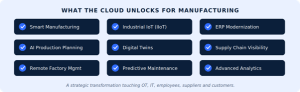
Cloud migration isn’t simply moving applications from on-premises servers to the cloud. It is a strategic digital transformation that affects production systems, operational technology (OT), IT infrastructure, employees, suppliers, and customers. Without careful planning, even minor mistakes can disrupt production and impact revenue.
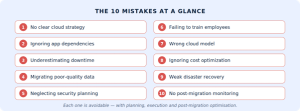
Common Cloud Migration Mistakes
1. Migrating Without a Clear Cloud Strategy
Why It Happens
Competitors implementing cloud solutions or executives pushing for digital transformation, without establishing measurable business goals, are among the many reasons for starting migration.
Business Impact
- Budget overruns
- Delayed implementation
- Misaligned business priorities
- Low ROI
Best Practices
- Define business outcomes before migration.
- Align cloud initiatives with production goals.
- Build a phased migration roadmap.
- Prioritize workloads based on business value.
2. Ignoring Application Dependencies
Manufacturing systems rarely operate independently. ERP systems connect with MES, SCADA, PLCs, Warehouse Management Systems, Quality Management Systems, and Supplier Portals. Failure to understand these dependencies can lead to integration failures when migrating to a single application.
Business Impact
- Production delays
- Inventory inaccuracies
- Data inconsistency
- Increased operational risk
Best Practices
- Perform application dependency mapping.
- Document integrations before migration.
- Test interconnected systems together.
3. Underestimating Production Downtime
Unlike many industries, manufacturing operations often run 24/7. Unexpected downtime affects production schedules, customer commitments, supply chain operations, and revenue.
Business Impact
- Lost production
- Missed deliveries
- Customer dissatisfaction
- Increased operational costs
Best Practices
- Schedule migrations during maintenance windows.
- Use phased migration approaches.
- Test rollback procedures.
- Develop contingency plans.
4. Migrating Poor-Quality Data
Cloud migration is not the time to move outdated, duplicate or inaccurate data. Many manufacturers move decades of old production records without cleaning them.
Business Impact
- Poor analytics
- Incorrect forecasting
- Reporting inaccuracies
- Operational inefficiencies
Best Practices
- Audit existing data.
- Remove duplicate records.
- Archive obsolete information.
- Standardize data formats before migration.
5. Neglecting Cloud Security Planning
Manufacturing has become one of the most targeted industries for ransomware and cyberattacks. Moving workloads without redesigning security introduces significant risks.
Business Impact
- Cybersecurity incidents
- Regulatory penalties
- Intellectual property theft
- Production disruption

Best Practices
- Implement Zero Trust architecture.
- Encrypt data at rest and in transit.
- Enable IAM and MFA.
- Continuously monitor cloud environments.
- Conduct regular security assessments.
6. Failing to Train Employees
Cloud transformation is as much about people as technology. Employees often struggle with new cloud-based workflows.
Business Impact
- Low adoption
- Reduced productivity
- Increased support requests
- Resistance to change
Best Practices
- Provide role-based training.
- Offer hands-on workshops.
- Develop cloud champions within departments.
- Maintain ongoing support after deployment.
7. Choosing the Wrong Cloud Model
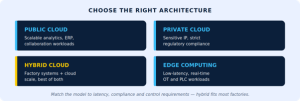
Not every workload belongs in the same environment. Some production environments require low latency, edge computing, regulatory compliance, or on-premises control — and a one-size-fits-all cloud choice creates problems later.
Business Impact
- Performance issues
- Compliance challenges
- Increased operational complexity
Best Practices
- Match each workload to the right model: public, private, hybrid, or edge.
- Keep latency-sensitive OT and PLC workloads at the edge or on-premises.
- Use hybrid architecture to combine factory control with cloud scale.
- Validate compliance and data-residency requirements before committing.
8. Ignoring Cloud Cost Optimization
Several organizations think that costs always decrease when they use cloud. If left un-governed, cloud spend can be a lot higher.
Business Impact
- Budget overruns
- Unused resources
- Poor financial visibility
Best Practices
- Implement FinOps practices.
- Monitor cloud consumption.
- Right-size workloads.
- Automate resource shutdowns.
- Review spending regularly.
9. Weak Disaster Recovery Planning
Migration does not eliminate disaster recovery requirements. Manufacturers must prepare for cyberattacks, hardware failures, human errors, and regional outages.
Business Impact
- Extended downtime
- Production losses
- Revenue impact
Best Practices
- Define Recovery Time Objectives (RTO).
- Define Recovery Point Objectives (RPO).
- Test backup restoration regularly.
- Automate disaster recovery processes.
10. Failing to Monitor and Optimize After Migration
Migration is only the beginning. Cloud environments require continuous monitoring and optimization.
Business Impact
- Performance degradation
- Higher costs
- Reduced productivity
- Poor user experience
Best Practices
- Monitor infrastructure performance and application health.
- Track security events and resource utilization.
- Watch cloud costs and user experience.
- Leverage AI-powered monitoring and observability platforms to proactively detect anomalies and optimize performance.
Expert Tips for Manufacturing Cloud Migration
Successful manufacturers don’t treat cloud migration as an isolated IT project; they approach it as a business transformation initiative. Consider these best practices:

- Start with a cloud readiness assessment.
- Prioritize business-critical workloads based on value and risk.
- Modernize applications instead of simply lifting and shifting everything.
- Adopt a hybrid cloud strategy for latency-sensitive factory systems.
- Involve operations, production, cybersecurity, finance, and supply chain teams early.
- Use Infrastructure as Code (IaC) and automation to reduce manual errors.
- Establish cloud governance, security, and compliance policies from day one.
- Continuously optimize cloud environments using performance monitoring and FinOps practices.
Conclusion
Cloud migration is no longer a luxury, it’s a necessity for manufacturers looking to reach Industry 4.0, smart manufacturing and digital transformation. But it’s not just about moving workloads to the cloud. It requires a well-defined strategy, a deep understanding of application dependencies, robust cybersecurity services, effective change management, and continuous optimization.
With this guide as a reference, manufacturers can reduce disruption to their operations, increase scalability, enhance resilience and maximize the value of their cloud investment by avoiding these common pitfalls. Organizations that think of cloud migration as a business transformation, not a mere IT project, are more likely to innovate, adapt to market shifts, and create networked, data-driven factories.

Secure, scalable and business-focused cloud migration services to modernize the IT infrastructure of manufacturing organizations is our specialty at Sphinx. Our cloud experts support manufacturers throughout the entire digital transformation journey from preparing for cloud readiness to moving from legacy ERP, hybrid cloud architecture, application modernization and DevOps to post-migration optimization helping to mitigate risks during migration, minimize production downtime, and provide digital transformation solutions. From initial cloud migration to optimizing an existing cloud environment, Sphinx offers the technical skills and industry expertise required to create a robust, future-proof manufacturing ecosystem.