






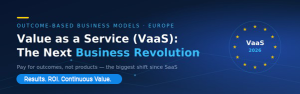
For years, software, infrastructure, and professional services investments were made with a simple goal of acquiring proper technology, implementation, and success, with the subsequent business value being a natural outcome. Numerous digital programs resulted in projects that were completed on time and on budget but had no tangible business impact. This divide is influencing the way enterprises make technology investments.
Today executives are posing other questions:
- Will this solution increase productivity?
- Does it save on expenses?
- What will be the time to ROI?
- Will it help us to innovate faster?
- How will it be known if the project is successful?
These are the types of questions that can be described as moving from a technology sale to a business-based sale.
As organizations accelerate digital transformation, adopt artificial intelligence, migrate to the cloud, and modernize operations, they increasingly expect service providers to share responsibility for business success — not just technology delivery. This expectation has fueled the rise of Value as a Service (VaaS).
VaaS providers do not charge customers only for products, licenses, implementation time and infrastructure — they are directly connected to the customer’s success. There is a direct relationship between pricing, delivery, and value to the business, including increased revenue, lower costs, better customer experience, quicker innovation, or greater operational efficiency.
“This change is one of the largest transformations since Software as a Service (SaaS) came into the world.”
Introduction to Value as a Service (VaaS)
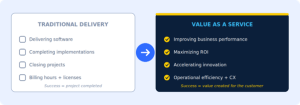
Value as a Service (VaaS) is a business model that delivers products, technologies, and services with a strong emphasis on a measurable business outcome, not just access to technology and the completion of a predefined product or service.
With VaaS, success is not about the number of hours billed, software licenses sold or infrastructure deployed — but value created for the customer!
Business Perspective
On a business level, VaaS changes the business-customer dynamics. Implementation typically marks the end of traditional engagements. However, after delivery, all responsibility for the project becomes the customer’s.
Value as a Service, on the other hand, creates a service contract and a partnership agreement between both parties to focus on common business goals. This involves the ongoing tracking of performance, optimization of systems, analysis of data, recommendations for change and the implementation of innovations that deliver ongoing business value.
Why Businesses Are Moving to VaaS
The concept of Value as a Service is gaining traction in different industries due to multiple trends. There is a growing demand for organizations to provide measurable results while keeping costs down, getting the innovation right and adjusting to fast changes in technology and market dynamics.
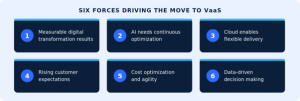
1. Digital Transformation Demands Measurable Results
While companies are spending a significant amount on Digital Transformation Services, it’s the executives who are looking for investment to yield results for the business in the form of better efficiency, faster time to market, and better customer experience. VaaS directly maps technology initiatives to these strategic goals.
2. AI Adoption Requires Continuous Optimization
Artificial Intelligence and Generative AI are only beneficial when they are monitored, refined and embedded in business processes. A VaaS approach means continuous optimization, not a single-time occurrence or implementation, and AI & ML Development Services and AI governance play a supporting role in achieving continuous success.
3. Cloud Computing Enables Flexible Delivery
Cloud platforms and platforms that scale with use are the norm these days. The value that providers can offer goes on long after the migration is finished, as they can continuously optimize performance, availability, and costs with Cloud Migration Services, Managed Cloud Services, and automation.
4. Rising Customer Expectations
Technology partners are now expected to directly support and drive business growth, resilience and innovation. This has given customer success, proactive support and outcome-based engagement models greater significance.
5. Cost Optimization and Business Agility
Economic uncertainty has made cost efficiency a board-level priority. Organizations are moving away from large upfront investments toward flexible commercial models where spending is tied to measurable business value, reducing financial risk while improving agility.
6. Data-Driven Decision Making
Modern enterprises generate vast amounts of operational and customer data. VaaS uses Data Analytics Services, AI and real-time monitoring to turn this data into actionable information that enables ongoing improvements and informed decision making.
Key Components of a VaaS Model
Successful Value as a Service is built on multiple interconnected capabilities. Technology alone cannot deliver business value without the right people, processes, and governance.
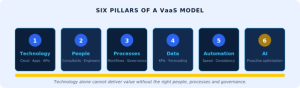
1. Technology Foundation
Technology serves as the backbone of VaaS. Common components include cloud platforms, enterprise applications, APIs, integration platforms, data platforms, and security frameworks.
Organizations often modernize legacy environments through Legacy Application Modernization, Enterprise Application Development, and Cloud Consulting Services before adopting VaaS.
2. Skilled People
Technology creates opportunities, but people create value. A mature VaaS team typically includes business consultants, solution architects, cloud engineers, AI specialists, DevOps engineers, data analysts, Customer Success Managers, and security experts. Cross-functional collaboration ensures that technical solutions align with business objectives.
3. Business Processes
Optimized processes are essential for achieving measurable outcomes. Examples include automated approvals, digital workflows, incident management, continuous delivery, IT service management, and governance processes. Modern organizations often leverage Business Process Automation, DevOps Services, and Security Operations (SecOps) Services to streamline operations.
4. Data & Analytics
Every optimization decision should be supported by data. Analytics enables organizations to measure KPIs, forecast demand, identify inefficiencies, improve customer experience, monitor service performance, and predict business risks.
This is where Data Analytics Services become critical for evidence-based decision-making.
5. Automation
Automation reduces manual effort while improving consistency and scalability. Examples include workflow automation, infrastructure provisioning, incident response, compliance checks, software deployment, and reporting. Automation accelerates time-to-value and reduces operational costs.
6. Artificial Intelligence
AI enables VaaS providers to move from reactive support to proactive optimization. Use cases include predictive maintenance, intelligent recommendations, demand forecasting, chatbots, anomaly detection, capacity planning, and process optimization. AI enhances decision-making while continuously improving service delivery.
How Value as a Service Works
Implementing VaaS is a continuous journey rather than a one-time project. Below is a practical framework that organizations can follow to transition from traditional service delivery to a value-driven operating model.
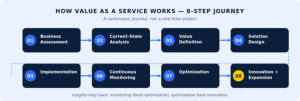
Step 1: Business Assessment
The journey begins with understanding the organization’s strategic priorities. Key questions include: What business challenges are we solving? Which KPIs matter most? Where are current inefficiencies? What outcomes define success? This phase aligns stakeholders around measurable objectives.
Step 2: Current-State Analysis
Evaluate the organization’s existing capabilities, including the technology stack, business processes, data maturity, workforce skills, security posture, and customer experience. This assessment identifies gaps and modernization opportunities.
Step 3: Value Definition
Rather than defining project scope alone, organizations define desired business outcomes. Examples:
- Reduce cloud costs by 20%
- Increase customer retention by 15%
- Cut incident response times in half
- Improve deployment frequency by 3×
Clear success metrics establish accountability from the outset.
Step 4: Solution Design
Develop an integrated roadmap that combines technology, processes, governance, automation, AI, analytics, and change management. The roadmap should prioritize initiatives based on business impact and feasibility.
Step 5: Implementation
Execute the transformation through iterative phases, minimizing disruption while delivering incremental value. Activities may include cloud migration, process automation, AI deployment, security enhancements, application modernization, and integration of enterprise systems. Agile methodologies enable faster feedback and continuous refinement.
Step 6: Continuous Monitoring
After deployment, organizations track performance using predefined KPIs, such as system availability, user adoption, productivity metrics, operational costs, and customer satisfaction. Real-time visibility supports informed decision-making.
Step 7: Optimization
Insights from monitoring drive ongoing improvements. Typical optimization initiatives include fine-tuning AI models, automating additional workflows, optimizing cloud resources, enhancing user experience, and strengthening cybersecurity. Continuous optimization ensures that business value grows over time.
Step 8: Innovation & Expansion
Once foundational goals are achieved, organizations explore new opportunities such as Generative AI, Digital Twins, predictive analytics, edge computing, new digital products, and ecosystem partnerships. Innovation becomes a continuous process rather than a periodic initiative.
Industries Using Value as a Service (VaaS)
One of the biggest strengths of Value as a Service (VaaS) is its flexibility. Because it focuses on measurable business outcomes rather than specific technologies, the model can be adapted across virtually every industry. Below are some of the most impactful industry use cases.
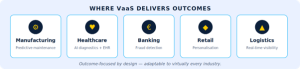
1. Manufacturing
Business Challenges
Manufacturers are under constant pressure to reduce production costs, minimize equipment downtime, improve supply chain visibility, increase production efficiency, meet sustainability targets, and address labor shortages. Traditional technology implementations often solve isolated problems without delivering long-term operational improvements.
How VaaS Helps
A Value as a Service model combines Digital Transformation Services, Industrial IoT, AI-powered predictive maintenance, cloud platforms, manufacturing analytics, and process automation to continuously optimize factory operations.
2. Healthcare
Business Challenges
Healthcare organizations must balance patient care quality, regulatory compliance, data privacy, rising operational costs, staff shortages, and digital patient experiences.
VaaS Applications
Healthcare providers leverage AI-assisted diagnostics, Electronic Health Record optimization, telemedicine platforms, cloud infrastructure, cybersecurity monitoring, and workflow automation — supported by Cybersecurity Consulting Services, Managed Cloud Services, and Data Analytics Services.
3. Banking & Financial Services
Challenges
Financial institutions face regulatory compliance, fraud prevention, legacy systems, digital banking expectations, cyber threats, and operational risk.
VaaS Approach
Banks increasingly combine AI fraud detection, cloud-native banking, risk analytics, process automation, and customer journey optimization with Legacy Application Modernization and Enterprise Application Development.
4. Retail & eCommerce
Retail organizations compete primarily on customer experience. VaaS enables continuous optimization of inventory, pricing, personalization, omnichannel experiences, customer support, and supply chain performance.
5. Logistics & Supply Chain
Supply chain disruptions have highlighted the need for real-time visibility and resilience. VaaS helps organizations optimize fleet management, route planning, warehouse operations, inventory tracking, and delivery performance — using IoT sensors, AI forecasting, cloud analytics, and automation.
Real-World Examples of VaaS
The examples below are inspired by publicly available strategies and service portfolios, focusing on business models rather than unsupported performance claims.
Microsoft
Microsoft has shifted from selling perpetual software licenses to delivering continuous business value through Microsoft Azure, Microsoft 365, Dynamics 365, Microsoft Fabric, and Microsoft Copilot. Beyond software subscriptions, Microsoft emphasizes customer adoption, business productivity, AI-driven innovation, security posture improvement, and continuous cloud optimization. This reflects a VaaS mindset where long-term customer success is central to the relationship.
Amazon Web Services (AWS)
AWS offers more than cloud infrastructure. Its ecosystem includes architecture guidance, cost optimization frameworks, managed services, AI and analytics platforms, and operational best practices. Programs such as the AWS Well-Architected Framework encourage customers to continuously optimize security, reliability, performance, sustainability, and cost — core principles aligned with Value as a Service.
Salesforce
Salesforce positions customer success as a strategic priority. Its platform combines CRM, AI, analytics, automation, and industry solutions. The emphasis extends beyond CRM implementation to improve sales productivity, customer engagement, marketing effectiveness, and service quality.
Future of Value as a Service (2026–2030)
The next phase of VaaS will be shaped by AI, automation, sustainability, and ecosystem collaboration. Several trends are expected to define the market between 2026 and 2030.
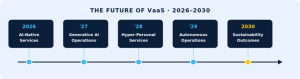
1. AI-Native Services
AI will be integrated into all aspects of service provision, ranging from planning and execution to optimization and assistance. AI agents will suggest enhancements, eliminate repetitive tasks and forecast future business requirements.
2. Generative AI for Business Operations
Generative AI will become a standard capability for knowledge management, customer support, software development, proposal generation, document creation, and decision support. It will be a mandatory part of enterprise workflows — not an optional item.
3. Hyper-Personalized Services
Organizations will expect solutions tailored to industry, business size, user behavior, customer preferences, and regulatory requirements. Data and AI will help providers deliver highly personalized experiences on a scale.
4. Autonomous Operations
Advances in AI and automation will enable systems to detect issues, predict failures, optimize resources, self-heal infrastructure, and recommend strategic actions. While routine activities will become increasingly automated, human supervision will still be needed.
5. Sustainability as a Business Outcome
Organizations are placing greater emphasis on environmental and social impact. Future VaaS engagements may include KPIs such as energy efficiency, carbon footprint reduction, sustainable cloud operations, and responsible AI governance.
Frequently Asked Questions (FAQs)
1. What is Value as a Service (VaaS)?
Value as a Service is a business model that provides technology and services based on measurable business outcomes (results), not just products or project completion.
2. How is VaaS different from SaaS?
SaaS provides software through a subscription model, while VaaS combines technology, services, customer success, and continuous optimization to achieve business goals.
3. Is VaaS only for large enterprises?
VaaS can be very helpful to SMBs and startups as well, as they can avail of enterprise-level facilities with flexible pricing and continuous support.
4. Which industries benefit the most from VaaS?
Some of the industries that have been successfully implementing VaaS principles are manufacturing, healthcare, banking, retail, telecom, logistics, education, government and energy.
5. Does VaaS replace Managed Services?
No — Managed Services are frequently a part of a VaaS solution. VaaS adds business outcome accountability and continuous optimization.
6. How does AI support VaaS?
AI enables predictive analytics, intelligent automation, personalized recommendations, proactive issue detection, and continuous optimization.
7. How is ROI measured in a VaaS model?
Organizations typically measure ROI through KPIs such as cost savings, productivity improvements, revenue growth, adoption rates, and customer satisfaction.
8. What technologies enable VaaS?
Cloud computing, AI, Generative AI, IoT, analytics, APIs, automation, Digital Twins, and edge computing are key enabling technologies.
Final Thoughts
Investing in technology doesn’t ensure business success anymore. Organizations today are evaluated on the results they bring — whether it is enhancing customer experiences, accelerating innovation, cutting costs, or making them more resilient.
Measuring business value is at the heart of every engagement, as is captured in Value as a Service (VaaS). VaaS is not a one-time investment or a standalone project, but rather an ongoing process of collaboration, shared responsibility and constant improvement.
The rapidly changing nature of the world has already transformed industries using AI, cloud computing, automation, and data analytics, leaving organizations with outcome-driven operating models more agile, innovative, and competitive in a rapidly evolving business landscape. From technology refresh to the implementation of AI, optimizing cloud operations to driving enterprise transformation, a VaaS approach can help ensure investments in technology yield tangible business benefits.