





Software delivery has changed dramatically over the past decade.
From monolithic applications to cloud-native, from annual releases to daily deployments and from disparate development teams to distributed engineering teams around the world, organisations have evolved over time. Modern demands regarding software delivery have come a long way since Continuous Integration and Continuous Delivery (CI/CD) made it possible to achieve this shift.
The enterprise landscape is now multi-cloud, Kubernetes, AI-driven applications, edge environments and ever-more complex regulations. The engineering teams must provide software in a timely manner, while also keeping it secure and compliant, maintaining infrastructure consistency, optimizing cost of service, and ensuring operational reliability all along the delivery lifecycle.
As this complexity continues to increase, Continuous Integration and Continuous Automation (CI/CA) emerge as the way to automate software beyond just code delivery, into all aspects of software development, infrastructure management, security, governance and operations.
CI/CA is not a substitute for CI/CD, but it extends the capabilities of CI/CD to make the software delivery ecosystem smarter, stronger, and more scalable. For organisations seeking to innovate faster, maintain high quality and good governance, CI/CA has become a strategic ability for achieving digital transformation.
What Is CI/CA?
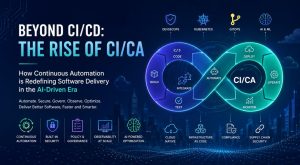
Continuous Integration and Continuous Automation (CI/CA) is an advanced software delivery approach that builds on the concept of CI/CD, but not only for code integration and deployment, but also for all the other operational, security, compliance, infrastructure and governance processes encompassing the delivery of modern software.
In essence:
- CI ensures code changes are integrated, tested, and validated continuously.
- CA ensures that every repeatable activity across the software lifecycle is automated wherever practical, reducing manual intervention and enabling consistent, policy-driven operations.
This gives the company a faster, more reliable, more secure and flexible software delivery pipeline which can support evolving business requirements.
Why CI/CD Is No Longer Enough
CI/CD revolutionized software development by minimizing the need for manual efforts in application construction, testing, and deployment. But in the present-day enterprise context, there are complexities that are far broader than what is addressed in conventional CI/CD pipeline.
For example, software releases often require:
- Provisioning infrastructure on multiple cloud platforms
- Security and vulnerability scanning
- Policy and compliance validation
- Infrastructure-as-Code execution
- Kubernetes Configuration Management
- Secrets management
- Cost optimisation checks
- Performance validation
- Observability configuration
- Incident response automation
- Release governance and approvals
Many organisations have mature CI/CD pipelines, but these activities are still partially manual, thus introducing bottlenecks.
With the ongoing trend of businesses moving towards cloud-native architectures, AI-powered applications, and distributed development models, having CI/CD alone can severely restrict agility and complicate operations.
By not only moving code but also orchestrating automation throughout the wider software delivery ecosystem, CI/CA is a solution that tackles these challenges.
Why CI/CA Matters for European Enterprises
European organisations face a unique combination of business pressures:
- Accelerating digital transformation initiatives
- Increasing adoption of cloud-native platforms
- Shortages of skilled engineering talent
- Heightened cybersecurity threats
- Evolving regulatory obligations, including GDPR, NIS2, DORA (for financial services), and the EU AI Act
- Growing emphasis on operational resilience and digital sovereignty
In this system, manual systems add needless risk. CI/CA helps organisations by integrating automation into governance, security and operational processes, enabling engineering teams to deliver the software more consistently and ensure they meet organisational policies and regulatory expectations.
Instead of automation being only a productivity project, today several European businesses are considering it as a strategic asset that enhances their resilience, scalability and competitiveness going forward.
Business Drivers Accelerating the Shift to CI/CA
Several trends are encouraging organisations to move beyond conventional CI/CD practices:
- Increasing Software Complexity
Microservices, APIs, containers, serverless computing and distributed cloud infrastructure are used in modern applications. Manual management becomes more challenging in such environments with scaling systems.
- Platform Engineering Adoption
Platform engineering teams are developing internal developer platforms that are portable, streamline deployment, security, infrastructure, and governance. CI/CA complement this by automatically running platform operations and freeing up development team’s time.
- AI-Powered Development
The use of AI coding assistants is speeding up software development, leading to more software changes being validated, tested, secured and deployed. The increased delivery speed demands wider automation to guarantee quality and reliability.
- Security by Design
Security is moving earlier in the development lifecycle (DevSecOps), which means that automated security checks, policy validation and compliance controls are necessities, not luxury.
Emerging Trends Shaping CI/CA in 2026
The evolution of CI/CA is being influenced by several technology and business trends.
- AI-Native Software Delivery
Generative AI is assisting with:
- Code generation
- Test creation
- Documentation
- Pipeline optimization
- Incident analysis
The next phase will focus on AI-supported decision-making across the delivery lifecycle.
- Platform Engineering Becomes Mainstream
To offer standardised, self-service engineering team capabilities, organisations are investing in Internal Developer Platforms (IDPs).
CI/CA’s complement to this model is governance, security and operational workflows automation behind the platform.
- Policy as Code
Many organisations are turning to the code for security, compliance and operational policies instead of manual approvals.
This allows for uniform governance and makes auditing easier.
- GitOps Expansion
GitOps principles continue to gain adoption for managing infrastructure and Kubernetes deployments.
Using Git as the single source of truth improves consistency, traceability, and rollback capabilities.
- Software Supply Chain Security
In recent supply chain attacks, there has been a growing focus on securing all elements of the software supply chain.
Organizations are strengthening practices such as:
- Artifact signing
- Dependency verification
- Software Bills of Materials (SBOMs)
- Continuous vulnerability management
These measures help improve trust and resilience throughout the delivery pipeline.
- Sustainability and Green Software
European enterprises are placing greater emphasis on sustainable IT practices.
Automation can be contributed by:
- Optimizing cloud resource utilization
- Reducing unnecessary compute workloads
- Improving infrastructure efficiency
- Supporting FinOps initiatives
Although sustainability is not the focus of CI/CA, automating efficiently can assist with other sustainability and cost optimization goals.
Future Outlook: From Continuous Automation to Autonomous Delivery
CI/CA is an important step in the evolution of increasingly intelligent, adaptive, and self-managing software delivery systems.
In the next 3-5 years organizations will see more usage of capabilities like:
- AI-assisted release planning
- Predictive quality assurance
- Self-healing infrastructure
- Autonomous pipeline optimization
- Context-aware security enforcement
- Automated compliance reporting
- Intelligent resource allocation
Human oversight will continue to be vital, especially for strategic decisions and governance. But engineering staff will be able to devote more time to innovation and product development and less to repetitive operational tasks.
Companies that make investment in scalable automation today will be better equipped to meet the evolving needs of customers, new rules and regulations, and more complex technological environments.
Frequently Asked Questions (FAQs)
- What is the difference between CI/CD and CI/CA?
CI/CD (Continuous Integration and Continuous Delivery/Deployment) automates code integration, testing, and deployment. CI/CA (Continuous Integration and Continuous Automation) extends this approach by automating infrastructure provisioning, security validation, compliance checks, observability, governance, and operational workflows. Rather than replacing CI/CD, CI/CA builds upon it to create a more intelligent and resilient software delivery lifecycle.
- Is CI/CA replacing CI/CD?
No. CI/CA is an evolution of CI/CD, not a replacement. Organizations with mature CI/CD practices can extend their existing pipelines by incorporating automation across infrastructure, security, compliance, operations, and AI-assisted decision-making.
- Which organizations benefit the most from CI/CA?
CI/CA is particularly valuable for organizations that:
- Develop cloud-native applications
- Operate in multi-cloud or hybrid environments
- Manage complex microservices architectures
- Have frequent software releases
- Operate in regulated industries such as financial services, healthcare, manufacturing, telecommunications, and the public sector
- How does CI/CA support DevSecOps?
CI/CA provides security at each phase of the software delivery lifecycle, including automating the following processes:
- Static application security testing (SAST)
- Software composition analysis (SCA)
- Secret detection
- Infrastructure policy validation
- Container image scanning
- Compliance checks
This can minimize manual reviews and facilitate teams to identify and fix security problems earlier in the development lifecycle.
- Does CI/CA require migrating to the cloud?
No. Though cloud-native is the setting where CI/CA is most beneficial, there are numerous automation practices applicable to on-premises and hybrid environments. CI/CA can be phased in depending on the current technology situation and business needs of an organisation.
- What technologies are commonly used in a CI/CA ecosystem?
A modern CI/CA implementation may include:
- Git-based source control
- Jenkins, GitHub Actions, GitLab CI, or Azure DevOps
- Kubernetes
- Terraform or OpenTofu
- Argo CD or Flux for GitOps
- Docker
- Prometheus and Grafana
- OpenTelemetry
- SonarQube
- HashiCorp Vault or cloud-native secrets management
- AI-assisted developer tools
The exact technology stack depends on organizational requirements and existing investments.
Conclusion
The transition from CI/CD to CI/CA is part of a bigger change in how contemporary businesses approach software delivery.
The main goal for years has been to automate code integration and deployment. In today’s landscape, however, things are much more complicated with distributed cloud, platform engineering, AI-driven development, cybersecurity, regulatory requirements, and the expectation to deliver innovation at scale at the core.
However, in this context, isolated automation is no longer sufficient.
Businesses require policy-driven, connected automation that extends from development and infrastructure to security and operations to governance. With CI/CA, this can be achieved through a practical approach that takes automation beyond release pipelines and infuses it throughout the software delivery lifecycle.
Sphinx’s solutions enable enterprises to build and adopt modern software delivery platforms that merge DevOps, Platform Engineering, DevSecOps, Cloud Engineering, AI-driven automation, and Digital Transformation, to enhance speed, reliability, and operational resilience.
Whatever your journey is, we’re here to help you build scalable automation at the speed of your business goals, whether you’re modernizing your legacy delivery pipelines, moving to Kubernetes and GitOps, improving your DevSecOps practices, or developing an Internal Developer Platform.