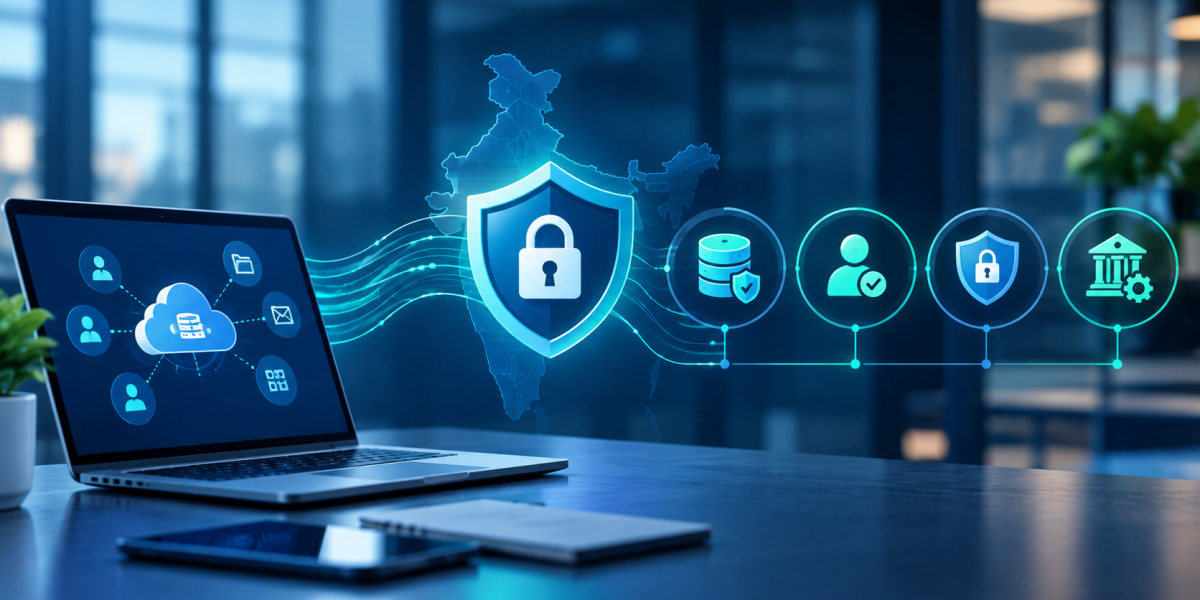







Artificial Intelligence is the gamechanger in cyber security. Meanwhile, businesses in Europe are quickly moving workloads to public, private and hybrid clouds to boost agility and innovation. These technologies offer great business value but also increase the attack surface.
From AI-enabled phishing attacks to misconfigured clouds, identity-based attacks to ever-evolving compliance standards, cybersecurity is no longer just an IT matter, but a strategic business concern.
Organisations must have an integrated Cybersecurity Services, secure Cloud Services, and professional Resource Augmentation to support secure Digital Transformation initiatives to succeed.
Why Are AI, Cloud Services and Cybersecurity Connected?
This is one of the top questions that business leaders often ask when they are thinking about adopting the cloud.
The answer is simple.
Cloud infrastructures are essential for Artificial Intelligence to process and analyse large amounts of data. AI solutions can help secure cloud platforms by automating threat detection, identifying unusual patterns, and speeding up the response to incidents, while cloud platforms offer the scalability that AI needs to power its applications.
If they aren’t properly protected by Cybersecurity Services, both AI and cloud environments are easy targets for cybercriminals.
This is why organisations are increasingly looking at combined Cloud Services and cyber security strategies as opposed to them being individual projects.
What Are Cybersecurity Services?
Cybersecurity Services are skilled offerings that shield organisations against cyber risks and help them grow securely. They use technology, expertise and constant surveillance to protect applications, cloud environments, networks, identities and business data.
Common Cybersecurity Services include:
- Managed Security Operations Centre (SOC)
- Threat Detection and Response
- Vulnerability Assessment
- Penetration Testing
- Cloud Security Services
- Identity and Access Management (IAM)
- Incident Response
- Security Consulting
- Compliance Assessments
- Security Awareness Training
These services are not designed to respond to cyber threats, but rather to proactively detect and negate risks before they affect business operations.
Why Are Cloud Services Driving Digital Transformation?
European companies are adopting “Cloud Services” due to their scalability, flexibility and speed to innovation.
Cloud platforms enable organisations to:
- Launch applications faster
- Improve collaboration
- Reduce infrastructure costs
- Support remote work
- Deploy AI solutions efficiently
- Accelerate Digital Transformation
But cloud adoption comes with its own set of challenges such as identity management, data protection, workload security and regulatory compliance.
This is why Cloud Security Services are vital to all cloud strategies.
The Growing Cybersecurity Challenges Faced by European Organisations
As technology advances, so do cyber threats. Ransomware, identity compromise, cloud misconfigurations, and supply chain attacks are also top five risks for European enterprises, according to industry reports by ENISA and IBM.
The most common challenges include:
- AI-Powered Cyberattacks
AI is being utilized by cybercriminals to automate phishing attacks, generate deep-fake videos and audio with high credibility, find vulnerabilities, and bypass legacy security mechanisms. Cyber attackers are now using AI to automate phishing campaigns, produce deep-fake content that is highly believable, exploit vulnerabilities, and compromise traditional security measures.
For this transformation to take place, organisations need to equip themselves with AI-powered Cybersecurity Services that can identify and react to threats in real time.
- Cloud Misconfigurations
A significant proportion of cloud security incidents result from human error rather than platform vulnerability.
Common examples include:
- Publicly exposed storage
- Excessive permissions
- Weak authentication
- Insecure APIs
- Poor identity governance
Organisations can mitigate these risks by detecting and remediating them through continuous monitoring, while also utilising Cloud Security Services to help prevent exploitation.
- Identity Is the New Security Perimeter
User identity is now the main weapon of attack, as organisations become cloud-native and have hybrid working arrangements.
In modern cybersecurity approaches, the focus is on:
- Multi-factor authentication
- Least privilege access
- Privileged Access Management
- Identity Governance
- Continuous authentication
How AI Is Transforming Cybersecurity
AI is not taking the place of cybersecurity professionals but it’s helping to complement them.
AI is leveraged in modern Cybersecurity Services to process billions of security events and detect anomalies, while also automating repetitive tasks.
Key applications include:
- AI-Based Threat Detection
AI continuously monitors user behaviour, cloud workloads, and network activity, looking for anything that doesn’t fit the pattern, which might signify a cyberattack.
Unlike conventional rule-based systems, AI can detect threats that haven’t been known before.
- Intelligent Security Operations
AI helps Security Operations Centres (SOC) prioritise alerts, reduce false positives, and accelerate incident investigations.
This enables security teams to focus on genuine threats instead of manually reviewing thousands of alerts.
- Predictive Cybersecurity
AI allows organisations to predict potential threats by analysing historical attack trends, vulnerability information and threat intelligence, instead of reacting to attacks as they happen.
Predictive cybersecurity is in service of proactive risk management rather than reactive incident response.
The Role of Resource Augmentation in Modern Cybersecurity
One of the key challenges for organisations in Europe is finding cyber security professionals. This is where Resource Augmentation makes a lot of sense.
Instead of hiring specialist staff, organisations expand their in-house teams by bringing in experienced cybersecurity experts with a range of skills such as cloud security, compliance, incident response, DevSecOps, and security architecture.
Resource Augmentation enables businesses to:
- Scale security operations faster
- Access specialised expertise
- Reduce hiring challenges
- Accelerate security projects
- Support complex cloud migrations
- Improve operational resilience
Resource augmentation allows organisations to meet the flexibility needed to ensure optimal cybersecurity without increasing permanent staff.
Cybersecurity and Digital Transformation Must Go Hand in Hand
Successful Digital Transformation depends on trust.
Every cloud migration, AI initiative, application modernisation project, or remote working programme introduces new cyber risks.
Integrating Cybersecurity Services from the beginning helps organisations:
- Protect sensitive business data
- Reduce operational risk
- Meet regulatory obligations
- Maintain customer trust
- Enable innovation securely
Security should no longer be viewed as a barrier to transformation but is an enabler of sustainable growth.
European Compliance Is Raising the Security Standard
Organisations operating across Europe face increasingly stringent cybersecurity requirements.
Key frameworks include:
- GDPR
- NIS2 Directive
- Digital Operational Resilience Act (DORA)
- EU AI Act
- ISO 27001
These regulations provide incentives for organisations to enhance governance, incident response and secure cloud environments throughout the digital transformation lifecycle.
Best Practices for Building a Secure Digital Future
To strengthen cyber resilience, organisations should:
- Integrate Cybersecurity Services into every Digital Transformation initiative.
- Adopt secure-by-design principles for all Cloud Services.
- Use AI to improve threat detection and incident response.
- Continuously monitor cloud environments.
- Strengthen identity and access management.
- Conduct regular vulnerability assessments and penetration testing.
- Build a Zero Trust architecture.
- Invest in employee security awareness.
- Leverage Resource Augmentation to address cybersecurity skills shortages.
- Regularly review compliance with European regulations.
Frequently Asked Questions
- Why are Cybersecurity Services important during Digital Transformation?
As organisations adopt new technologies, migrate to the cloud, and implement AI solutions, the attack surface expands. Cybersecurity Services help identify vulnerabilities, protect critical assets, maintain compliance, and reduce the likelihood of costly cyber incidents.
- How do Cloud Services improve business performance?
Modern Cloud Services enable organisations to scale infrastructure, improve collaboration, accelerate innovation, and reduce operational costs. When combined with robust Cloud Security Services, they also provide a secure foundation for business growth.
- What is Resource Augmentation in cybersecurity?
Resource Augmentation allows organisations to strengthen their internal IT and security teams by bringing in external cybersecurity specialists with expertise in cloud security, compliance, incident response, and advanced threat detection.
- How does AI improve cybersecurity?
AI enables organisations to detect threats faster, automate repetitive security tasks, analyse large volumes of security data, identify suspicious behaviour, and improve incident response. Combined with expert analysts, AI enhances the effectiveness of modern Cybersecurity Services.
- Why is cloud security essential for European businesses?
Cloud environments store critical applications and sensitive data. Effective Cloud Security Services protect these environments from misconfigurations, identity attacks, ransomware, and compliance risks while supporting secure Digital Transformation.
Conclusion
Smart, connected and cloud-based is the future of business. Cybersecurity needs to keep pace with the investments being made by organisations around Europe in AI, Cloud Services and Digital Transformation.
Resilience is not just about implementing security solutions. It requires a blend of Cybersecurity Services, AI-powered threat detection, a secure cloud framework, Resource Augmentation, and dedication to ongoing enhancements.
By integrating security into its digital journey, organisations can innovate without fear, comply with changing regulations, and safeguard their most important digital assets.
If your organisation is planning AI adoption, our guide on How Businesses Can Innovate with AI While Staying GDPR Compliant provides practical recommendations for balancing innovation, privacy, and cybersecurity.