






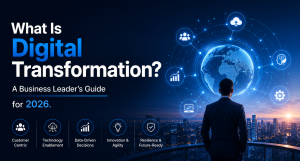
Imagine two manufacturing companies competing in the same market. One relies on spreadsheets, manual processes, and disconnected systems, causing delays and slow decision-making. The other leverages are AI-powered forecasting, cloud-based ERP, real-time dashboards, and automated workflows to optimize operations, respond faster to customers, and make data-driven decisions.
Both operate in the same industry, but only one is prepared for the future. That’s the difference between simply adopting digital tools and achieving true enterprise digital transformation.
In 2026, Digital Transformation is a must-have for business. Organizations must adapt continually, not only IT, but expectations of their customers, the impact of AI, cybersecurity threats, economic instability and competition are all forcing a constant evolution.
According to leading research by Gartner, companies that use artificial intelligence, cloud services, automation and data-driven decision making are always ahead of their peers in productivity, innovation and customer experience. The most successful are those that concentrate on technology that produces measurable business results.
Digital transformation is not just about replacing the old systems, it’s about creating an intelligent, resilient and customer-centric enterprise that can adapt, innovate and grow in a rapidly changing digital economy.
What Digital Transformation Really Means in 2026
Many organizations still associate digital transformation services with migrating to the cloud or implementing new software. While these initiatives are important, they represent only a portion of the transformation journey.
In 2026, digital transformation is best understood as the comprehensive reinvention of an organization through the intelligent application of technology, data, processes, and people.
It is about the way work is done, the way decisions are made, the way customers relate to the business and the way value is created throughout the business.
Instead of asking:
“Which technology should we buy?”
Leading organizations ask:
“How can technology help us achieve better business outcomes?”
This subtle shift in mindset is what separates successful digital transformation strategies from expensive technology implementations that fail to deliver measurable value.
Unlike traditional IT modernization, digital transformation impacts every business function, including:
- Executive leadership
- Operations
- Finance
- Human resources
- Customer service
- Sales and marketing
- Supply chain
- Manufacturing
- Product development
- IT and cybersecurity
It requires collaboration across departments rather than isolated technology projects.
The Characteristics of Digitally Mature Organizations
Businesses with high digital maturity typically demonstrate the following capabilities:
- Executive leadership actively champions transformation initiatives.
- AI is embedded into business workflows and decision-making.
- Cloud-native platforms provide scalability and operational flexibility.
- Data is treated as a strategic business asset.
- Automation reduces repetitive manual work.
- Cybersecurity is integrated into every digital initiative.
- Customer experience is personalized using real-time insights.
- Cross-functional collaboration accelerates innovation.
- Employees continuously develop digital skills.
- Technology investments are directly linked to measurable business outcomes.
Instead of looking at individual technology solutions, these companies develop an ecosystem that involves various forms of technology, people, and processes to generate sustainable business value.
Why Digital Transformation Matters More Than Ever
Organizations today operate in an environment characterized by constant disruption. Economic uncertainty, evolving customer expectations, AI-driven competition, cybersecurity risks, and regulatory requirements are reshaping industries at an unprecedented pace.
Digital transformation enables businesses to respond proactively rather than reactively.
- Customers Expect Seamless Digital Experiences
Customers are now accustomed to experiencing a seamless relationship with a company through multiple channels, across websites, mobile apps, customer portals and support channels. Inconsistent digital experiences can be a threat to businesses looking to keep their market share, as they may be outflanked by more agile businesses.
- Artificial Intelligence Is Reshaping Every Industry
The swift integration of Artificial Intelligence and Generative AI has transformed the way businesses work. Organizations that don’t have an AI transformation roadmap may fall behind competitors who are taking advantage of intelligent automation and data-driven decision making.
- Business Agility Has Become a Competitive Advantage
Unpredictable changes in the markets, be they due to a shift in demand or a problem in the supply chain, necessitate businesses to make rapid adjustments. Agility is no longer a competitive requirement; it’s a business requirement.
- Data Is the Foundation of Better Decision-Making
Valuable data is created with each customer’s interaction, process and business transaction. Today’s analytics systems take raw data and turn it into usable business intelligence to help decision makers make better and quicker decisions.
- Cybersecurity Is Now a Board-Level Priority
With organizations becoming more digital the risks of being cyber attacked are increasing in both the number of attacks and the sophistication of them. Incorporating cyber security into transformation efforts can ensure the protection of customer trust, business operations and organizational resilience.
Key Technologies Driving Digital Transformation
Technology serves as the foundation of digital transformation, but true success comes from selecting the right technologies to solve real business challenges. In 2026, organizations are increasingly combining AI, cloud, automation, analytics, IoT, cybersecurity, and low-code platforms to build intelligent, scalable, and resilient enterprises.
The following technologies are shaping the next generation of business transformation.
- Artificial Intelligence (AI) & Generative AI
Artificial Intelligence has evolved from a niche capability into a core business function. In 2026, AI is embedded across operations, customer service, software engineering, finance, and decision-making. Generative AI further expands these capabilities by creating content, generating code, summarizing knowledge, assisting employees, and accelerating product development.
- Cloud Computing
Cloud transformation continues to be a cornerstone of enterprise digital transformation. Rather than relying solely on on-premises infrastructure, organizations are adopting public, private, and hybrid cloud environments to improve flexibility, scalability, and resilience. Cloud platforms provide the foundation for modern applications, AI workloads, data analytics, and global collaboration.
- Data Analytics
Data has become one of the most valuable business assets. Modern analytics platforms help organizations transform raw information into actionable insights that drive better decisions across every function. Organizations that treat data as a strategic asset gain a significant advantage in agility, innovation, and competitive decision-making.
Benefits of Digital Transformation for Businesses
Organizations that approach digital transformation strategically realize benefits that extend well beyond IT modernization. They become more agile, resilient, customer-centric, and prepared for future disruption.
- Improved Operational Efficiency
Automation, AI, and optimized workflows eliminate repetitive tasks, reduce errors, and enable employees to focus on higher-value activities.
Business Impact
- Lower operating costs
- Faster execution
- Improved productivity
- Reduced manual effort
- Faster Decision-Making
Data analytics and AI provide leaders with real-time insights rather than relying on outdated reports.
Business Impact
- Faster strategic decisions
- Improved forecasting accuracy
- Reduced uncertainty
- Greater Business Agility
Cloud platforms and modern architecture enable organizations to respond quickly to changing market conditions.
Business Impact
- Faster product launches
- Easier scaling
- Improved resilience
- Better collaboration
- Quicker innovation cycles
- Increased Employee Productivity
Employees spend less time on repetitive administrative work and more time on innovation, customer engagement, and strategic initiatives.
Examples include:
- AI copilots
- Knowledge management
- Workflow automation
- Digital collaboration platforms
- Stronger Cybersecurity and Compliance
Modern transformation initiatives incorporate security from the outset.
Organizations benefit from:
- Zero Trust architecture
- Identity management
- Threat monitoring
- Data governance
- Regulatory compliance (e.g., GDPR, NIS2)
Concluding Thoughts
Digital transformation in 2026 is no longer just about adopting new technologies but about reimagining how businesses operate, innovate, and deliver value. Organizations that combine AI, cloud, automation, data, and cybersecurity with the right strategy, people, and processes are better positioned to improve efficiency, enhance customer experiences, and stay competitive.
At Sphinx, we help businesses accelerate their digital transformation journey with expertise in AI, cloud modernization, application modernization, automation, data engineering, and cybersecurity. Our business-first approach enables organizations to modernize legacy systems, optimize operations, and build secure, scalable digital solutions that deliver measurable outcomes.
Whether you’re taking the first step or scaling enterprise-wide transformation, success starts with a clear strategy and the right technology partner. The businesses that invest in digital transformation today will be the ones leading their industries tomorrow.
FAQs
- What is digital transformation?
Digital transformation is the process of integrating digital technologies, such as AI, cloud computing, automation, and data analytics, into business operations to improve efficiency, enhance customer experience, and drive innovation.
- Why is digital transformation important for businesses in 2026?
Digital transformation helps businesses stay competitive by improving agility, reducing operational costs, enabling data-driven decisions, strengthening cybersecurity, and delivering better customer experiences in an increasingly digital economy.
- What are the key technologies driving digital transformation?
The primary technologies include Artificial Intelligence (AI), Generative AI, cloud computing, data analytics, automation and RPA, Internet of Things (IoT), cybersecurity, and low-code/no-code platforms.
- How long does a digital transformation initiative take?
The timeline depends on the organization’s size, goals, and complexity. While smaller initiatives may take a few months, enterprise-wide digital transformation is typically an ongoing journey with phased implementation and continuous optimization.
- How can businesses start their digital transformation journey?
Businesses should begin by assessing their current digital maturity, defining clear business objectives, identifying high-impact opportunities, creating a digital transformation roadmap, and partnering with experienced experts to implement the right technologies effectively.