







Cloud computing is no longer just an IT infrastructure option. It has become a strategic pillar for many businesses, enabling faster market response, resilience, AI adoption, application modernization, and operational scale.
However, should every business shift to the cloud?
Not necessarily.
The question isn’t whether cloud computing is worth investing in. It’s determining whether your organization has a solid business case, and the appropriate architecture, governance structure and operating strategy for the cloud.
It’s even more complicated for European businesses. In addition to scalability and cost-effectiveness, data protection, cybersecurity, regulatory compliance, operational resilience, data sovereignty, vendor reliance, and more recently AI infrastructure needs are all essential factors to consider.
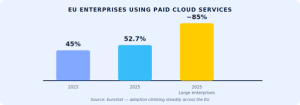
The European cloud market is already moving in this direction. Eurostat estimates that in 2023, 45% of EU enterprises used paid cloud computing services, while 52.7% did in 2025. Adoption was particularly high among large businesses, with almost 85% using paid cloud services.
So, are cloud computing solutions for business worth the investment?
In most cases, the answer is yes, when the move to the cloud is motivated by tangible business results, not just by offloading legacy servers to someone else’s data center.
The value is found in architecture selection, migrating the right workloads, securing the environment, managing consumption, and continuously optimizing the cloud estate.
What Are Cloud Computing Solutions for Business?
Cloud computing solutions for businesses refer to technology services that enable enterprises to leverage computing resources — servers, storage, databases, networking, applications, analytics, and AI — over the internet rather than solely on their own physical infrastructure.
In practical terms, businesses can use cloud platforms to:
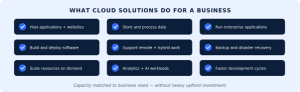
Organizations can access technology resources as needed rather than making heavy upfront investments in physical infrastructure, so infrastructure capacity matches business need.
How Cloud Computing Works for Modern Enterprises
Modern cloud computing is not limited to one platform or deployment model. Enterprises may combine:
- Infrastructure as a Service (IaaS)
- Platform as a Service (PaaS)
- Software as a Service (SaaS)
- Containers and Kubernetes
- Serverless computing
- Cloud-native applications
- Managed cloud services
- Data and analytics platforms
- AI and machine learning services
This flexibility allows businesses to create cloud environments that match their specific operational, regulatory, and technology requirements.
Why Is Cloud Computing Becoming a Business Priority in Europe?
There is a growing landscape of technology choices that can impact resilience, security, compliance, and digital sovereignty for European businesses.
The cloud strategy of the European Commission puts a strong focus on security, sustainability and interoperability of cloud infrastructure and services. The EU is also intensifying its focus on technology sovereignty and mitigating strategic dependencies in critical technology fields, such as cloud and data infrastructure.
For businesses, this creates a more sophisticated cloud decision. A modern cloud strategy must consider the below:
- Where business and customer data is stored
- How data is accessed and protected
- Which regulatory requirements apply
- How cloud providers manage security
- How dependent the organization becomes on a particular provider
- How workloads can be moved or recovered
- How cloud costs are monitored
- How cloud infrastructure supports AI and data initiatives
In regulated industries, the stakes are even higher. Digital operational resilience and third-party ICT risk are key considerations for financial services organizations under frameworks like DORA. Organizations in scope of NIS2 also face cybersecurity risk management and resilience requirements relevant to their sector and operations.
This makes the question of cloud investment less about “Should we move to the cloud?” and more about:
“What cloud strategy will help us become more scalable, secure, resilient, and competitive without creating unnecessary cost or risk?”
Are Cloud Computing Solutions Really Worth the Investment?
The answer depends on how effectively cloud investment translates into measurable business value. Here are the areas where cloud computing for businesses can create the greatest impact.
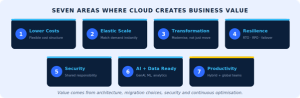
1. Lower Infrastructure and Operational Costs
Cloud can reduce the need for organizations to purchase, operate, and maintain large amounts of physical infrastructure. Businesses can potentially reduce spending associated with hardware procurement, data center operations, infrastructure maintenance, capacity planning, hardware refresh cycles, and physical infrastructure management.
But saving money in the cloud isn’t a foregone conclusion. Without optimization, a business moving inefficient workloads to the cloud is simply replacing one cost structure with another.
For cloud cost management, the following practices matter:
- Right-sizing resources
- Usage monitoring
- Workload scheduling
- Reserved or committed capacity where appropriate
- Storage lifecycle management
- FinOps practices
- Continuous optimization
The goal should not simply be “move to the cloud and spend less.” The better goal is:
“Create a more flexible technology cost structure that aligns IT spending with business value.”
2. Scale IT Resources with Business Demand
Scalability is one of the finest advantages of cloud solutions for businesses. Seasonal traffic, sudden surges, new market releases, or unexpected growth are all situations a business could face. With traditional infrastructure, response times to a sudden surge may be long, since capacity must be procured in advance.
Cloud environments offer far greater flexibility. For example:
- An e-commerce business can prepare for seasonal demand.
- A media company can support traffic spikes.
- A SaaS company can scale its infrastructure as its customer base grows.
- A manufacturer can expand digital workloads as connected operations increase.
This scalability enables businesses to pursue opportunities without waiting for long infrastructure procurement cycles.
3. Accelerate Digital Transformation
Cloud adoption can provide the foundation for broader technology transformation. Cloud environments make it easier to adopt microservices, containers, Kubernetes, DevOps, CI/CD, APIs, data platforms, AI and machine learning, and serverless technologies.
This is particularly important for businesses modernizing legacy applications. Instead of treating cloud migration as the destination, organizations can use migration as an opportunity to evaluate whether each application should be rehosted, re-platformed, refactored, rebuilt, retired, or replaced.

This approach turns cloud migration into a catalyst for application modernization and faster innovation.
4. Improve Business Continuity and Resilience
Business disruption can have financial, operational, and reputational consequences. Cloud infrastructure can support resilience strategies through automated backups, disaster recovery, geographic redundancy, high availability architectures, infrastructure automation, recovery orchestration, and continuous monitoring.
The value is not simply having data stored somewhere else. A resilient cloud strategy must define:
- Recovery Time Objectives (RTO)
- Recovery Point Objectives (RPO)
- Critical workloads
- Recovery dependencies
- Backup policies
- Failover procedures
- Testing frequency
Many companies in Europe face greater cyber and operational risk than ever, making resilience a board-level topic rather than an IT one. ENISA’s latest threat landscape report finds that availability threats, ransomware and data threats remain highly prominent in the European cybersecurity landscape.
5. Strengthen Security and Compliance
Cloud security can provide access to advanced capabilities that may be difficult for every organization to build independently. Depending on architecture and provider, businesses can implement identity and access management, multi-factor authentication, encryption, security monitoring, threat detection, security posture management, network segmentation, and automated compliance controls.
But cloud security is a shared responsibility. Moving workloads to the cloud does not transfer all security responsibilities to the cloud provider.
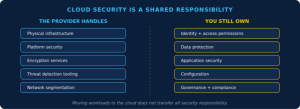
For European businesses, cloud security strategies may also need to align with requirements arising from GDPR, NIS2, DORA, ISO 27001, and sector-specific regulations.
6. Enable AI, Data, and Modern Applications
Cloud and AI are becoming more intertwined. AI workloads can be demanding in terms of computing power, data processing, storage, and specialized infrastructure. Organizations can access these capabilities through cloud platforms without deploying extensive infrastructure of their own.
The European Commission is also making cloud infrastructure a strategic enabler of the European AI and technology ecosystem. Its 2026 proposal for Cloud and AI Development aims to build cloud and data center capacity and boost Europe’s competitiveness and digital sovereignty in cloud and AI.
For businesses, this means cloud investment can become an enabler for:
- Generative AI
- Machine learning
- Predictive analytics
- Real-time data processing
- Intelligent automation
- AI-powered applications
The organizations that build flexible, governed, and secure cloud foundations today may be better positioned to operationalize AI tomorrow.
7. Improve Workforce Productivity
Cloud apps and services enable distributed teams to work together across locations. Business applications, data and collaboration tools are accessible from anywhere, while organizations retain centralized governance and access controls.
This can support hybrid work, global collaboration, faster information access, centralized data, and improved digital employee experiences. For European companies operating across multiple countries, cloud services can also support more consistent technology environments across geographically distributed teams.
Types of Cloud Computing Solutions Businesses Can Consider
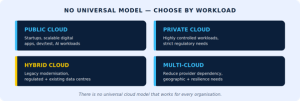
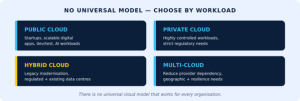
There is no universal cloud model that works for every organization.
1. Public Cloud
Public cloud platforms provide shared infrastructure operated by cloud service providers. Best suited for startups and growing companies, digital applications, scalable workloads, development and testing, and data and AI workloads.
2. Private Cloud
Private cloud environments provide dedicated infrastructure and greater control. Best suited for highly controlled workloads, specific regulatory requirements, and organizations with specialized infrastructure needs.
3. Hybrid Cloud
Hybrid cloud combines private infrastructure with public cloud services. Best suited for legacy modernization, regulated workloads, organizations with existing data centres, and workloads requiring different deployment environments.
4. Multi-Cloud
Multi-cloud involves using services from multiple cloud providers. Potential advantages include reducing dependency on a single provider, selecting specialized capabilities, supporting geographic requirements, and improving resilience with suitable architecture.
Cloud Computing Trends Shaping European Businesses in 2026
1. Cloud and AI Are Becoming Increasingly Connected
Adopting AI is driving demand for scalable compute, data infrastructure and cloud platforms. Enterprises therefore need to assess whether their cloud architecture will be able to accommodate future AI workloads.
2. Digital Sovereignty Is Becoming a Strategic Consideration
European technology strategy is now more centered on resilience, strategic dependencies and control over critical digital infrastructure. Cloud, AI, data and open-source technologies are identified as strategic areas in the European Commission’s technology sovereignty initiatives for 2026.
For enterprises, this may increase attention on data residency, provider dependencies, portability, interoperability, and sovereign cloud considerations.
3. Cloud Security Is Becoming More Proactive
Security is shifting from reactive controls to continuous risk management. Organizations are increasingly looking at identity-first security, Zero Trust, continuous monitoring, automated compliance, and cloud security posture management.
4. Hybrid and Multi-Cloud Strategies Will Continue
Many enterprises will remain in multiple environments for a variety of reasons — legacy requirements, regulatory needs, business acquisitions, and workload-specific needs. The emphasis will increasingly be on managing this complexity effectively, rather than following a one-size-fits-all cloud approach.
Conclusion: Is Cloud Computing Worth the Investment?
Yes, cloud computing solutions can be worth investing in, but only when the investment is connected to measurable business outcomes.
The strongest cloud strategies do more than replace physical servers. They help organizations build scalable infrastructure, modernize applications, improve resilience, strengthen security, accelerate software delivery, and prepare for emerging technologies such as AI.
For European businesses, the decision also requires a deeper focus on data governance, cybersecurity, regulatory requirements, resilience, and digital sovereignty.

Working this way, organizations can use cloud computing as a tool for achieving strategic objectives — not merely as the cost of running IT. The real question isn’t whether cloud is a trend to follow. It’s whether your existing technology environment is scalable, resilient, secure and agile enough to compete, and whether cloud can help bridge that gap.
At Sphinx, we help businesses design and execute cloud strategies that align business objectives, technology capabilities and future growth. We specialize in providing diverse Cloud services including Cloud Migration, Cloud Managed Services, Cloud Security, and Cloud & DevOps services that help our clients create secure, scalable, resilient and cost-effective cloud solutions.