







Digital transformation is more than cloud migration, automating manual processes, or launching a new digital channel.
For European enterprises, it has become a broader business strategy for modernizing operations, enhancing customer experiences, boosting resilience, leveraging AI, and developing the technology skills needed for long-term growth.
Yet in many organizations, transformation work is still a series of isolated IT initiatives. One department runs a cloud migration. Another implements AI. A third replaces an application. Meanwhile data stays scattered, staff still rely on manual methods, and technology doesn’t always translate into tangible business impact.
That is where the real challenge lies.
Digital transformation succeeds when technology, people, processes, data and business goals all move in the same direction.
The European transformation agenda is growing more complex. Organizations must modernize legacy systems amid a changing regulatory landscape, rising customer demands, cybersecurity risks, and the rapid advancement of AI. The outcome is a paradigm shift in how technology is used.
“Technology is no longer just an enabler of business strategy. It is becoming part of the business strategy.”
What Is Digital Transformation in Business?
In business, digital transformation is the process of using digital technologies to restructure how an organization operates, serves customers, makes decisions and generates value. It is far more than implementing a single software application.
A successful transformation program might involve:
- Cloud computing
- Artificial intelligence and machine learning
- Data and analytics
- Business process automation
- Application modernization
- Cybersecurity
- Digital customer experiences
- Enterprise integration
- Modern engineering practices
The goal is not simply to become “digital.” It is to become more agile, efficient, resilient, data-driven, scalable, and able to deal with change.
Digitization vs. Digitalization vs. Digital Transformation
These terms are often used interchangeably, but they are not identical.
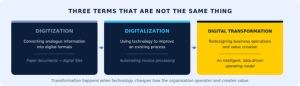
This distinction matters, because technological change alone does not transform a business. Transformation occurs when technology changes how the organization operates and generates tangible business results.
Why Does Digital Transformation Matter for European Businesses?
European businesses are operating in a market undergoing several rapid transformations at once. Digital transformation is becoming a priority for several converging reasons.

1. Legacy Technology Is Limiting Agility
Many well-known organizations are still running systems-built years or even decades ago. These environments can create high maintenance costs, integration complexity, security vulnerabilities, slow-release cycles, limited scalability, and difficulty adopting modern technologies.
Legacy app modernization can help organizations phase out, rearchitect, refactor or connect legacy systems to modern platforms.
2. AI Is Changing How Businesses Operate
Interest in intelligent automation, knowledge management, software engineering, customer service, analytics and decision support is accelerating with the rise of generative AI. But AI adoption isn’t just about deploying a model. Businesses also need:
- Quality data
- Secure infrastructure
- Governance
- Responsible AI practices
- Integration with enterprise systems
- Human oversight
European businesses must also consider regulatory and governance conditions when developing AI strategies, such as those set out in the EU AI Act.
3. Cybersecurity Has Become a Business Priority
As organizations become more technologically connected, technology risk becomes business risk. Cybersecurity must therefore be part of the digital transformation process from the outset.
Depending on their sector and size, European businesses may need to address the requirements and expectations of frameworks such as GDPR, NIS2, DORA, and the EU AI Act. Specific duties vary by sector, organization size, role, and jurisdiction.
4. Customer Expectations Are Rising
Customers increasingly expect faster digital interactions, personalized experiences, consistent omnichannel engagement, real-time information, and frictionless transactions. Businesses that cannot adapt to their digital experiences risk losing customers to more agile competitors.
5. Technology Talent Is Difficult to Scale
Transformation requires skills across cloud, cybersecurity, AI, data engineering, software development, DevOps and enterprise architecture. Not every organization can recruit — or retain — all these specialists. This has driven growing interest in more flexible delivery options such as IT staff augmentation, dedicated engineering teams, and managed technology services.
The Business Value of Digital Transformation
A well-designed transformation program should create measurable business outcomes — not simply deliver new technology.
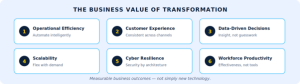
1. Improved Operational Efficiency
Automation and modern applications can reduce repetitive manual work and streamline workflows. Potential improvements include faster processing, fewer manual errors, reduced operational friction, better resource utilization, and improved employee productivity.
The key is to automate intelligently. Automating a broken process simply creates a faster broken process.
2. Better Customer Experiences
Digital transformation allows organizations to link customer information, business processes and digital channels together. This helps businesses provide more consistent experiences across websites, mobile applications, customer portals, contact centers, and physical and digital channels. The goal is to make customer interactions more relevant, accessible and convenient.
3. Faster, Data-Driven Decision-Making
Disconnected data makes it hard for leaders to see what is happening across the business. A modern data architecture integrates data from different systems and delivers more actionable insight, moving decision-makers up the ladder:

4. Greater Scalability
Modern cloud architectures, APIs, microservices, containers and automation make technology environments more flexible and adaptable. Businesses can scale resources as needed rather than being locked to fixed infrastructure. This is particularly valuable for organizations experiencing seasonal demand, geographic expansion, rapid growth, or new digital product launches.
5. Stronger Cyber Resilience
Transformation is an opportunity to re-imagine security architecture. Modern approaches can include Zero Trust principles, identity and access management, multi-factor authentication, security monitoring, secure software development, data protection, and threat detection and response.
Security should be treated as an architectural requirement rather than an add-on.
6. Greater Workforce Productivity
The key is increasing employee effectiveness rather than simply providing more tools. AI assistants, workflow automation, knowledge platforms, collaboration systems and modern enterprise applications can streamline administrative tasks and free employees for more meaningful work. The best transformation programs improve both customer experience and employee experience.
The Key Pillars of a Successful Digital Transformation Strategy
Digital transformation requires multiple capabilities working together.
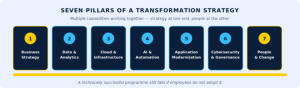
1. Business Strategy
Transformation must begin with a business objective — reducing operating costs, increasing revenue, improving customer retention, entering new markets, or improving resilience.
2. Data and Analytics
Data needs to be accessible, reliable, governed and usable. Without a robust data foundation, advanced analytics and AI efforts struggle to deliver long-term value.
3. Cloud and Infrastructure
Cloud technologies provide scalability and flexibility, but cloud transformation should also cover architecture, security, governance, FinOps and operational management.
4. AI and Intelligent Automation
AI can improve decision-making, automate workflows, assist customer service and support employees. Organizations should prioritize use cases according to business value rather than following the AI trend.
5. Application Modernization
Phased migration of legacy applications can improve maintainability, security, scalability and integration. Strategies may include rehosting, re-platforming, refactoring, rearchitecting, rebuilding, or replacing.
6. Cybersecurity and Governance
The transformation architecture should be built with security, privacy, compliance and risk management designed in from the start.
7. People and Change
Even technically successful programs fail if employees do not adopt the new processes. Change management, training, communication and leadership alignment are crucial.
Common Digital Transformation Challenges
Most transformation obstacles are predictable — and addressable with the right sequencing and governance.
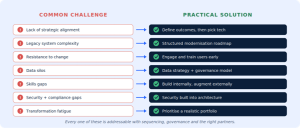
1. Lack of Strategic Alignment
Transformation can become a succession of uncoordinated technology initiatives if business and technology leaders have different goals.
Solution: Identify measurable business outcomes first, then choose technology.
2. Legacy System Complexity
Older systems can make integration and modernization difficult.
Solution: Create a structured modernization roadmap rather than attempting to replace everything simultaneously.
3. Resistance to Change
When benefits are not apparent, staff may be reluctant to accept new systems or processes.
Solution: Engage users early; train and communicate continuously.
4. Data Silos
Fragmented data prevents organizations from gaining a unified view of customers and operations.
Solution: Establish a data strategy and governance model.
5. Skills Gaps
Internal teams often lack the skills and capacity needed to implement transformation programmes at scale.
Solution: Adopt a mix of internal capability building and strategic partnerships, staff augmentation or managed services as appropriate.
6. Security and Compliance Gaps
Rapid transformation can create new attack surfaces and governance challenges.
Solution: Integrate cybersecurity and compliance into architecture and delivery from the beginning.
7. Transformation Fatigue
Running too many initiatives simultaneously can overwhelm employees and leadership teams.
Solution: Prioritize initiatives and establish a realistic transformation portfolio.
Digital Transformation Trends Shaping European Enterprises in 2026
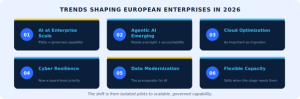
1. AI Is Moving from Experimentation to Enterprise Adoption
Organizations are increasingly exploring how AI can be embedded into business processes and products. The focus is shifting from isolated pilots toward scalable, governed AI capabilities.
2. Agentic AI Is Emerging
AI systems capable of executing multi-step tasks could reshape enterprise workflows. However, organizations will need strong governance, security controls, human oversight, and clear accountability.
3. Cloud Optimization Is Becoming as Important as Cloud Migration
Moving workloads to the cloud is only one step. Enterprises increasingly need to optimize cost, performance, security, resilience and governance.
4. Cyber Resilience Is Becoming a Board-Level Priority
As cyber risks evolve, organizations are increasingly focused on their ability to prevent, detect, respond to, and recover from incidents. IBM reports provide further insight into the evolving relationship between AI adoption, security, and governance.
5. Data Modernization Is Becoming an AI Prerequisite
AI initiatives depend heavily on data quality, accessibility, governance and architecture. Businesses with fragmented or poorly governed data may struggle to scale AI successfully.
6. Flexible Technology Capacity Is Becoming Strategic
Transformation programmes require access to specialized skills at different stages. For some organizations, combining internal teams with external engineering capacity provides greater flexibility than relying exclusively on permanent hiring.
Conclusion
Successful digital transformation depends on four things working together: strategy, technology knowledge, engineering capability, and execution.

Sphinx helps businesses tackle complex transformation projects across AI and ML, application modernization, cloud and DevOps, data and analytics engineering, cybersecurity, and technology transformation.
Whether you are modernizing legacy applications, migrating workloads to the cloud, strengthening cyber resilience, implementing AI, or expanding your engineering capacity, the right transformation strategy can make technology investments more sustainable for your business.