







The Digital Personal Data Protection Act (DPDP Act), 2023 is set to transform the way organizations in India handle digital personal data, including its collection, processing, storage, sharing, and protection. Compliance with the DPDP does not require a privacy policy or form of consent. It demands a coordinated approach to data governance, applications, cloud infrastructure, cyber security, third party systems, business processes and organizational accountability.
As the DPDP Rules 2025 are now notified and implementation is phased, 2026 should be regarded as a key preparation and implementation year, rather than just a compliance deadline. The Ministry of Electronics and Information Technology (MeitY) notified the Rules on 14 November 2025 and introduce a phased commencement of various provisions of the Rules.
This guide outlines the DPDP compliance requirements, the technology implications, security expectations, consent management considerations and the implementation roadmap that businesses can follow in preparation for meeting DPDP compliance in 2026; it also includes a checklist and penalties for non-compliance.
What Is the DPDP Act?
The Digital Personal Data Protection Act, 2023 is India’s primary legislation governing the processing of digital personal data. The Act aims to recognize an individual’s right to protect personal data while allowing organizations to process personal data for lawful purposes.
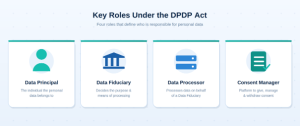
The Act defines important roles including:
- Data Principal – the individual to whom personal data relates.
- Data Fiduciary – the organization or person that determines the purpose and means of processing personal data.
- Data Processor – an organization or person that processes personal data on behalf of a Data Fiduciary.
- Consent Manager – a registered entity that can provide a platform through which individuals can give, manage, review and withdraw consent.
The Act applies to processing of digital personal data in India and can also apply to processing outside India when connected with offering goods or services to Data Principals in India, subject to the Act’s provisions
Who Needs DPDP Compliance?
DPDP compliance is not restricted to SaaS companies or technology businesses.
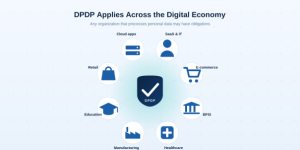
Organizations across the digital economy may need to assess their obligations depending on how they process personal data.
This can include:
- Software and SaaS companies
- IT services organizations
- E-commerce businesses
- Banks and financial institutions
- Insurance companies
- Healthcare organizations
- Manufacturing companies
- Retail businesses
- Educational institutions
- Telecommunications companies
- Travel and hospitality businesses
- Professional services firms
- Digital platforms and marketplaces
- Organizations using cloud-based business applications
- Enterprises processing employee, customer, partner or vendor data
The important question is not simply “What industry are we in?”
The better question is:
“What personal data do we process, why do we process it, how do we process it, and what role do we have in that processing?”
Understanding the DPDP Compliance Requirements
The DPDP compliance requirements span several interconnected areas.
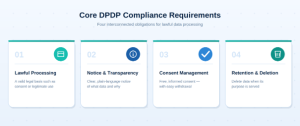
- Lawful Processing
The organizations must have a lawful basis to process personal data under the Act, such as consent, or a specified legitimate use if applicable. The Act sets out a lawful purpose to process personal data, under which the Data Principal can give consent or certain legitimate uses arise.
This means that enterprises must be aware of the meaning of each major processing function.
- Clear Notice and Transparency
If consent is necessary, an adequate notice must be provided, informing us of the data being processed and purpose of processing.
The DPDP Rules 2025 also provide additional guidance on notices, such as giving notices separately, in plain and understandable language and providing an itemized description of personal data and the purpose/purposes.
This implies that privacy notices need to be linked to technology and business processes. The notice and the application, analytics system or platform should not say one thing and do another.
- DPDP Consent Management
DPDP consent management is more than adding a consent checkbox to a website.
Consent, according to the Act, is free, certain, informed, unconditional and unambiguous; it is where the person gives clear, positive consent. It also provides Data Principals with a right to revoke consent, on par with the ease of giving consent.
- Data Retention and Deletion
Another crucial aspect of DPDP readiness is the understanding of organizations on when personal data should no longer be stored.
The Act mandates the deletion of personal data for a Data Fiduciary, in accordance with the applicable legal retention obligations, if the purpose for which the data was collected is no longer pursued, or if the conditions included in the Act conditions for its deletion are met.
DPDP Security Requirements: What Businesses Should Implement
The DPDP security requirements should be translated into practical technical and organizational controls.
The Act requires Data Fiduciaries to implement appropriate technical and organizational measures and take reasonable security safeguards to prevent personal data breaches.
The DPDP Rules 2025 provide further details around reasonable security safeguards, including measures such as encryption or masking, access controls, monitoring, logs, backups and related security measures.
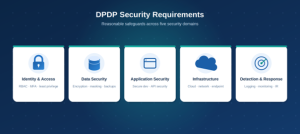
A practical DPDP security program can include:
Identity and Access Management
- Role-based access
- Least privilege
- Multi-factor authentication
- Privileged access management
- Periodic access reviews
Data Security
- Encryption
- Masking
- Tokenization where appropriate
- Database security
- Secure backups
- Key management
Application Security
- Secure development practices
- Vulnerability management
- API security
- Authentication and authorization
- Security testing
Infrastructure Security
- Cloud security
- Network segmentation
- Endpoint security
- Configuration management
- Security monitoring
Detection and Response
- Security logging
- Monitoring
- Incident detection
- Breach response
- Investigation
- Recovery
Security should therefore be integrated into the complete data lifecycle rather than implemented as a standalone compliance activity.
DPDP Compliance Architecture for Modern Businesses
DPDP compliance should be embedded across the technology ecosystem.
A practical architecture can be organized into seven layers.
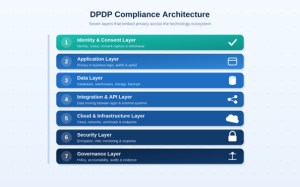
- Identity and Consent Layer
Carries out user identity management, user privacy notices, captures consent, and implements consent status and withdrawal procedures.
- Application Layer
Incorporates privacy in business processes, authentication, authorization and processing logic.
- Data Layer
Offers transparency and security in all databases, data warehouses, object storage, back-ups and analytics stores.
- Integration and API Layer
Captures information that moves within enterprise apps and between apps and external systems.
- Cloud and Infrastructure Layer
Protects cloud environments, networks, workloads, storage and endpoint and infrastructure configuration.
- Security Layer
Implements encryption, IAM, monitoring, vulnerability management and incident detection and response.
- Governance Layer
Relates technology controls to policies, accountability, vendor management, audits, and risk assessment and compliance evidence.
The architecture supports organizations in transitioning from policy compliant to operational compliant.
DPDP Compliance Roadmap: A Six-Stage Approach
A practical DPDP compliance roadmap can be structured into six stages.
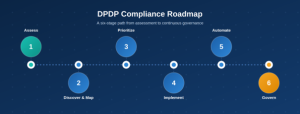
Stage 1: Assess
Understand existing data, systems, processes, stakeholders and compliance gaps.
Output: Current-state assessment.
Stage 2: Discover and Map
Identify personal data and map its movement across applications, infrastructure and third parties.
Output: Data inventory and data-flow maps.
Stage 3: Prioritize
Rank gaps based on data sensitivity, business impact, security exposure and regulatory requirements.
Output: Prioritized remediation plan.
Stage 4: Implement
Introduce required controls across consent, applications, IAM, encryption, monitoring, retention, deletion and vendor management.
Output: Implemented controls.
Stage 5: Automate
Automate repeatable activities such as data discovery, access reviews, consent synchronization, retention workflows and security monitoring.
Output: Scalable compliance operations.
Stage 6: Govern
Continuously monitor compliance, review vendors, test controls, manage incidents and update policies.
Output: Continuous DPDP readiness.
DPDP Penalties: Why Compliance Cannot Be an Afterthought
DPDP penalties can be significant.
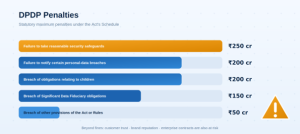
Under the Act’s Schedule, penalties may extend to:
| Non-compliance | Maximum penalty |
| Failure to take reasonable security safeguards | ₹250 crore |
| Failure to notify certain personal-data breaches | ₹200 crore |
| Breach of obligations relating to children | ₹200 crore |
| Breach of Significant Data Fiduciary obligations | ₹150 crore |
| Breach of other provisions of the Act or Rules | ₹50 crore |
These are statutory maximum penalties; the actual penalty depends on the applicable provision and circumstances.
The potential financial impact is only one reason to invest in DPDP readiness.
A personal-data incident can also affect:
- Customer trust
- Business continuity
- Enterprise contracts
- Brand reputation
- Vendor relationships
- Regulatory relationships
- Internal operational efficiency
For this reason, DPDP should be treated as an ongoing risk-management capability rather than a one-time compliance project.
How DPDP Compliance Changes Across Industries
The principles of DPDP are general and the technology and operational issues may vary across industry sectors.
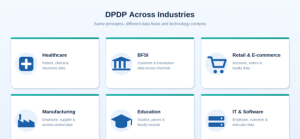
- Healthcare
Patient, employee, appointment, insurance health-service data can be exchanged throughout clinical applications, portals and cloud systems.
- BFSI
Banks and financial institutions and insurance providers store large volumes of customers and transaction data in digital channels, core systems and third-party platforms.
- Retail and E-commerce
Customer accounts, contact information, transaction data, loyalty programs and marketing data can be transferred between websites, mobile applications, CRM systems and analytics platforms.
- Manufacturing
Personal information can be stored in employee systems, supplier systems, customer applications, access-control systems and in enterprise applications.
- Education
Students, parents, faculty and employee information may be processed by institutions throughout learning platforms, admission applications, portals and administration applications.
- IT and Software
Technology companies can capture employees, customers, end-user and client data on applications, cloud platforms, development environments, support systems and analytics platforms.
How Sphinx Can Support DPDP Readiness
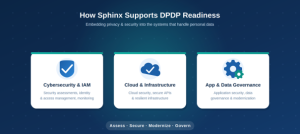
DPDP implementation often requires collaboration across privacy, cybersecurity, cloud, application engineering, data platforms and enterprise architecture.
Sphinx can help organizations address the technology side of DPDP readiness through:
- Cybersecurity assessments
- Dataflow and security architecture reviews
- Identity and access management
- Cloud security
- Application security
- Secure API development
- Data governance
- Modernization application
- Security monitoring
- Incident-response capabilities
- Compliance-focused technology transformation
- Technology resource augmentation
The objective is to help organizations embed privacy and security controls into the systems where personal data is collected, processed, stored and shared.
Conclusion
The DPDP Act changes how organizations need to think about personal data. Compliance is not simply about creating a privacy policy, adding a consent checkbox or completing a legal assessment.
The most effective DPDP compliance roadmap therefore combines:
Data governance + Privacy + Cybersecurity + Cloud security + Application controls + Vendor governance + Continuous monitoring
Organizations that begin with a structured DPDP gap assessment, establish a practical DPDP compliance checklist, address their DPDP security requirements, and build scalable DPDP consent management capabilities will be better positioned to manage the phased implementation of the framework and strengthen customer trust. DPDP compliance should not be treated as a one-time regulatory deadline. It should become part of how an organization designs, manages and protects personal data.