



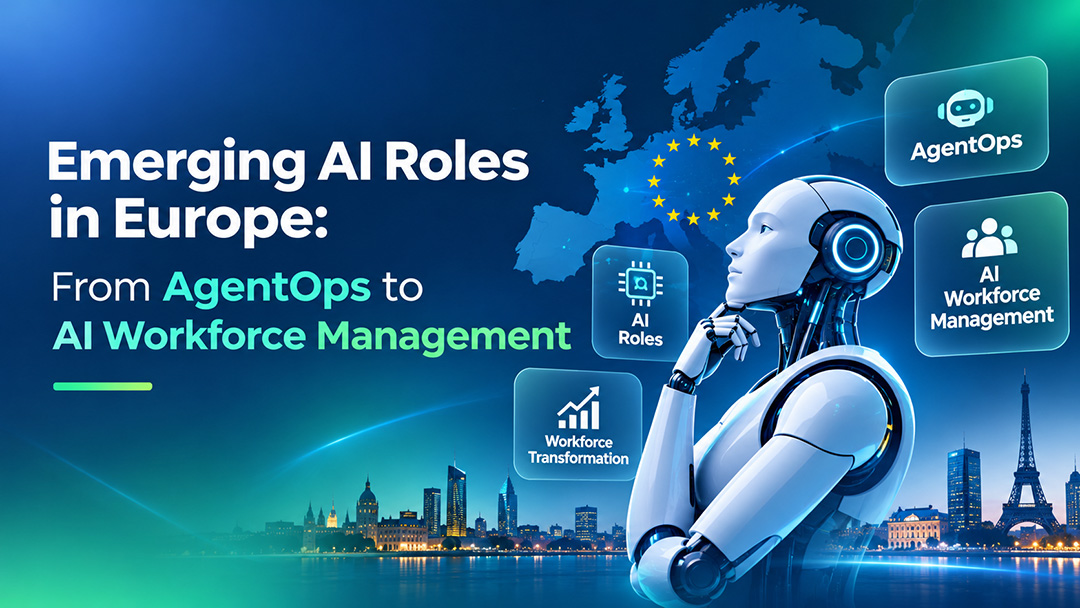

Artificial intelligence is changing more than the technology enterprises use. It is reshaping how organizations organize work, make decisions, and what skills they need to remain competitive.
As businesses move from generative AI experiments to autonomous and agent-based systems, new responsibilities are emerging across AI engineering, operations, governance, security, and workforce management. Roles such as AgentOps Engineer, AI Platform Architect, AI Governance Specialist, and AI Workforce Manager are becoming increasingly relevant to organizations looking to deploy AI responsibly and at scale.
This shift is also influencing digital transformation strategies across Europe. Businesses need professionals who can connect AI capabilities with enterprise systems, manage operational risks, and ensure that human teams and AI agents work effectively together.
The opportunity is not limited to technology companies. Organizations across sectors need a combination of technical expertise, business understanding, and governance capabilities to make AI adoption sustainable.
Why Is Demand for New AI Roles Growing in Europe?
AI adoption is moving beyond individual productivity tools and isolated pilot projects. Enterprises are exploring AI agents that can retrieve information, coordinate tasks, interact with applications, and support multi-step business processes.
This creates new responsibilities throughout the AI lifecycle. Someone must design the agent architecture, monitor its performance, and ensure its decisions remain secure, explainable, and aligned with business policies.
A McKinsey report published in May 2026 found that demand for AI fluency across Europe increased fivefold between Q4 2023 and Q4 2025. It is also estimated that 58% of current work hours across ten European countries could theoretically be automated using existing technologies. This is automation potential, not a forecast of job losses. It highlights why organizations need to rethink skills, responsibilities, and workforce planning.
For European enterprises, digital transformation increasingly involves building teams that can develop, deploy, govern, and continuously improve AI systems. This is also increasing the relevance of AI engineering services in Europe, particularly where organizations need specialized capabilities to move from experimentation to production.
7 Emerging AI Roles Reshaping the Enterprise Workforce
The following roles represent important areas of responsibility emerging as organizations scale AI. Job titles and reporting structures may differ between companies, but the underlying capabilities are becoming increasingly important.
- AgentOps Engineer: Managing AI Agents in Production
AgentOps focuses on the deployment, monitoring, evaluation, and optimization of AI agents throughout their operational lifecycle.
Unlike conventional software applications, AI agents can make decisions, use tools, retrieve information, and execute multi-step tasks. Their behavior may vary depending on context, data, and model responses. This makes continuous monitoring essential.
An AgentOps Engineer helps ensure that agents perform reliably and remain within defined operational boundaries.
Key responsibilities include:
- Monitoring agent performance, task completion, and response quality.
- Managing agent workflows, orchestration, and tool integrations.
- Tracking latency, token consumption, and operating costs.
- Identifying failures, unexpected behavior, and performance degradation.
- Establishing evaluation processes and operational safeguards.
As agent-based applications become part of enterprise workflows, AgentOps will become an important capability within AI engineering services in Europe. It also supports digital transformation by helping organizations operate AI applications beyond the pilot stage.
- AI Agent Architect: Designing Connected Agent Systems
An AI Agent Architect designs the technical structure through which multiple AI agents, models, enterprise applications, and data sources work together.
The role goes beyond developing individual agents. It involves determining which tasks should be handled by an agent, how agents should communicate, and when human approval or intervention is necessary.
Key responsibilities include:
- Designing single-agent and multi-agent architectures.
- Connecting agents with enterprise APIs, databases, and applications.
- Defining memory, context retrieval, and orchestration approaches.
- Establishing human-in-the-loop controls.
- Evaluating architecture for scalability, reliability, and cost.
As organizations invest in connected AI systems, the demand for architecture expertise will grow. Businesses exploring AI engineering services in Europe may need this capability to build solutions that integrate with existing technology environments.
- AI Governance Specialist: Making AI Accountable
AI governance is becoming a core enterprise responsibility. Organizations need to understand how AI systems are developed, what data they use, where they are deployed, and how their output affects people and business decisions.
An AI Governance Specialist develops and manages the policies, processes, and controls required for responsible AI adoption.
Key responsibilities include:
- Maintaining AI system inventory and documentation.
- Supporting risk classification and impact assessments.
- Defining policies for responsible AI use.
- Coordinating compliance, audit, and transparency requirements.
- Establishing human oversight and accountability processes.
In Europe, this role is particularly relevant because of the EU AI Act. AI literacy obligations under Article 4 have applied since February 2025, while the Act’s broader application and enforcement framework reached a major milestone in August 2026, subject to specific transitional provisions.
Governance is therefore not separate from digital transformation. It is part of how organizations build trust into AI adoption. It also creates closer collaboration between AI teams, legal functions, risk specialists, and cybersecurity services professionals.
- AI Security Engineer: Protecting AI Systems and Data
Traditional cybersecurity controls remain important, but AI introduces additional risks. These can include prompt injections, data leakage, model manipulation, insecure integrations, and unauthorized agent actions.
An AI Security Engineer focuses on identifying and reducing security risks across AI applications, models, data pipelines, and agent workflows.
Key responsibilities include:
- Assessing AI applications for vulnerabilities.
- Protecting model endpoints, APIs, and sensitive data.
- Testing for prompt injections and adversarial inputs.
- Securing agent permissions and tool access.
- Integrating AI security controls into development and deployment.
As AI becomes connected to business-critical systems, organizations will need stronger coordination between AI engineering and cybersecurity services teams. Security must be considered during architecture and development, not added only after deployment.
This makes AI security an increasingly important part of enterprise digital transformation programs and a specialist capability within AI engineering services in Europe.
- AI Evaluation and Quality Engineer: Testing Beyond Conventional Software
AI systems do not always produce identical outputs for the same input. Their quality must therefore be assessed according to accuracy, consistency, relevance, safety, and performance.
An AI Evaluation and Quality Engineer develop testing frameworks to determine whether models and agents behave as expected in real-world conditions.
Key responsibilities include:
- Building evaluation datasets and test scenarios.
- Measuring model accuracy, relevance, and reliability.
- Testing hallucination rates and response consistency.
- Evaluating agent task completion and decision quality.
- Monitoring performance after deployment and model updates.
This role is especially important when AI systems support business decisions or interact with customers, employees, and sensitive information.
For organizations expanding AI engineering services in Europe, evaluation and quality engineering help establish repeatable standards for deploying dependable AI applications.
- AI Product Manager: Connecting Business Needs with AI Capabilities
AI Product Managers translate business problems into practical AI initiatives. They determine where AI can deliver value, prioritize use cases, and coordinate the teams responsible for developing and deploying solutions.
The role requires a combination of product management, business analysis, technical understanding, and risk awareness.
Key responsibilities include:
- Identifying and prioritizing AI use cases.
- Defining product requirements and success metrics.
- Coordinating engineering, design, security, and business teams.
- Managing AI product roadmaps and release priorities.
- Measuring adoption, performance, and business outcomes.
As organizations expand AI beyond experimentation, product ownership becomes essential. AI Product Managers help ensure that digital transformation investments address measurable business needs rather than technology trends alone.
- AI Workforce Manager: Coordinating People and AI Agents
As AI agents take on more structured tasks, organizations will need to rethink how work is distributed between employees, automated systems, and autonomous agents.
An AI Workforce Manager focuses on coordinating this combined workforce. The role considers which tasks can be automated, where human expertise remains essential, and how responsibilities should be assigned and monitored.
Key responsibilities include:
- Mapping workflows across employees and AI agents.
- Identifying tasks suitable for automation or augmentation.
- Defining human approval and escalation processes.
- Monitoring productivity, quality, and workforce adoption.
- Identifying skills gaps and planning employee reskilling.
AI workforce management is not simply about reducing manual work. It is about designing effective collaboration between people and intelligent systems.
This capability will influence future digital transformation programs, workforce planning, and resource augmentation in Europe, as organizations combine internal expertise with external specialists to address changing skill requirements.
The Skills Behind Europe’s Emerging AI Roles
Although these roles have different responsibilities, they share several technical and organizational capabilities.
| Skill area | Important capabilities |
| AI and machine learning | LLMs, model integration, fine-tuning, inference and evaluation |
| Agent development | Agent frameworks, orchestration, tool calling and multi-agent systems |
| Data engineering | Data pipelines, retrieval-augmented generation (RAG), vector databases and data quality |
| Cloud and platforms | Cloud infrastructure, APIs, containers, deployment and monitoring |
| AI security | Access controls, threat modelling, data protection and AI red teaming |
| Governance | Risk assessment, documentation, auditability and responsible AI practices |
| Business and workforce | Product management, process redesign, change management and AI literacy |
Technical expertise alone will not be enough. Organizations also need professionals who can understand business processes, communicate with stakeholders, assess risk, and translate AI capabilities into practical outcomes.
For this reason, AI engineering services in Europe increasingly need to cover the complete lifecycle, from architecture and development to testing, deployment, security, and ongoing optimization.
How European Enterprises Can Build Their AI Workforce
Building an AI-ready workforce does not necessarily mean creating a separate team for every emerging role. Organizations can begin by identifying the capabilities required for their current AI initiatives and assigning clear ownership.
A practical approach includes the following steps:
- Assess current AI maturity
Review existing AI applications, data infrastructure, technology skills, governance processes, and operational readiness. Identify where expertise is missing before expanding deployment.
- Define roles around business outcomes
Start with the responsibilities required to operate AI systems. For example, a company deploying AI agents may initially need architecture, evaluation, security, and operational monitoring capabilities.
- Strengthen AI governance and security
Build governance into AI development and deployment. Work closely with risk, compliance, IT, and cybersecurity services teams to establish appropriate controls.
- Upskill existing employees
Not every AI responsibility requires an entirely new hire. Existing software engineers, data specialists, product managers, and security professionals can develop additional AI capabilities through structured training and practical experience.
- Use flexible talent models
Some capabilities may be needed throughout the year, while others are required only during specific development or deployment phases. Resource augmentation in Europe can help organizations hire specialized professionals without committing to a permanent expansion of every team.
A combination of internal hiring, employee development, and resource augmentation in Europe can help businesses address immediate skills gaps while building long-term capabilities.
The Role of AI Engineering and Technology Partners
The growing complexity of enterprise AI creates opportunities for technology partners to support organizations at different stages of adoption.
Businesses may require assistance with agent development, model integration, data engineering, cloud infrastructure, quality assurance, and AI security. Access to these capabilities can help internal teams focus on business priorities while professionals support technical execution.
The right partner should understand enterprise architecture, integration requirements, security considerations, and the operational demands of AI systems.
For organizations planning digital transformation, external expertise can help accelerate implementation while maintaining control over architecture and governance. AI engineering services in Europe can provide access to specialized development and implementation capabilities, while cybersecurity services help address risks across connected applications and data environments.
Similarly, resource augmentation in Europe can help businesses extend existing teams with AI engineers, data specialists, cloud professionals, and security experts when specific skills are unavailable internally.
The objective is not to outsource AI ownership. It is to strengthen internal capability with the right technical expertise and delivery support.
What Does the Future of AI Workforce Management Look Like?
The next phase of enterprise AI will involve more than deploying individual tools or automating isolated tasks. Organizations will increasingly coordinate people, AI agents, and connected systems within shared workflows.
This will create demand for a broader mix of technical, operational, governance, and workforce capabilities. AgentOps Engineers will help keep AI agents reliable. AI Security Engineers will protect connected systems. Governance Specialists will support responsible deployment, while AI Workforce Managers will help organizations redesign how work gets done.
For European businesses, successful digital transformation will depend on bringing these capabilities together. It will require investment in skills, secure technology foundations, and operating models that can adapt as AI evolve.
Organizations that plan their AI workforce today will be better positioned to move from isolated experiments to reliable, scalable enterprise applications.
Frequently Asked Questions
What are the emerging AI roles in Europe?
Emerging AI roles in Europe include AgentOps Engineers, AI Agent Architects, AI Governance Specialists, AI Security Engineers, AI Evaluation and Quality Engineers, AI Product Managers, and AI Workforce Managers. These roles support the development, operation, security, and management of enterprise AI systems.
What does an AgentOps Engineer do?
An AgentOps Engineer manages the operational lifecycle of AI agents. Responsibilities include deployment, monitoring, performance evaluation, workflow orchestration, cost optimization, and troubleshooting.
Why is AI workforce management becoming important?
AI workforce management helps organizations coordinate tasks between employees and AI agents. It supports workflow redesign, productivity measurement, human oversight, employee reskilling, and workforce planning.
How is the EU AI Act influencing AI job roles?
The EU AI Act increases the importance of AI literacy, risk management, documentation, transparency, and human oversight. These requirements contribute to the need for professionals who understand AI governance, security, compliance, and responsible deployment.
How can businesses address AI talent shortages in Europe?
Businesses can combine internal training, specialist recruitment, partnerships, and resource augmentation in Europe. This approach helps organizations access skills in AI development, data engineering, cloud infrastructure, and cybersecurity services according to project requirements.
What should businesses look for in an AI engineering partner?
Businesses should assess technical expertise in AI architecture, agent development, model integration, data engineering, testing, cloud deployment, and security. Experience with enterprise integration and governance is also important when evaluating AI engineering services in Europe.
How can AI engineering support digital transformation?
AI engineering helps organizations develop and integrate AI applications into existing business processes and technology environments. Combined with cybersecurity services, data capabilities, and appropriate workforce planning, it supports more secure and scalable digital transformation.