





Cloud isn’t just a modernization initiative for IT. It’s a business approach that can determine an organization’s speed to market, overall technology costs, data security, ability to scale and adapt to customer expectations in 2026.
There are, however, significant mindset changes for businesses when it comes to cloud: Not everything should be “everything in the cloud”.
There are workloads that are better suited to public cloud scalability. Regulatory, performance, data residency or operational requirements may dictate the need for private infrastructure for others. For many organizations there’s a sweet spot between the two, a hybrid solution, while for cloud-native companies, it may be better to build applications with the cloud in mind.
The 2026 cloud landscape also introduces additional complexity. The use of Generative AI and other data-intensive workloads is growing the demand for infrastructure, and the growing focus on FinOps, governance, cybersecurity and operational resilience are also increasing the need for infrastructure.
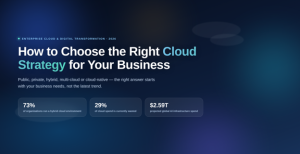
According to Flexera’s 2026 State of the Cloud Report, 73% of respondents have a hybrid cloud environment, 63% have a FinOps team and 71% have a Cloud Center of Excellence or similar governance body. The same report revealed that the amount of wasted cloud spending had increased to 29%, justifying cloud strategy to focus on value and governance, rather than just migration.
Then, which cloud strategy is the best choice for business in 2026?
The answer begins by first determining your business needs, rather than picking a cloud provider.
What Is a Cloud Strategy?
A cloud strategy is a structured plan for determining how, where, and why an organization uses cloud technology.
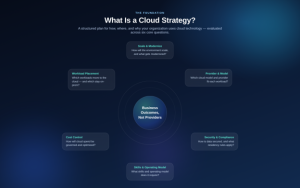
A cloud strategy answers six core questions — centered on business outcomes.
It defines decisions such as:
- Which workloads should move to the cloud?
- Which applications should remain on premises?
- Which cloud model is appropriate for each workload?
- Which cloud providers should be used?
- How will cloud costs be controlled?
- How will applications and data be secured?
- What compliance and data residency requirements apply?
- How will the organization scale its cloud environment?
- Which workloads should be modernized rather than simply migrated?
- What skills and operating model are required?
A successful cloud strategy is one that aligns technology choices with measurable business results like quicker product deliveries, increased resilience, reduced operational costs, enhanced customer satisfaction or increased agility.
It should also be treated as an evolving roadmap rather than a one-time migration document.
Why Businesses Need to Rethink Cloud Strategy in 2026
The cloud environment has changed significantly since the early “lift and shift” era.
- Cloud is becoming more business-value driven
Organizations are increasingly evaluating cloud investments based on the value they create rather than infrastructure consumption alone.
According to Flexera’s research, 64% of organizations now use value delivered to business units as a cloud progress metric, an increase of 12 percentage points from the prior year.
This means that Cloud teams must answer questions like:
Does this architecture increase productivity, customer experience, resilience, revenue, or speed of innovation?
- AI is changing infrastructure requirements
AI workloads may have high computing, storage, networking and data-processing requirements. They can also put into practice erratic consumption patterns.
Gartner predicts global AI spending to reach $2.59 trillion for the year 2026, a 47% increase from the previous year. It predicts that more than 45% of AI spending will happen on AI optimized infrastructure. GPU availability, data architecture, model deployment, security, observability, and cost management are all factors that must be considered in a cloud strategy for businesses that are looking to leverage AI.
- Cloud costs are becoming harder to predict
Consumption-based pricing has flexibility, but unmanaged consumption can cause huge waste. The 2026 Flexera report found that 68% of respondents deemed cloud cost optimization a top initiative and that wasted IaaS and PaaS spending had risen to 29%.
FinOps is thus moving from being a post-cloud bill solution and being part of the cloud strategy.
- Compliance and cybersecurity requirements are becoming more complex
There are several requirements to consider, including GDPR, NIS2, DORA, data residency, sector-specific requirements, and developing AI governance requirements, for companies that operate in Europe.
Security and compliance issues, then, should be considered when designing cloud architecture, not as an afterthought when workloads are moved to the cloud.
- Not every workload belongs in the public cloud
Cloud repatriation and workload optimization have become legitimate parts of cloud planning.
If there are strict latency constraints, special hardware requirements or regulatory requirements, a workload may be more appropriate for on-prem or private infrastructure.
The goal should not be to maximize cloud adoption, but rather to improve the usage workload.
Major Cloud Strategy Options in 2026
There is no universally superior cloud model. Each approach solves different business problems.
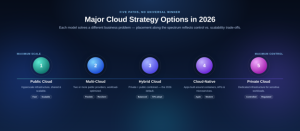
The five major cloud strategy models, from maximum scale to maximum control.
- Public Cloud Strategy
A public cloud strategy uses infrastructure and services provided by hyperscale cloud providers such as AWS, Microsoft Azure, or Google Cloud.
Businesses share the underlying provider infrastructure while maintaining logically isolated environments.
Advantages
- Rapid deployment
- High scalability
- Access to managed services
- Lower upfront infrastructure investment
- Global availability
- Access to advanced AI, analytics, and automation capabilities
Ideal for
Public cloud is often suitable for:
- Startups
- SaaS businesses
- Digital products
- Variable workloads
- Development and testing
- Customer-facing applications
- AI experimentation and scalable workloads
Potential challenge
The biggest risk is assuming that pay-as-you-go automatically means low cost. Poor resource utilization, unnecessary services, data transfer charges, and uncontrolled environments can increase expenditure quickly.
- Private Cloud Strategy
A private cloud provides cloud-like capabilities within infrastructure dedicated to a single organization.
It can be operated internally or through a managed provider.
Advantages
- Greater infrastructure control
- Strong customization
- Predictable performance
- Greater control over sensitive workloads
- Potentially useful for strict regulatory requirements
Ideal for
- Highly regulated organizations
- Sensitive workloads
- Certain financial services
- Healthcare environments
- Organizations with specialized infrastructure requirements
Potential challenge
Private cloud requires greater responsibility for infrastructure, security, operations, capacity planning, and maintenance.
It should therefore be selected for clear business or technical reasons not simply because “private is more secure.”
- Hybrid Cloud Strategy
Hybrid cloud combines private or on-premises infrastructure with public cloud services.
For many established businesses, this can provide practical middle ground.
A company might, for example, keep sensitive databases in a controlled environment while running customer-facing applications in the public cloud.
Advantages
- Flexible workload placement
- Easier integration with existing infrastructure
- Supports gradual modernization
- Can address data residency requirements
- Provides options for business continuity
- Useful for legacy environments
Ideal for
- Large enterprises
- Regulated industries
- Manufacturing
- Financial services
- Healthcare
- Businesses with significant legacy infrastructure
Hybrid cloud is particularly relevant in 2026. Flexera reports that 73% of surveyed organizations use hybrid cloud.
Potential challenge
Hybrid environments can be operationally complex. Organizations need consistent identity, security, monitoring, networking, governance, and cost management across environments.
- Multi-Cloud Strategy
Multi-cloud means using two or more public cloud providers.
For example, an organization might use Azure for Microsoft-centric workloads, AWS for certain application platforms, and Google Cloud for specific data or AI workloads.
Advantages
- Access to different provider capabilities
- Potential reduction of strategic dependency on one provider
- Workload-specific optimization
- Useful following mergers and acquisitions
- Geographic and resilience options
Ideal for
- Large enterprises
- Global businesses
- Organizations with specialized cloud requirements
- Companies integrating acquired technology estates
Potential challenge
Multi-cloud is not automatically a strategy.
Sometimes organizations become multi-cloud because different teams selected different platforms, or because acquisitions brought in incompatible environments together.
Flexera’s 2026 research specifically notes that multi-cloud adoption is often driven by siloed applications or mergers rather than deliberate workload-placement strategy.
- Cloud-Native Strategy
A cloud-native strategy goes beyond migrating existing applications.
Instead, applications are designed or significantly modernized around cloud capabilities such as:
- Containers
- Kubernetes
- Serverless computing
- APIs
- Microservices
- Infrastructure as Code
- Automated CI/CD
- Observability
- Platform engineering
Advantages
- Faster software delivery
- Greater scalability
- Better automation
- Improved resilience
- Easier integration with modern services
Ideal for
- Digital-first businesses
- SaaS companies
- New applications
- Organizations undergoing application modernization
- Businesses competing on software delivery speed
Potential challenge
Cloud-native transformation requires architectural, engineering, DevOps, security, and platform skills. Rebuilding every application as microservices is rarely necessary.
How to Choose the Right Cloud Strategy for Your Business
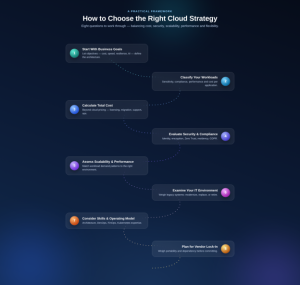
The first step to selecting a cloud strategy is to know what you are looking to achieve, your technology landscape, and your future needs. The right solution should not be based on the latest cloud trend and should include a consideration of balance with cost, security, scalability, performance and flexibility.
- Start With Business Goals
Start by establishing your objectives for migrating to the cloud, whether they involve cost savings, faster time to market, resilience, new market opportunities, or AI initiatives. The type of cloud architecture you need should be dictated by your business goals.
- Classify Your Workloads
Assess each application according to its business significance, performance, sensitivity of data, compliance, cost and scalability requirements. There may be workloads that require rehosted, modernized, replaced, retired or better served in their current state.
- Calculate Total Cost of Ownership
Don’t just think of cloud pricing, consider infrastructure, licensing, security, backup, migration, support, data transfer, and operational costs. Business value generated from increased productivity, agility and resilience is also a crucial component to consider when evaluating a robust cloud strategy.
- Evaluate Security and Compliance
Security should be a fundamental part of your cloud approach. Consider identity management, encryption, monitoring, Zero Trust, data residency, backup and regulatory requirements like GDPR and the applicable European industry regulations.
- Assess Scalability and Performance
Consider how your workloads behave today and how they may change in the future. Applications with unpredictable demand may benefit from public cloud scalability, while workloads requiring consistent performance, specialized infrastructure, or very low latency may benefit from hybrid, private, or edge environments.
- Examine Your Existing IT Environment
Make sure to take your current infrastructure considerations into account with your cloud roadmap. While some organizations may desire to migrate all their applications to the cloud, it may be preferable to take a process-by-process approach with legacy applications. Modernization may be possible in some systems and replacement, or retirement of others may be required.
- Consider Skills and Operating Model
The skills needed in cloud environments include architecture, DevOps, security, Kubernetes, FinOps, automation, and data engineering. When internal capacity is limited, businesses can leverage managed services, strategic partners or even recruit cloud experts to speed up implementation and continued operations.
- Plan for Vendor Lock-In
It is not always a bad thing when there is a vendor lock-in if the benefits are greater than the dependency. Consider data portability, proprietary services, application dependencies, migration costs and other service providers before signing up to a platform. Don’t overly complicate things to make sure you have no dependency on any vendor.
Which Cloud Strategy Is Right for Different Businesses?
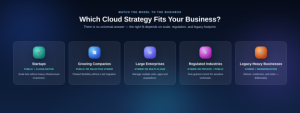
- Startups
Potential fit: Public cloud + cloud-native
Companies in their early stages will find that they don’t have to make substantial investments in infrastructure and can access scalable managed services.
Focus on speed, security, cost controls, and avoiding unnecessary architectural complexity.
- Growing Companies
Potential fit: Public cloud or selective hybrid
Scalability is required for growing businesses, but existing businesses might have on-premises systems.
A phased approach can allow for flexibility without the need for a complete migration to take place.
- Large Enterprises
Potential fit: Hybrid or multi-cloud
Large organizations have several business units, applications, data environments, acquisitions and regulatory requirements.
A managed hybrid or multi-cloud approach might be more flexible.
- Regulated Industries
Potential fit: Hybrid or private + public cloud
Other regulated industries like healthcare, financial services, insurance, and more, might require finer-grained control over sensitive workloads.
The architecture should be based on real regulatory and business needs and not assume that it must be all on premises.
- Businesses With Legacy Systems
Potential fit: Hybrid + modernization
Most legacy systems require more than one migration strategy.
A useful roadmap can include some systems, rehost some others, modernize some strategic apps, and remove old platforms.
How Sphinx Can Support Your Cloud Strategy
The decision on the right architecture is just the first step. The strategy will either turn out or fail, depending on how it is executed.
Sphinx’s cloud consulting, migration, DevOps, cloud security, hybrid and multi-cloud architecture, and FinOps services are all based on scalability, governance, security, and business outcomes, spanning across Europe. It provides cloud services throughout the European region, including AWS, Microsoft Azure, Google Cloud, hybrid cloud and multi-cloud solutions.
Businesses that need additional engineering capacity can also hire cloud experts across cloud architecture, cloud engineering, migration, DevOps, Kubernetes, security, SRE, and FinOps.
Cloud decisions can also form part of a broader digital transformation services roadmap, particularly when cloud migration relates to application modernization, data modernization, automation, cybersecurity, and AI adoption.
For European organizations, Sphinx’s cloud approach emphasizes cloud modernization, security, compliance, hybrid and multi-cloud architecture, and cost optimization.
Conclusion: Choose the Cloud Strategy That Fits Your Business
Business’ future cloud strategy for 2026 may not be public cloud, private cloud, hybrid cloud, or multi-cloud.
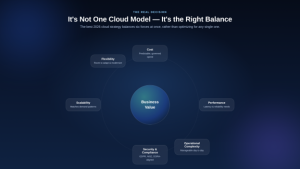
It is the strategy that best balances business value, cost, security, scalability, performance, compliance, operational complexity, and long-term flexibility.
Hybrid cloud can offer a more optimal mix of control and scalability for a regulated business. Instead of a big-bang approach, a phased hybrid modernization strategy might be more viable option for an organization with decades worth of legacy infrastructure.