






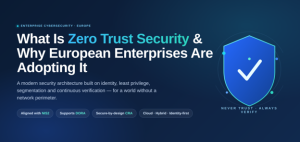
Enterprise IT environments no longer have a clearly defined perimeter. Employees work remotely, applications run across public and private clouds, partners connect to business systems, and sensitive data moves between applications, devices, regions, and third-party platforms. At the same time, attackers increasingly target identities, credentials, endpoints, cloud workloads, and supply-chain relationships rather than simply trying to break through a traditional network firewall.
For European organizations, this changing environment is accompanied by a stronger regulatory focus on cybersecurity risk management, resilience, supply-chain security, and protection of critical digital infrastructure. NIS2, DORA, and the Cyber Resilience Act (CRA) are part of a broader European cybersecurity landscape that places greater emphasis on systematic risk management and resilience.
This is where Zero Trust Security becomes strategically relevant.
Rather than assuming that everything inside the corporate network is trustworthy, a Zero Trust model starts with a different principle: no user, device, application, or connection should receive implicit trust simply because it is inside a network or has connected before.
Zero Trust is not a single security product. It is a security architecture and operating strategy that combines identity security, least privilege access, device controls, segmentation, monitoring, and continuous risk assessment.
What Is Zero Trust Security?
Zero Trust Security is a part of the cybersecurity strategy that follows the mantra of “never trust, always verify.”
In a traditional security approach, a company may use a firewall and a Virtual Private Network (VPN) to secure its internal network and then grant users wide access after they enter its boundaries.
Every access request is potentially risky, even when it comes from known or trusted sources, per a Zero Trust model.
An organization can assess, amongst others:
What is the purpose of accessing?
What is your app or data request?
- Does the user have permission?
- Is the device trusted and secure?
From where does the request come from?
- Is the activity consistent with normal behavior?
What is the actual level of access that is needed?
The aim is not to make access unfeasible. To ensure access is suitably controlled, monitored and restricted where necessary.
For a European company, this could be a staff member working on a financial app from the comfort of his or her home. Rather than giving the employee access to the network over a VPN, the organization can ensure the employee’s identity, evaluate the device, and implement conditional access policies so that access is limited to the application or resources that are needed.
How Does Zero Trust Work?
A mature Zero Trust Architecture combines several security principles rather than relying on one technology.
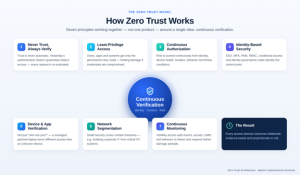
The seven principles of a Zero Trust architecture, unified by continuous verification.
- Never Trust, Always Verify
Zero Trust assumes that trust should not be automatically granted.
If a user has been authenticated yesterday, this user might still require evaluation today. Similarly, access to the corporate network is not granted to any device by default. Authentication and authorization are consequently not a one-off occurrence, but instead an ongoing security decision.
- Least-Privilege Access
The principle of least privilege states that users, applications and systems are granted only the privileges they need to do a specific job.
For instance, a procurement employee may require access to a supplier’s records, but not the entire HR database of the organization.
This can minimize the damage that can be done if the credentials fall into the wrong hands, and it also restricts attackers’ ability to jump between systems.
- Continuous Authentication and Authorization
Authentication should not necessarily be considered a one-time event.
With the Zero Trust implementation, risk can be continually assessed in the following factors:
- User identity
- Device health
- Location
- Application
- Behavior
The sensitivity of the requested resource.
- Current threat conditions
Access may be denied, challenged, or be denied when risk changes.
- Identity-Based Security
Identity is a key security management point.
Single sign-on, multi-factor authentication, privileged access management, role-based access controls, conditional access and identity governance can all be integrated into modern identity security.
This is especially crucial as organizations shift away from fixed network perimeters and toward cloud applications.
- Device and Application Verification
Zero Trust is not just asking “who are you?”.
It can also inquire what application and device are being used. The access that a corporate laptop with current security controls receives may be different from an unmanaged laptop with outdated software or suspicious configuration.
Security policies can also be used to evaluate and safeguard applications and workloads.
- Network Segmentation
A segmented environment is a division of the environment into smaller security zones. Segmentation can limit the number of systems a compromised workstation can communicate with, rather than having a free rein over a large portion of the enterprise network.
For critical manufacturing environments in Europe, for instance, segmentation can provide the ability to isolate corporate IT systems from critical operational technology (OT) systems.
- Continuous Monitoring
Zero Trust requires visibility.
Security teams need to monitor authentication events, access requests, device activity, network traffic, application behavior, and potential anomalies.
This helps organizations detect suspicious activity earlier and respond before a compromised identity or endpoint causes widespread damage.
Why Traditional Security Models Are No Longer Enough
The perimeter security is still relevant. Traditional firewalls, endpoint protection, secure gateway and VPNs still offer value.
The problem is that the traditional assumption of a trusted internal network is increasingly difficult to maintain.
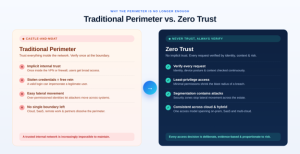
The shift from castle-and-moat perimeter security to a Zero Trust model.
Consider a European enterprise with:
- Employees working across several countries
- SaaS applications hosted outside the corporate data center
- Cloud infrastructure across multiple providers
- Contractors and suppliers requiring access
- Connected manufacturing or IoT systems
- Sensitive customer and intellectual-property data
- Multiple offices and hybrid work environments
There may be no single network boundary that can reliably separate “trusted” users from “untrusted” users.
If an attacker acquires valid credentials he/she may be able to present himself/herself as a legitimate person. If that identity has too many permissions, it is possible that the attacker could advance further into the environment.
Zero Trust solves this issue by moving from the traditional network location and implicit trust paradigm to identity, context, authorization, segmentation, and ongoing verification.
Why Are European Enterprises Adopting Zero Trust?
Zero Trust is not being widely adopted just because it’s a fashionable security framework. The principles are congruent with some of the practical issues that confront European businesses.
- Increasing Cybersecurity Threats
European organizations are exposed to ransomware, credential theft, phishing, supply-chain attacks, exploitation of vulnerabilities and other attacks causing cyber disruption. Cyber and hybrid attacks on essential services and other organizations are a growing concern, and the European Commission has outlined other steps to bolster European cybersecurity resilience. By narrowing privileges and controlling lateral movement, Zero Trust can help minimize the impact of a successful compromise.
- Cloud and Hybrid-Work Environments
Cloud adoption has transformed the location of enterprise applications and data. Microsoft 365, SaaS platforms, cloud applications, internal systems and partner systems can be accessed from various locations and devices by employees. This is only further increasing the significance of cloud security and identity-based controls. A Zero Trust strategy can bring a unified approach to access across cloud, on-premises, and hybrid deployments and not just a traditional corporate network.
- Regulatory and Compliance Pressures
Cybersecurity regulation in Europe focuses more on risk management, security controls, incident response, security of the supply chain, and resilience.
Important, these regulations do not mandate organizations to adopt Zero Trust as an architecture. But Zero Trust may also offer a solution for organizations to augment controls that are relevant to their regulation needs.
For instance, least-privilege access, robust authentication, monitoring and segmentation, asset management and third-party risk controls can help achieve more comprehensive cybersecurity and resilience goals.
- Protection of Sensitive Business and Customer Data
European businesses manage critical information, such as personal information, financial information, intellectual property, medical information, engineering information and commercially sensitive documents. Minimize unnecessary access to reduce exposure if an account, device or application is compromised. Zero Trust, then, is a complement to a wider data-protection and cyber-security compliance program.
- Supply Chain and Third-Party Risks
Modern enterprises rarely operate in isolation.
Some access may be needed by cloud providers, software vendors, contractors, managed service providers, logistics partners and technology suppliers.
Specific aspects covered by NIS2 are supply-chain security and vulnerability management.
In many cases, Zero Trust can enable organizations to deny third parties’ access to the entire network when it is needed to access only certain applications, systems or resources.
- Stronger Identity and Access Controls
Identity is now one of the critical security layers in enterprise environments.
If the password is compromised, it should NOT automatically give someone unrestricted access.
The use of MFA, least privileged access, conditional access, privileged access controls, identity governance and continuous monitoring can provide a big boost to the organization’s identity security posture.
The Role of European Cybersecurity Regulations
Zero Trust is not a one-size-fits-all solution for regulatory needs and should be considered a security strategy that can aid in regulatory goals rather than a regulatory mandate.
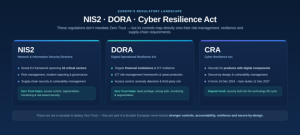
How Zero Trust controls map onto NIS2, DORA and the Cyber Resilience Act.
- NIS2
The NIS2 Directive creates a more comprehensive EU cybersecurity framework including 18 critical sectors and raises the level of risk-management, reporting, supervision and enforcement. It also covers topics like supply-chain security, vulnerability management, incident handling and cybersecurity governance.
Zero Trust principles can contribute to a few of these objectives with enhanced access control, segmentation, monitoring and risk-based security practices within scope.
ENISA has also released technical implementation guidance, which aims to provide relevant entities with the understanding and the implementation of NIS2 security requirements.
- DORA
Digital Operational Resilience Act (DORA) is a law targeted at financial institutions and digital operational resilience.
Financial institutions are obligated to implement ICT risk-management frameworks, safeguard information and ICT assets, control access to information and ICT assets, monitor information and ICT systems, detect anomalies and deal with ICT third-party risks in accordance with DORA.
These requirements can be integrated with Zero Trust principles like least privilege, robust authentication, ongoing monitoring, segmentation and third-party access controls, naturally.
In this context, DORA has prioritized the importance of identity, access, resilience and ICT risk management for financial organizations across Europe.
- Cyber Resilience Act
The Cyber Resilience Act (CRA) sets standards for the cybersecurity of products that include digital components, which include secure design and development, vulnerability management and product maintenance.
The CRA came into effect on 10 December 2024. The main obligations of it come into force on 11 December 2027 and the reporting obligations on 11 September 2026.
The CRA is not about Zero Trust systems being built within enterprises but about the cybersecurity of products that have digital components.
Its secure-by-design and vulnerability-management concepts, however, support the general trend of European moves toward cybersecurity being integrated into technology life cycles.
Europe’s Regulatory Direction Is Still Evolving
European cybersecurity policy is continuing to develop.
In January 2026, the European Commission proposed additional cybersecurity measures, including changes intended to simplify compliance and clarify aspects of NIS2 implementation.
In July 2026, the Commission also announced an EU plan addressing the cybersecurity risks and opportunities associated with advanced AI.
For business leaders, the practical lesson is straightforward: security architecture should be designed around enduring risk-management principles rather than short-term compliance checklists.
Key Benefits of Zero Trust for European Enterprises
A robust Zero Trust initiative may offer a number of business and security advantages.
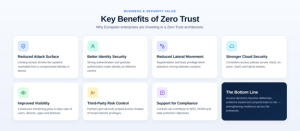
Key business and security benefits of a Zero Trust program.
- Reduced Attack Surface
Limiting access reduces the number of systems and resources that can be reached from a compromised identity or device.
- Better Identity Security
Strong authentication and granular authorization make identity a more effective security control.
- Reduced Lateral Movement
Segmentation and least privilege can hinder attacker’s abilities to transfer from one compromised system to another.
- Stronger Cloud Security
Zero Trust can provide consistent access policies across cloud, on-premises, SaaS, and hybrid environments.
- Improved Visibility
Security teams get a better view of users, devices, applications and access behavior through continuous monitoring.
- Better Third-Party Risk Management
Partners and suppliers can receive narrowly defined access instead of broad network privileges.
- Support for Compliance
In some instances, Zero Trust controls may be part of a wider NIS2, DORA, data-protection, and cybersecurity risk management goals, depending on the organization’s regulatory requirements
Challenges of Implementing Zero Trust
Zero Trust is strategically valuable, but implementation is rarely simple.
- Legacy Systems
Some legacy apps might not support the latest authentication, granular authorization, and segmentation.
Organizations may need compensating controls or phased modernization.
- Cost and Complexity
Zero Trust is a combination of technologies, processes and governance changes. Organizations must focus on high-risk systems, not on trying to make a “big bang” transformation.
- Identity Management
The accuracy of identity data is crucial to a Zero Trust approach. Neglecting identities, granting too many privileges, leaving accounts inactive, or having inconsistent roles can jeopardize the plan.
- Employee Experience
Security of users should be protected but shouldn’t cause unnecessary friction.
Poorly defined authentication policies can be frustrating to employees and lead to workarounds.
- Skills and Staffing
Zero Trust requires expertise across identity, networking, cloud security, endpoint protection, architecture, governance, and monitoring.
In ENISA’s 2025 cybersecurity investment results, they found that the ongoing cybersecurity skills and talent shortfall still existed, with a surge in investment and regulatory pressure.
- Integration With Existing Security Infrastructure
Zero Trust does not replace every existing security technology.
Organizations need to integrate identity providers, endpoint security, SIEM/SOC platforms, firewalls, cloud controls, vulnerability management, application security, and governance processes into a coherent architecture.
How Enterprises Can Start Their Zero Trust Journey
Zero Trust should be implemented progressively rather than treated as a single technology deployment.
An eight-step, phased roadmap for starting a Zero Trust journey.
Step 1: Identify Critical Assets
Start by identifying the applications, data, systems, workloads, and business processes that would cause the greatest damage if compromised.
Step 2: Map Users, Devices, Applications, and Data
Understand who accesses what, from which devices, through which applications, and under what conditions.
This creates the foundation for identity-centric security.
Step 3: Assess the Current Security Posture
Examine authentication, privileged access, endpoint security, network architecture, segmentation, cloud security, monitoring, third-party access and legacy systems.
Identify the largest gaps first.
Step 4: Strengthen Identity and Least Privilege
Implement or improve MFA, single sign-on, identity governance, privileged access management, and role-based access.
Remove unnecessary permissions and regularly review access rights.
Step 5: Segment Critical Environments
Separate high-value systems from general-purpose environments.
For example, a manufacturing enterprise might isolate OT networks, production systems, corporate IT, development environments, and third-party access paths.
Step 6: Introduce Risk-Based Access Controls
Move beyond simple username-and-password authentication.
Apply context – posture of device, user role, sensitivity of the application, location, behavior etc. to decide access.
Step 7: Improve Monitoring and Response
Connect identity, endpoint, cloud, application, and network signals to security monitoring.
Establish processes for investigating anomalous activity and rapidly restricting compromised identities or devices.
Step 8: Measure and Continuously Improve
Zero Trust is not a destination.
Monitor privileged accounts, MFA coverage, excessive permissions, unmanaged devices, segment coverage, third-party access, detection & response performance.
Review the architecture as the business, technology environment, and threat landscape evolve.
Conclusion: Why Zero Trust Matters for European Enterprises
The shift toward Zero Trust Security reflects a fundamental change in how modern enterprises operate.
Cloud adoption, hybrid work, interconnected supply chains, SaaS applications, distributed infrastructure, and sophisticated identity-based attacks have made traditional perimeter assumptions increasingly difficult to maintain.
In Europe this change is bolstered by a regulatory landscape that is becoming more cybersecurity risk management, cyber resilience, cyber supply chain security, incident management and secure technology driven.
NIS2, DORA, and the Cyber Resilience Act are not an overarching requirement for implementing Zero Trust. Rather, they are a part of a larger European cyber security trajectory, with greater controls, accountability, resilience, and secure-by-design becoming more prevalent.
For organizations looking to strengthen Zero Trust Architecture, cloud security, identity controls, and European cybersecurity resilience, Cybersecurity Services provides security assessment, Zero Trust implementation, cloud security, segmentation, IAM, third-party risk, and regulatory-readiness capabilities for European enterprises.
You can also explore Cloud & DevOps Services for cloud and hybrid-environment security capabilities, including IAM, network segmentation, encryption, and continuous vulnerability monitoring.
The goal of Zero Trust is not to trust anybody. It is to make every access decision deliberate, evidence-based, and proportionate to risk.
Frequently Asked Questions
- What is Zero Trust Security in simple terms?
Zero Trust Security is a philosophy that does not assume any user, device, application or connection is trusted. Access is continually assessed in terms of identity, authorization, device status, context and risk.
- Is Zero Trust mandatory under NIS2?
No. NIS2 lays out cybersecurity risk-management and reporting requirements for organizations in its scope, it does not require that Zero Trust architecture must be implemented in all cases. The Zero Trust approach can be applied to help achieve relevant security goals in organizations.
- How does Zero Trust improve cloud security?
Zero Trust can build the security foundation of cloud by adding identity-based access, least privilege access, strong authentication, verifying devices, segmentation, and continuous monitoring in both cloud and hybrid environments.
- Is Zero Trust relevant to DORA compliance?
There are multiple aspects of DORA security goals for which Zero Trust can be employed, such as access management, robust authentication, monitoring, ICT risk management, protection of information assets, and third-party risk. Zero Trust is, however, not a DORA compliance.
- How long does it take to implement Zero Trust?
There is no set time frame. In most cases, large enterprises take the Zero Trust approach gradually starting with a small number of critical identities, applications, privileged accounts, devices, and high-risk environments and gradually rolling controls out across the enterprise.