





European organizations are under pressure to modernize faster.
Customers expect seamless digital experiences. Workplaces that are smart and always connected are expected. Manufacturers are linking up the factories and operational technology. Financial institutions are increasingly creating digital services. Healthcare organizations are scaling up connected care and data driven operations. In the meantime, AI powers software creation, automation and decision-making in virtually all industries.
Much of this is based around cloud computing.
The proportion of EU enterprises utilizing paid cloud computing services rose from 45% in 2023 to 52.7% in 2025, according to Eurostat. There was a big gap between large enterprises (85%) and SMEs (52%) for paid cloud services.
However, with cloud and digital transformation comes a basic strategic issue: the greater an organization’s digital connection, the closer it is to relying on the security and resilience of the digital world.
That’s why cybersecurity in Europe must be treated as an IT part.
Cloud migration involves moving data away from one location and accessing the systems from a different location. A digital transformation program brings in new applications, APIs, identities, devices and third-party dependencies. AI adds new data flows and attack surfaces. There is a growing requirement placed on organizations to be able to identify, manage and respond to technology risks through regulatory requirement.
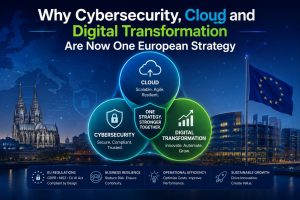
Why Cybersecurity, Cloud and Digital Transformation Must Be One Strategy
Historically, organizations often manage these areas independently.
Consider a European manufacturer moving its production planning systems to the cloud. The initiative may begin as a cloud migration, but it quickly becomes a broader transformation program involving connected factories, IoT devices, suppliers, remote access, analytics and AI.
Every new connection introduces potential risk.
Cloud transformation changes the technology environment. Digital transformation changes the business operating model. Cybersecurity determines whether both can be trusted.
The team of ENISA’s 2025 Threat Landscape analyzed 4,875 incidents between July 2024 and June 2025. It identified ransomware as the most impactful threat in the EU and highlighted growing abuse of cyber dependencies and digital supply chains. Phishing and vulnerability exploitation were identified as leading initial intrusion methods.
Cloud Transformation Expands the Attack Surface
Cloud computing isn’t insecure. In most instances, advanced security features of modern cloud platforms are superior in capability to those that organizations could construct and manage on their own.
The problem is security in the cloud is a shared responsibility.
Organizations are responsible for the configuration of services, protection of identities, management of data, security of applications and access control of services, while cloud providers secure the underlying infrastructure.
Common cloud security risks include:
- Misconfigured storage and databases
- Excessive identity privileges
- Weak authentication
- Inadequate secrets management
- Unsecured APIs
- Poor network segmentation
- Incomplete logging and monitoring
- Shadow IT and unmanaged SaaS adoption
- Vulnerable cloud workloads and containers
- Inadequate third-party risk management
- Insufficient backup and recovery testing
In multi-cloud and hybrid environments, the risk factor is more intricate and can involve workloads across public clouds, private infrastructure, SaaS and on premises.
So, a cloud transformation organization in Europe should build its security architecture in the cloud and not in the after-thought model.
This includes defining:
- Data classification – What data is being moved, and how sensitive is it?
- Identity architecture – Who can access it, from where and under what conditions?
- Security controls – How will workloads, endpoints, networks and applications be protected?
- Resilience requirements – How quickly must services recover from disruption?
- Regulatory obligations – Which GDPR, NIS2, DORA or sector-specific requirements apply?
- Third-party dependencies – Which cloud and technology providers become critical to operations?
Therefore, a cloud strategy should be considered an architectural concept, not a set of security products.
Read More: Europe Cloud Computing Market Growth
European Regulation Is Reshaping Digital Transformation
European companies are undergoing change in one of the most mature regulatory landscapes in the world.
This does not have to be a hindrance to innovation. Indeed, regulation can be a foundation for creating more resilient digital businesses, but it is only part of technology strategy.
GDPR: Data Protection by Design
The General Data Protection Regulation (GDPR) is applicable to the processing of personal data in the EU and provides a harmonized framework for the protection of personal data.
So, in the world of cloud transformation, GDPR issues are not just about picking an EU data center.
Organizations need to understand:
- Where personal data is stored and processed
- Who can access it
- How data moves between systems and regions
- How cloud providers act as processors
- How retention and deletion are enforced
- How encryption and key management are implemented
- How data breaches are detected and reported
- How privacy requirements are incorporated into new digital services
This makes GDPR compliance closely connected with cloud architecture, identity management, data governance and cybersecurity.
NIS2: Raising the Cybersecurity Baseline
NIS2 will widen the scope of cybersecurity obligations to more sectors and organizations deemed vital or significant to the EU economy and society.
Cybersecurity is becoming a board-level issue and responsibility for organizations that have been targeted, it’s a business continuity and incident response issue, a risk management issue, a supply chain security and vulnerability management issue.
This is especially true for cloud transformation, as today’s organizations rely heavily on technology suppliers and digital service providers.
Even if the cloud platform is secure, there can be compliance and operational gaps if a cloud migration program does not consider the third-party dependencies, incident response and resilience.
DORA: Operational Resilience for Financial Services
DORA has become a key priority for regulatory agendas for European financial organizations. It is a regulatory initiative which has been submitted from 17 January 2025 and covers four areas of ICT risk management, incident reporting, resilience testing and ICT third-party risk for financial entities. This has implications for cloud adoption, which is significant. Source: ESMA
A financial institution must not consider a cloud provider as just a procurement offer. It should have a good sense of how technology dependencies play an important part in operational resilience, contractual relations and risk management.
EU Cyber Resilience Act: Security Across the Product Lifecycle
The EU Cyber Resilience Act (CRA) sets out cybersecurity obligations for products that contain digital components, including security during the planning, design, development and maintenance process.
The primary responsibilities take effect on 11 December 2027, and reporting responsibilities for actively exploited vulnerabilities and serious incidents takes effect on 11 September 2026.
For organizations that design or sell connected products, software, or digital technologies, it’s yet another trend in the industry towards security by design and security for the entire software lifecycle.
GDPR, NIS2, DORA and the CRA show one of the key cybersecurity trends in Europe: Cybersecurity is becoming an issue that affects the products, services, supply chains, technology providers and business operations.
The Security Architecture of Modern Digital Transformation
To be successful with digital transformation, multiple capabilities must come together.
- Zero Trust
The need for Zero Trust is growing increasingly relevant for cloud first organizations in which network boundaries are disappearing.
The principle is straightforward: never assume trust based solely on network location or previous access.
A Zero Trust architecture continuously evaluates:
- User identity
- Device security
- Application context
- Location and risk
- Data sensitivity
- Behavior and access patterns
Zero Trust can help European businesses secure distributed workforces, SaaS applications, cloud workloads and third-party access.
- Identity and Access Management
One of the most critical security perimeters in the cloud has become identity.
Organizations should strengthen:
- Multi-factor authentication
- Conditional access
- Privileged access management
- Role-based access controls
- Just-in-time access
- Identity lifecycle management
- Service account governance
If an attacker can gain access to an identity, they may be able to gain legitimate access to multiple cloud resources. So, robust identity governance becomes the core of cloud security.
- AI and Automation
AI has a dual role in cybersecurity.
Attackers can exploit Artificial Intelligence to enhance phishing, social engineering and other methods of attack. In 2025, ENISA published its Threat Assessment, which noted the increasing potential of AI to enhance malicious activity, and the rising concern of AI supply-chain risks, respectively.
Defenders, however, can use AI and automation to:
- Detect anomalous behavior
- Correlate security events
- Prioritize vulnerabilities
- Automate incident response
- Analyze large volumes of telemetry
- Identify identity-related risks
- Improve threat intelligence
The strategic opportunity here is not to hire AI to replace cybersecurity professionals, but to use AI automation to lessen repetitive tasks and enhance the velocity and accuracy of decision making.
- Data Protection
Digital transformation is basically a data transformation.
Sensitive information is being shared more often with organizations spread across cloud platforms, analytics systems, AI applications and digital ecosystems.
A mature data protection strategy should combine:
- Encryption
- Data classification
- Data loss prevention
- Key management
- Access controls
- Data lifecycle governance
- Privacy engineering
- Secure data sharing
This creates a direct connection between cybersecurity and business transformation: data cannot become a strategic asset if the organization cannot control, protect and trust it.
5 Key Takeaways for European Business Leaders
- Cybersecurity, cloud and digital transformation should be managed as one strategic program. Separating them creates security gaps and slows transformation.
- Cloud adoption requires architectural security, not just security products. Identity, data governance, resilience and monitoring must be designed into cloud environments.
- European regulation is becoming part of technology strategy. The General Data Protection Regulation (GDPR), the NIS2 Directive, the DORA and the Cyber Resilience Act are now having a growing impact on the design, operation and procurement of digital technologies in organizations.
- Identity, Zero Trust and data protection are foundational. It is a time when the traditional network boundaries are fading and access control is increasingly critical to systems and data.
- Resilience matters as much as prevention. Organizations must prepare to detect, respond to and recover from cyber incidents and technology disruptions.
5 Practical Actions Organizations Should Take Next
- Map your digital transformation roadmap against your cyber risk profile. Prioritize new applications, cloud workload, AI projects and third-party dependency risks.
- Conduct cloud security and identity assessment. Go over privileged access, MFA, IAM, workload configurations, data exposure and monitoring.
- Map regulatory obligations to technical controls. Link GDPR, NIS2, DORA and CRA requirements (if applicable) to specific policies, architectures and operational processes.
- Test resilience, not just compliance. Conduct incident response drills, disaster recovery drills and third-party failure scenarios for critical systems.
- Create a unified transformation and cybersecurity governance model. Incorporate CIO, CISO, CTO, data, compliance and business decision makers into the same decision-making environment.
Conclusion
Digital transformation will not be a one-off for European organizations; it will not be just about cloud services, AI or automation. It will be characterized by the capacity to embrace these technologies safely, sustainably and responsibly.
Cybersecurity and cloud and digital transformation are no longer distinct strategic priorities. These work together as a framework to how modern businesses operate, innovate, and compete. Cloud platforms offer the scalability and agility necessary to enable transformation, digital technologies will generate new customers and operational value, and cybersecurity will deliver trust and resilience that will help to keep the momentum going.
This relationship is further strengthened by the regulatory setting in Europe. With GDPR, NIS2, DORA and the Cyber Resilience Act, organizations are increasingly becoming more structured when it comes to data protection, cyber risk, operational resilience and security by design. Meanwhile, AI and increasingly complex digital supply chains are presenting new risks which cannot be adequately mitigated by traditional security models.
The solution is not to slow down transformation! It’s to make secure changes.