






The fast-paced evolution of Generative AI has sparked a prediction: “SaaS is dead.” But what if AI can answer questions, generate reports, automate workflows and even write software? Then why should companies keep paying for dozens or hundreds of software applications?
The truth is the exact opposite, though.
Artificial Intelligence is not about to stand in for SaaS. It’s not just its value that’s being enhanced, but it’s being enhanced in a dramatic way.
Large Language Models (LLMs) can create intelligence, but they cannot power an enterprise. Structured workflows, governance, compliance, integration, security, audit trails, permissions, analytics and industry-specific business logic are still required by businesses. These capabilities are not provided by AI models, but rather by SaaS applications.
This distinction is gaining significance all over Europe. Compliance with frameworks like GDPR, the EU AI Act, NIS2, and sector-specific regulations is a critical challenge for organizations as they integrate AI tools. These enterprise requirements cannot be met by AI alone.
Rather, AI is gaining momentum as a capability that is built into SaaS applications, morphing them from systems of record to intelligent systems of action. AI and SaaS are not two competing options for enterprise software.
It’s AI through SaaS.
“AI provides intelligence. SaaS delivers outcomes.”
The AI Myth: “Will AI Replace SaaS?”
Each significant wave of technology engenders fear of what is coming next.
The expectation was that cloud computing would replace traditional IT. Low-code platforms were forecast to take the place of software developers. Automation was to take the place of humans. Today, Generative AI is making headlines as the new technology that will take the place of software.
The argument usually goes something like this:
- “Why click through CRM screens if an AI assistant can simply answer questions?”
- “Why use ERP software when an AI can manage business processes?”
- “Why buy SaaS licenses when AI agents can do everything?”
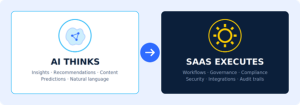
These assumptions confuse intelligence with execution. An AI model can recommend action. A SaaS platform performs that action within governed business processes.
That difference changes everything.
Why This Assumption Is Incorrect
What if you could rely on ChatGPT to manage payroll for 50,000 employees in 12 European countries, while also following the local tax laws, GDPR, employment requirements, approval processes, and audit requirements?
It cannot independently execute it.
Enterprise software exists because organizations require:
- Business rules
- Identity management
- Role-based permissions
- Secure data storage
- Regulatory compliance
- Workflow orchestration
- System integrations
- Transaction processing
- Auditability
- Reporting
These capabilities are not language model features. They are software capabilities. AI becomes exponentially more valuable when embedded inside software that already understands how businesses operate.
The Evolution of SaaS in the AI Era
Software has evolved through several distinct generations.
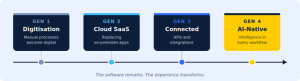
First Generation — Digitizing manual processes.
Second Generation — Cloud-based SaaS replacing on-premises applications.
Third Generation — Connected platforms through APIs and integrations.
Fourth Generation — AI-native SaaS where intelligence is embedded into every workflow.
This latest phase isn’t replacing SaaS. It is making SaaS significantly smarter. Instead of manually searching dashboards, users simply ask questions. Instead of configuring workflows, AI recommends optimizations. Instead of spending hours creating reports, AI summarizes insights instantly.
The software remains. The experience transforms.
Why SaaS Remains Indispensable in the AI Era
1. AI Needs Software to Deliver Business Outcomes
Large Language Models generate content and recommendations. Businesses require execution.
Consider a procurement workflow. AI may recommend selecting a supplier. The SaaS platform handles:
- Vendor validation
- Approval routing
- Purchase orders
- Compliance checks
- Contract storage
- Payment integration
Without software, AI has nowhere to be used.
“AI thinks. SaaS executes.”
2. SaaS Provides Governance, Security, and Compliance
For European enterprises, trust is non-negotiable. Organizations must comply with GDPR, the EU AI Act, the NIS2 Directive, DORA (financial services), ISO 27001, and industry-specific regulations.

AI models do not inherently provide:
- Access controls
- Data residency
- Audit logs
- Retention policies
- Consent management
- Governance frameworks
SaaS platforms embed these controls into daily operations. This is particularly critical for healthcare, finance, manufacturing, and public sector organizations where compliance is a competitive advantage — not merely a legal obligation.
3. SaaS Organizes Fragmented Enterprise Data
Modern enterprises generate data across hundreds of systems: CRM, ERP, HR, finance, support, marketing, operations, collaboration tools, documents and emails.
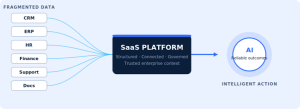
AI performs best when data is structured, connected, and governed. SaaS platforms create this foundation. Rather than replacing software, AI relies on software to provide trusted enterprise context. Without organized data, AI produces inconsistent outcomes.
4. AI Models Are Becoming Commodities — Business Software Creates Differentiation
Foundation models continue to improve rapidly. OpenAI, Anthropic, Google, Meta, and others are narrowing performance differences across general-purpose AI capabilities. As AI models become increasingly accessible, sustainable competitive advantage shifts elsewhere.
It shifts to:
- Proprietary workflows
- Industry expertise
- Customer experience
- Business process automation
- Enterprise integrations
- Data quality
- Governance
These are strengths of SaaS, not just standalone AI models. The companies creating long-term value will be those that combine advanced AI with deep domain expertise.
5. Vertical AI Needs Vertical SaaS
Generic AI understands language. Industry-specific software understands industries.

Vertical SaaS provides the business context that allows AI to generate meaningful recommendations. This is why many analysts expect vertical AI applications to become one of the fastest-growing enterprise software segments over the coming decade.
6. Human Collaboration Still Happens Inside Business Applications
Business decisions rarely happen in isolation. Sales teams collaborate inside CRM platforms. Developers work in engineering tools. Marketing teams coordinate campaigns. HR teams manage employee journeys. Finance teams approve budgets.
AI may accelerate work. People still collaborate through applications. SaaS platforms remain the digital workplace where humans and AI work together.
7. SaaS Becomes the Operating System for Enterprise AI Agents
AI agents represent the next evolution of enterprise automation. However, agents require secure access to systems, governed permissions, orchestrated workflows and trusted data. SaaS platforms provide the operating environment where agents can act safely and effectively.
8. AI Makes SaaS More Valuable, Not Less
Every workflow that AI accelerates increases the value of the platform it runs on. Faster insights, automated reporting, intelligent recommendations and natural-language interfaces all deepen user engagement and expand the outcomes SaaS delivers.
How Leading SaaS Companies Are Reinventing Their Platforms with AI
Salesforce
Salesforce is embedding autonomous agents directly into CRM workflows, enabling sales, service, and marketing teams to act faster without leaving the platform.
Microsoft
Microsoft 365 Copilot transforms familiar productivity applications by bringing AI into Word, Excel, Teams, Outlook, and Power Platform, while enterprise governance remains central to adoption.
ServiceNow
ServiceNow combines AI with enterprise workflow automation, helping organizations automate IT, HR, customer service, and operational processes rather than simply generating text.
HubSpot
HubSpot integrates AI across marketing, sales, and customer support to improve content creation, forecasting, personalization, and CRM productivity.
Adobe
Adobe Firefly enhances creative workflows while Creative Cloud continues to provide asset management, collaboration, editing capabilities, and enterprise governance.
Notion
Notion AI accelerates knowledge discovery, document creation, and collaboration inside an already structured workspace.
Shopify
Shopify Magic helps merchants create product descriptions, marketing content, customer support responses, and business insights while remaining integrated with commerce operations.
Atlassian
AI capabilities in Jira and Confluence improve software development, project management, documentation, and knowledge sharing across distributed teams.
Zoom
Zoom AI Companion extends meetings through intelligent summaries, action items, and collaboration features instead of replacing communication platforms.
The common theme is clear. None of these companies are replacing their SaaS products. They are making them significantly more intelligent.
What the Next 5–10 Years Will Look Like
The future of SaaS will likely be defined by intelligence rather than interfaces. We can expect several major shifts:
- AI-first user experiences where natural language becomes the primary interface.
- Autonomous AI agents executing approved business workflows.
- Hyper-personalized applications adapting to each user’s role and behavior.
- Increased demand for trustworthy, explainable AI aligned with European regulations.
- Greater investment in AI governance, security, and data sovereignty.
- Growth of industry-specific AI platforms tailored to healthcare, manufacturing, finance, energy, and the public sector.
- SaaS evolving from systems of record into systems of decision-making and action.
Rather than reducing software spending, many organizations may redirect investment toward AI-enabled SaaS platforms that improve productivity while maintaining governance and compliance.
Recommendations for SaaS Founders Building AI-Native Products
The winners of the AI era will not simply add a chatbot to existing software. They will rethink how AI enhances every customer’s outcome. Key priorities include:
- Build AI around workflows, not features. Customers value measurable business outcomes over novelty.
- Treat governance as a product capability. Privacy, explainability, auditability, and regulatory compliance are essential — particularly in Europe.
- Differentiate through proprietary data and domain expertise. Your unique customer context is harder to replicate than the underlying AI model.
- Design for human-AI collaboration. AI should augment decision-making, with humans retaining control over critical actions.
- Invest in integrations. AI becomes more valuable when it can securely access and orchestrate data across enterprise systems.
- Prioritize trust. Transparent AI, secure architectures, and responsible deployment will become major buying criteria for enterprise customers.
Conclusion
The conversation should never have been about whether AI will replace SaaS. The more important question is:
Which SaaS companies will successfully reinvent themselves with AI?
Enterprise software has always evolved alongside technological innovation. Cloud computing reshaped deployment models. Mobile transformed accessibility. APIs improved connectivity. AI is now redefining how software delivers value.
But the fundamentals remain unchanged. Organizations still need secure systems, governed workflows, trusted data, compliance, integrations, and exceptional user experiences. AI amplifies these capabilities, but it does not eliminate them.
For technology leaders, the opportunity is clear: invest in AI where it strengthens business processes, while continuing to build on the trusted SaaS platforms that run the enterprise.

As European organizations navigate digital transformation, responsible AI adoption, and evolving regulatory expectations, the winners will be those who view AI as an accelerator of enterprise software — not its replacement.
The question is no longer whether AI will replace SaaS. The real question is: How will your SaaS platform evolve to become the intelligent operating system for your business?